Competitive Analysis Example for B2B Revenue Teams
Live competitive analysis only works when signals reach the right person before the deal closes.

Most competitive analysis gets built once, printed as a slide deck, and shelved until someone remembers it exists during next year's planning cycle. That timing problem is the whole issue. The signals that actually matter, like a pricing-page visit or a demo request, appear on every competitor's radar at the same moment they appear on yours. Nobody has an edge there. By the time a static document gets updated to reflect what's happening in a deal, the deal has usually already been decided by someone who moved faster. Competitive analysis only pays off when it runs as a live motion, catching what's happening mid-cycle and getting it to the right person before the account has made up its mind.
What a live competitive analysis motion consists of
A working motion has three parts that depend on each other. First, signal collection: spotting that an account is actively comparing you to someone else. Second, signal interpretation: figuring out where that account is in its decision process and what it actually cares about. Third, signal activation: getting the right content or the right rep action to that account at the right moment, before the window closes.
Signals come in a few flavors worth knowing by name, because the rest of this piece relies on them. First-party signals are the ones an account generates on your own site: pricing-page visits, repeat views of your comparison pages, downloaded content. These carry the most confidence because the account has already found you, though they catch only accounts that already know you exist. Second-party signals live on platforms like G2, where an account views a comparison page pitting your product against a named competitor. These appear late in the funnel and carry high confidence. Third-party signals are broader research patterns, like a spike in topic searches across publisher networks. Contextual signals sit outside all of that: job postings for a new VP of Sales or Head of RevOps, earnings-call language about "go-to-market efficiency," funding announcements, leadership changes. Few teams track these systematically, which makes contextual signals the least crowded channel available.
Intent data and buying signals get used interchangeably, and that's a mistake with real cost. Intent data is one input among several. A buying signal is any observable event that raises the odds someone buys, which can be a job posting, a leadership change, or a product research surge. Treating them as the same thing makes a team lean too hard on one data source while missing the rest of the stack. None of this holds still for long, either. The gap between "actively researching" and "picked a vendor" can run as short as a few weeks for mid-market deals, so a signal sitting in a dashboard for a month is close to useless by the time anyone looks at it.
A concrete example: reading the signal stack when an account is mid-evaluation
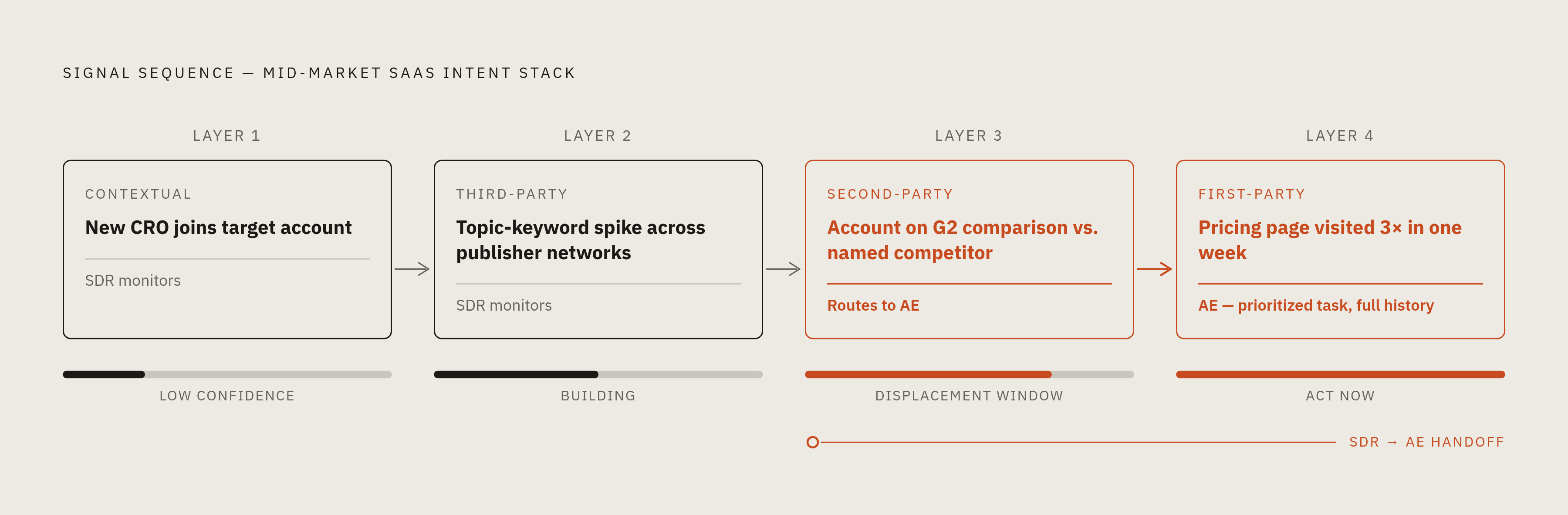
Picture a mid-market SaaS company's revenue team watching one target account start lighting up across multiple signal types within the same stretch of weeks. This is the exact moment the whole motion exists to catch.
The first spark is contextual. A new CRO joins the target account. New executives arrive with new budgets, new mandates, and a need to show results fast, which makes the early months of a leadership change one of the strongest buying windows in B2B. The account gets added to an active monitoring list, and an SDR gets assigned to watch for anything that confirms the hunch, rather than reaching out cold on the strength of a single data point.
Two weeks later, a second signal lands. The account shows a spike in topic research across publisher networks, with searches on keywords tied to the relevant solution category climbing well above its historical baseline. On its own, this doesn't mean much. Research interest isn't the same as budget or authority, so it still doesn't justify a phone call. But paired with the new CRO, it starts to look less like noise and more like a pattern forming.
Then the third layer arrives, and the stakes change. The account turns up on a G2 comparison page for the category, actively weighing the team's product against a named competitor. This is the competitive displacement window: the account has stopped researching the category in the abstract and started comparing specific vendors by name. That's late-funnel behavior, and it gets routed differently than everything before it, straight to the account executive instead of the SDR, because this calls for an account-owner conversation, not another sequence.
The fourth signal seals it. Within the same week, the account visits the pricing page three times. One visit might be curiosity. Three visits in a week looks like someone building a business case to bring to their own team. Speed matters enormously here, because the first vendor to respond to that kind of activity usually gets the meeting. The AE gets a prioritized task that carries the entire signal history behind it, contextual, third-party, second-party, first-party, so the outreach reflects everything the account has done.
No single layer of that stack would have justified picking up the phone on its own. Stacked together, fit, intent, and a trigger event turn into a real reason to reach out today instead of a guess dressed up as a hunch.
Signal routing and whether the motion produces revenue or noise
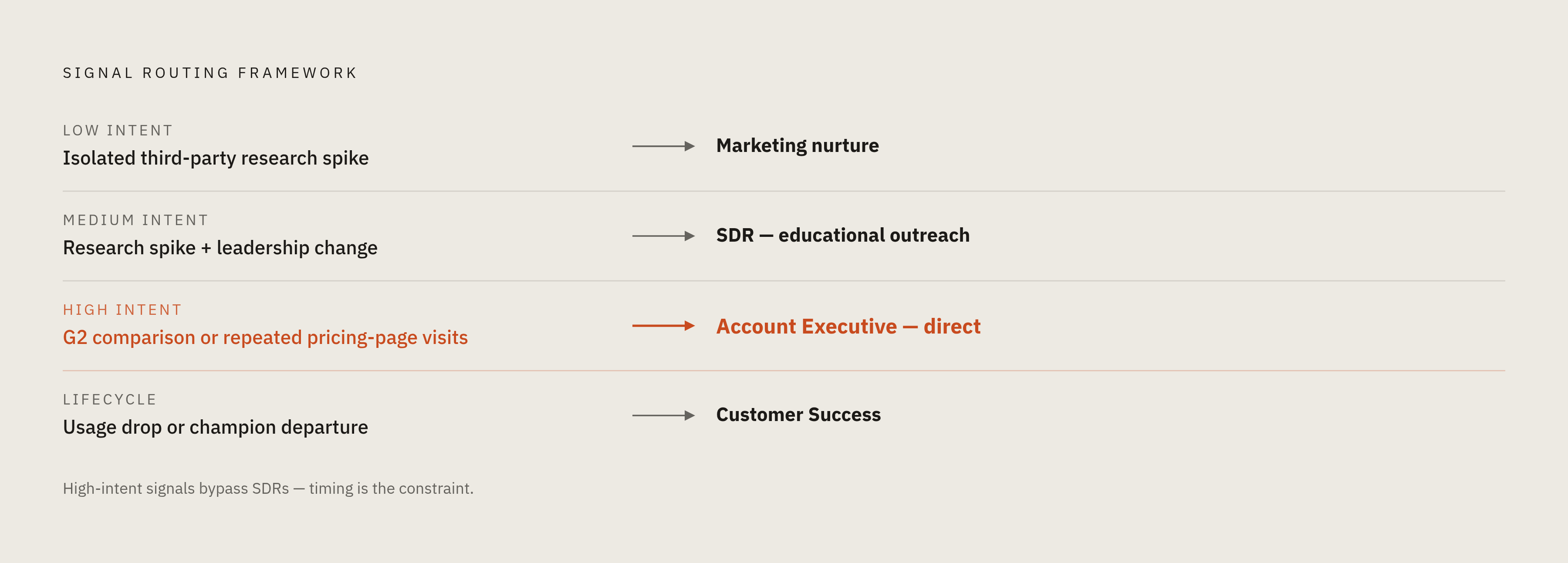
Collecting signals is the easy part. What happens next decides whether any of it turns into revenue. Signal strength should decide which human being sees a given alert, not which tool happened to log it first.
A routing framework built around signal strength looks something like this. Low-intent signals, like an isolated spike in third-party topic research with nothing else backing it up, feed marketing nurture sequences rather than triggering a rep to pick up the phone. Medium-intent signals, a corroborated research spike alongside a contextual trigger like a leadership change, route to an SDR for early, educational outreach, a relevance test that checks whether the hunch holds up. High-intent signals, G2 comparison activity or repeated pricing-page visits, route straight to the AE, because this is late-funnel behavior that calls for a conversation with the account owner. Lifecycle signals, like a drop in product usage or a champion leaving the account, belong to customer success rather than new business. Sending those to an SDR instead wastes the signal and gives the account an awkward, badly timed sales call.
Operationalizing this at scale sounds hard, and it is. Routing rules tied to signal strength are a structural requirement, because the real problem most teams run into isn't a shortage of signals but an activation gap: intent sitting in a dashboard instead of turning into a CRM task, a nurture trigger, or an ad-audience sync. Signal volume was never the constraint. Getting the signal to a person who can act on it in time was. And timing is unforgiving: the first vendor to respond to a pricing-page visit or a G2 comparison typically wins the meeting, while a signal that takes days to reach a rep has already lost most of its value by the time anyone sees it.
Competitive Messaging for the Rep
A signal that reaches the right rep at the right time still produces nothing if the rep has nothing useful to say. Dropping a task into someone's queue without the message to go with it leaves that rep improvising against a buyer who has spent weeks doing homework. The rep shows up to a conversation already in progress, and shows up late.
Three parts make the outreach land. One is a clear, specific reason why accounts evaluating that particular competitor tend to have a certain kind of unmet need, built on what that competitor's own customers commonly complain about rather than generic "we're better" messaging. Two is a proof point or case study matched to the account's industry, informed by whatever the contextual signals revealed. A new CRO's public comments or a line from an earnings call about go-to-market efficiency often points straight at the business problem that executive is trying to solve, which tells the rep which case study to lead with. Three is a piece of content the rep can send before or after that first conversation that shows the team already understands the buyer's situation, something that demonstrates the team has been paying attention to the exact problem the buyer is currently chewing on.
Go back to the account from the earlier scenario. The rep who gets that stacked signal, new CRO, rising research activity, G2 comparison views, pricing-page visits, should already know two things before picking up the phone: what to say and what to send. The message should speak to whatever gap commonly comes up with the competitor named on that G2 page. The content should speak to the problem a newly hired CRO is usually trying to solve in the first few months on the job. Sent ahead of the first meeting, thought leadership like that changes how the buyer sees the conversation, shifting the vendor from "one of several options" to "the team that already gets our situation." A generic content kit built once and blasted out to everyone never does that work, because it wasn't built with this account's evaluation in mind.
How the content layer feeds the motion continuously
None of this works if content only gets created the moment a signal fires. A motion that depends entirely on reps improvising in real time is fragile. It needs a library built ahead of time for the evaluation scenarios the signals are going to surface, so the content is ready before anyone needs it.
Three kinds of content do the heavy lifting here. Comparison content comes first, not thin "us versus them" pages but substantive guides answering the actual questions buyers are typing into G2 and other review sites. This is the content most likely to appear inside the third-party signal layer the whole motion is watching. It does double duty: it informs buyers and it serves as a signal source at the same time. Second is thought leadership that demonstrates real expertise in the problem the buyer is solving, published somewhere buyers in evaluation mode will actually find it. That includes the answers tools like ChatGPT and Perplexity now hand buyers before they ever land on a vendor's website. Third are assets mapped to the evaluation and decision stages specifically, the stages where the competitive signals in this motion actually fire, rather than another round of top-of-funnel awareness content nobody asked for.
Getting the content in front of buyers matters as much as making it. A guide that exists but never reaches an account during its active evaluation window contributes nothing to the motion. The goal is showing up in the channels buyers already use, review sites, AI-generated answers, the industry publications they read, before they ever signal intent anywhere else. Teams without unlimited resources can stretch one solid asset a long way: a detailed guide, a research-backed comparison, or an in-depth webinar can cascade into blog posts, social clips, email segments, and shorter formats, multiplying the number of places a buyer might encounter it without multiplying the headcount needed to produce it.
Measuring whether the motion is working: the metrics that reflect revenue, not activity
None of this matters if it gets measured by the wrong yardstick. Counting signals collected, sequences launched, or pieces of content published shows activity, not whether any of it moved a deal forward or closed one.
Three metrics actually reflect what the motion is doing. Win rate on accounts where competitive signals fired, measured against accounts with no signal at all, isolates the value of catching a deal mid-cycle rather than crediting the motion for deals that would have closed anyway. Pipeline influenced by competitive displacement outreach, deals sourced through signal activity rather than an inbound form fill, shows whether the motion is generating business or just riding alongside business that was coming regardless. Competitive displacement rate, the share of closed-won deals where the account was actively comparing a named competitor at the moment the signal fired, confirms the analysis is catching real moments and not false alarms.
None of this works well if marketing still gets scored on MQL volume. A team measured on how many leads it collects has no reason to care whether those leads reflect genuine evaluation behavior. A team measured on pipeline quality and influence does, and that shift is what turns the competitive motion's contribution to sourced and influenced pipeline into the proof point that justifies keeping it funded.
The strongest pushback on all of this is fair: signal decay and false positives can quietly erode the return at scale. A signal from several weeks ago is close to noise by the time anyone acts on it, and tying a specific marketing touch to a specific closed deal is always an approximation, never an exact measurement. The fix is building the motion around signal freshness, routing rules that expire stale signals automatically, and stacked confirmation that requires more than one signal type to agree before anything escalates to a human. That's precisely the pattern the CRO-to-pricing-page sequence in the earlier example walked through step by step: no single signal carried the deal. The stack did.