Geographic Segmentation in B2B Account Prioritization
Apply geography only after firmographic fit and buying intent have already narrowed the list.

Geographic segmentation works best as the last filter applied to an account list, applied only after firmographic fit and buying intent have already sharpened it, so each layer refines the one before.
Why geography alone produces imbalanced account lists
Picture two reps on the same sales team, each handed a map. One rep's territory happens to be stuffed with mid-market manufacturers who fit the product perfectly. The other rep gets a region that looks the same size on paper but is mostly small shops and bad fits. Same number of zip codes. Wildly different amount of real opportunity. That's what happens when territory plans get drawn along geographic lines before anyone checks whether the geography actually holds good accounts.
The map isn't the issue. The order is. When geography gets applied before a team has sorted out who fits and who's actually shopping, it doesn't organize the work, it just organizes the noise into tidier-looking piles. Both reps end up putting in equal effort against unequal opportunity, and the pipeline numbers that come out the other end look like a coaching problem. They're a sequencing problem wearing a coaching problem's clothes.
HG Insights' 2026 guide to firmographic segmentation makes this point: when territories get drawn without regard for where the real opportunity sits, the account lists that come out of them drift away from the criteria that were supposed to define them. A good filter applied at the wrong stage still produces a bad list.
What firmographic segmentation establishes before geography enters the picture
Before geography says anything useful, firmographics need to answer a simpler question: which companies structurally look like the right market? Industry, revenue band, employee count, ownership model, growth stage. These attributes describe the shape of a good account, and they need to get locked in first because everything built afterward depends on them.
Firmographics also happen to be the steadiest data a sales team has. Behavioral signals move around week to week, sometimes day to day. A company's revenue band or employee count doesn't swing like that. It holds steady across quarters, which makes it a dependable base to build the rest of the segmentation on top of.
A good ideal customer profile doesn't come from a gut feeling about which logos look impressive on a case study slide. It comes from looking at where the best deals actually happened: highest contract value, fastest sales cycles, strongest renewal rates. Pull the pattern out of those outcomes, not out of intuition about which company size seems "enterprise enough." And that pattern needs to get checked against real numbers. Testing proposed ICP attributes against actual win rates and deal velocity will show which criteria genuinely predict a closed deal and which ones are just noise that happened to correlate once.
Two companies can match an ICP attribute for attribute, same industry, same revenue band, same headcount, and still be standing in completely different places when it comes to actually buying something. Firmographics tell a team the shape of the market. They say nothing about which specific companies inside that shape are ready to move right now. HG Insights' 2026 guide draws this line directly: firmographic data defines fit, but it doesn't say who's ready to buy. That gap is why another layer of intelligence has to get stacked on top.
Using intent signals to identify in-market accounts
That's where intent signals come in. Firmographic fit tells a team an account is eligible. Intent tells them which eligible accounts are actually researching right now, and that distinction is what turns a list from aspirational into actionable. Without it, every firmographic-fit account looks identical on paper, and applying geography on top of an undifferentiated pile just produces a prettier, better-organized pile. Still undifferentiated.
Speed matters here in a way that's easy to underestimate. Run the math on a slow pipeline: a two-week delay in the data itself, plus a week for a sales team to actually act on it, and the buying window has already closed before anyone picks up the phone.
One kind of intent signal deserves a callout here because it leads directly into the next section: geographic expansion announcements. A company announcing a new office, a new regional hub, a push into a new market, that's an intent signal and a geographic signal at the same time. It's the bridge between "this account is in motion" and "this account is in motion somewhere specific," which is exactly the question geography is built to answer next.
Where geographic segmentation belongs in the prioritization sequence
Geography is rarely the right first filter in B2B. It's almost always the right third one. Once an account has cleared firmographic fit and shown real intent, geography changes from a crude boundary line into precise, operational work.
Once that account clears both earlier thresholds, geography governs several things at once, and all of them are operational. Regulatory zone determines which outreach rules and consent requirements apply. Time zone sets realistic send windows and SLA expectations. Language and local market context shape which proof points and content actually land. Urbanicity affects field coverage and event strategy. Local fiscal calendars determine budget timing. None of this is about tone or polish. It's about whether a campaign can legally run, whether it arrives at a moment that makes sense, and whether the content inside it means anything to the person reading it.
The practical tool for handling all this is a small segmentation grid. Pick two or three dimensions that genuinely change how a deal gets worked, say country, language, and industry cluster; build cells where they intersect. A German manufacturing company with a defined employee count is a cell. "European enterprise" is a shrug dressed up as a segment.
For global accounts, headquarters country and buyer country don't always agree. A company headquartered in the US might have its actual decision-maker sitting in a London office. Someone on the team has to decide, on purpose, which geography drives routing and which geography drives the message, because leaving that decision to default settings usually means it gets made badly.
Geographic data quality across regions
Not every geographic segment is built on equally solid ground. Enrichment match rates for firmographic and contact data swing a lot from country to country. A CRM can show two regional segments that look identically populated and healthy, and one of them is built on far shakier data than the other.
That gap doesn't come from a vendor cutting corners. It comes from how dense the data sources are in a given market, what the regulatory environment looks like there, and how widely local companies have adopted the platforms that generate clean, trackable data. A market with fewer digital footprints to enrich from is just going to produce thinner records, no matter whose tool is doing the enriching.
The practical risk: a segment sitting in a low-match-rate market can look just as full and complete as a high-confidence one, while actually carrying stale records, missing fields, and contacts nobody can reach anymore. ZoomInfo's 2026 segmentation guide ties this straight to results: CRM records with gaps from leadership turnover or M&A activity cause emails to bounce and engagement to drop, and refreshing firmographic records before a campaign launches is what separates a campaign that lands from one that burns budget on dead addresses.
Privacy law adds another layer of friction. GDPR in the EU, plus a patchwork of different regimes across APAC and LATAM, limits how visitor location can be collected and used for identifying and routing prospects. Abmatic AI's 2026 guide points out that raw IP-based location is inherently noisy to begin with, and GDPR puts a hard constraint on EU visitor identification specifically. The value lies in how carefully location data gets resolved and acted on, not in collecting more of it.
The operational fix is to weight geographic segments by data confidence before layering intent signals on top of them. Otherwise a high-signal account sitting in a low-coverage market gets scored as if the ground under it is just as solid as everywhere else, and it isn't.
How localization changes outreach performance
Localization is the payoff that geographic segmentation is actually for, and it shows up directly in response rates. If you apply geographic context at the message and channel level, after an account has already cleared firmographic fit and shown intent, the response looks measurably different from generic outreach dropped into the same region.
Localization means more than translation. It covers proof points, regulatory language specific to that market, case studies pulled from local companies, references to local buying norms, and timing that respects local fiscal calendars and realistic send windows. A message that references a prospect's local customers, their local compliance environment, and their local buying context tells that prospect the seller actually understands where they're sitting. That's a credibility signal, and it lands before a single meeting gets booked.
The localization premium is real in a measurable sense. Identical outreach sequences, tested with and without localization baked into the subject line in the same market, come back with reply rates that differ by a meaningful margin. Not always a multiple, but a real, consistent gap, and that gap widens further in markets where English isn't the language business gets done in.
This is where content marketing and geographic segmentation become the same job. Region-specific case studies, local regulatory commentary, and industry-specific insight pieces function as sales assets that make a localized sequence feel earned. A rep backed by content that speaks directly to a buyer's geography and industry gets treated like an advisor instead of a vendor cold-calling off a list, and that shift in perception shortens the path to a meeting. Abmatic AI's 2026 guide calls out language as often the single highest-leverage geographic cut you have, because it changes whether a message gets understood at all, not just whether it feels relevant. HG Insights' 2026 guide also frames competitive displacement as a direct application of firmographic segmentation, and geography shapes which competitive proof points and local customer stories actually carry weight in that kind of play.
Competitor intent signals and geographic segmentation in mid-cycle interception
The competitor-engagement signal matters most when it lines up with both firmographic fit and geographic operability. If an account visits comparison pages, runs branded searches against a competitor, or shows up active on third-party review sites, it's telling a sales team something urgent. When that same account also fits the ICP and sits somewhere the team can operate cleanly, that's the strongest case for moving immediately that the whole prioritization stack can produce.
This is where geography carries the most weight. A customer story from the same country or vertical is the right proof point. The right outreach channel respects whatever norms that region actually trusts, instead of defaulting to whatever channel works at headquarters. The right timing accounts for the prospect's fiscal calendar and where they sit in their own decision cycle. A generic sequence doesn't cut it here. The right response is a targeted play: a battlecard built for the local competitive landscape, a customer story from the same market, outreach sent through the channel that market actually responds to.
Signal decay is the real threat. If routing an account to the right rep in the right region takes days because territory assignments are fuzzy or the geographic data behind them is stale, the interception window closes before the play ever gets a chance to run. Clean geographic segmentation inside the CRM is what makes fast routing possible, and fast routing is what separates acting inside the window from showing up after the deal is already decided.
Buying committees complicate this further. Complex B2B deals now involve many stakeholders, and those stakeholders are often scattered across different offices and different countries. Multi-threading across a buying group like that requires knowing exactly which stakeholders sit in which markets and adjusting the outreach accordingly. HG Insights' 2026 guide names competitive displacement specifically as a firmographic-layer application, which reinforces the point: knowing which competitor a target account currently runs is itself a firmographic input, and it sharpens the geographic play layered on top of it. Put all three signals together, firmographic fit, an active intent signal, geographic operability, and the account that clears all three is at the top of any prioritization list a team can build.
Building a ranked, actionable account list by stacking the three layers in the right order
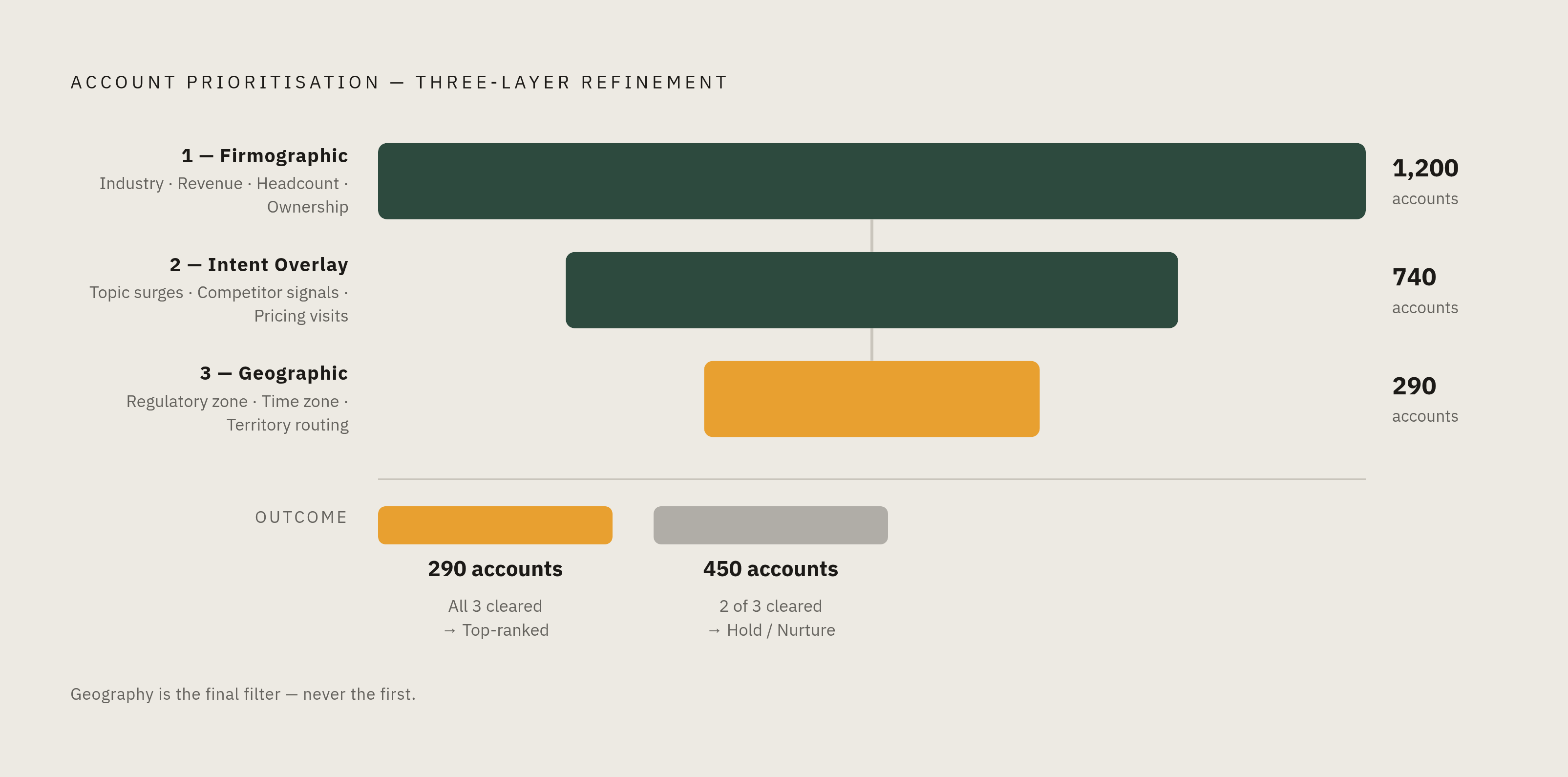
Get the sequencing right and the output is a ranked account list, and the accounts sitting at the top have cleared three separate layers: firmographic fit, in-market intent, and geographic operability.
Step one is the firmographic filter. Bound the total addressable market down to accounts matching the ICP on industry, revenue band, employee count, and ownership structure, and check those criteria against actual win rates and deal velocity rather than a hunch about what a good account looks like.
Step two is the intent overlay. Inside that firmographic-fit pool, find the accounts showing active research behavior: topic surges, competitor engagement, pricing page visits, geographic expansion announcements. Score and rank them by how recent the signal is and how many signals are stacking on top of each other.
Step three is the geographic layer. Inside that intent-qualified pool, apply the filters that govern operational reality: regulatory zone, time zone, language, territory routing, data confidence level. Use this layer to route each account to the right rep and the right localized play. Don't use it to throw out accounts that already earned their place on the first two layers.
Accounts clearing all three layers rank at the top. Accounts that clear two layers but stumble on one get held or routed to a nurture track instead. That sequencing is what stops geography from quietly deleting accounts that should have stayed in the pipeline the whole time.
The same logic should set territory and quota design. Draw territory boundaries around opportunity density, the concentration of high-fit, in-market accounts within a given area, not around geographic area by itself. That's what actually produces balanced workloads: reps get assigned to territories where the three-layer stack produces a comparable number of prioritized accounts, not a comparable number of square miles or zip codes.
Content and outreach assets should follow the same cells the three layers produce. A specific vertical, in a specific geography, showing a specific intent signal, gets a specific content play, not a generic sequence with a localized subject line stapled on top. Abmatic AI's 2026 guide backs this build directly: pick two or three geographic dimensions that genuinely change the go-to-market motion, build cells where they intersect with firmographic attributes, and use geography to personalize and route rather than to define the addressable market from zero. ZoomInfo's 2026 segmentation guide ties the whole framework to outcomes that matter: segmentation that routes the best-fit accounts to the reps with the right expertise and capacity, focuses campaigns on the segments most likely to buy, and stops spending money chasing accounts that were never going to close. That's precisely what stacking these three layers in the right order is built to deliver.