CRM Data Enrichment Tools for Sales Teams
Sales reps waste 546 hours yearly fixing bad CRM data.

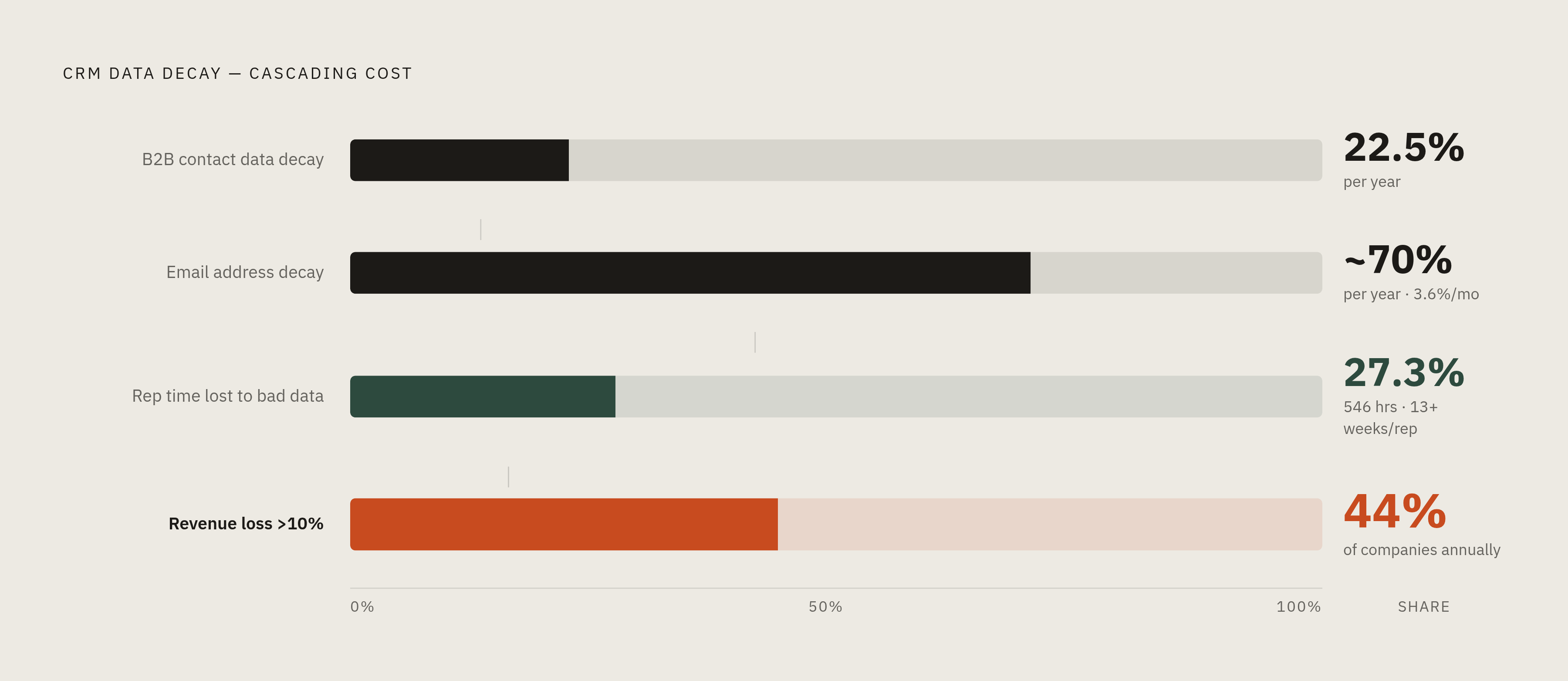
Your CRM data is rotting right now, as you read this sentence. B2B contact data decays at roughly 22.5% a year on the aggregate, and specific fields like email addresses fall apart even faster, up near 70% annually. Email alone decays about 3.6% a month as of late 2024, which means it's a faucet somebody left running.
And here's the part nobody wants to admit at the sales all-hands: your reps are the ones mopping the floor. ZoomInfo's research puts the number at 27.3% of a rep's time spent wrestling with bad data. That's 546 hours a year, per rep, which works out to more than 13 full work weeks spent verifying a title that changed eight months ago or redialing a number that now belongs to a dentist's office in Ohio. Multiply that across a 40-person sales floor and you've built an entire shadow department whose only job is fixing what should've fixed itself.
The money part isn't subtle either. Validity's 2025 State of CRM Data Management report surveyed 602 CRM users and found 37% had lost revenue they could directly trace back to bad data. The average company loses 16 sales opportunities a quarter this way, and 44% of companies report annual revenue losses over 10% tied specifically to CRM decay. Then there's the AI wrinkle: the same report found 45% of CRM data isn't ready for AI tools, even though 54% of organizations are already running AI on top of it. It's feeding a very expensive, very confident model a pile of garbage and asking it to make predictions, and it will, just wrongly, quickly, and at scale.
So that's the cost of doing nothing. Let's talk about what enrichment tools are supposed to do about it.
What enrichment tools actually do to a CRM record
Enrichment goes well beyond filling in blanks, since anyone can slap a phone number into an empty field. Real enrichment adds context: firmographics, technographics, direct contact info, and signals about what a company is actually doing right now. The job is closing the gap between "this contact exists" and "this rep knows who to call, why today, and what to actually say when they pick up."
Think of enrichment as the layer that sits between data capture and outreach. A form gets submitted, or a contact gets pulled from a list purchase, and before a rep ever touches it, the record should already be dressed for the occasion. Enriched records land in Salesforce, HubSpot, or Pipedrive ready for segmentation and scoring, sparing a rep from researching a raw name-and-email pair from scratch. A CRM without enrichment functions like a phone book; a CRM with it functions like a prioritized list of who to call first and why.
Where this is heading in 2025 and 2026 is past the basics. Job titles and phone numbers used to be the whole game; now the frontier is behavioral signals, technographic shifts, and topic-level interest data. Automated daily or weekly refresh cycles, once a premium add-on, are becoming the baseline expectation, saving an estimated 20 hours a month per rep that used to go into manual data entry.
But here's the underrated variable nobody puts on the feature comparison chart: timing. A tool can enrich a record perfectly and still be useless if it does it three days too late. Most teams enrich in batches, well after the moment a lead actually converts or engages, which means the rep is calling into a window that already closed. The real question is when enrichment happens: at the moment of form submission, at record creation, or during some overnight batch job that runs while everyone's asleep and the lead has moved on. Keep that question in your back pocket, since it's going to matter a lot more once we get to picking a tool.
The signal types that actually move sales conversations forward
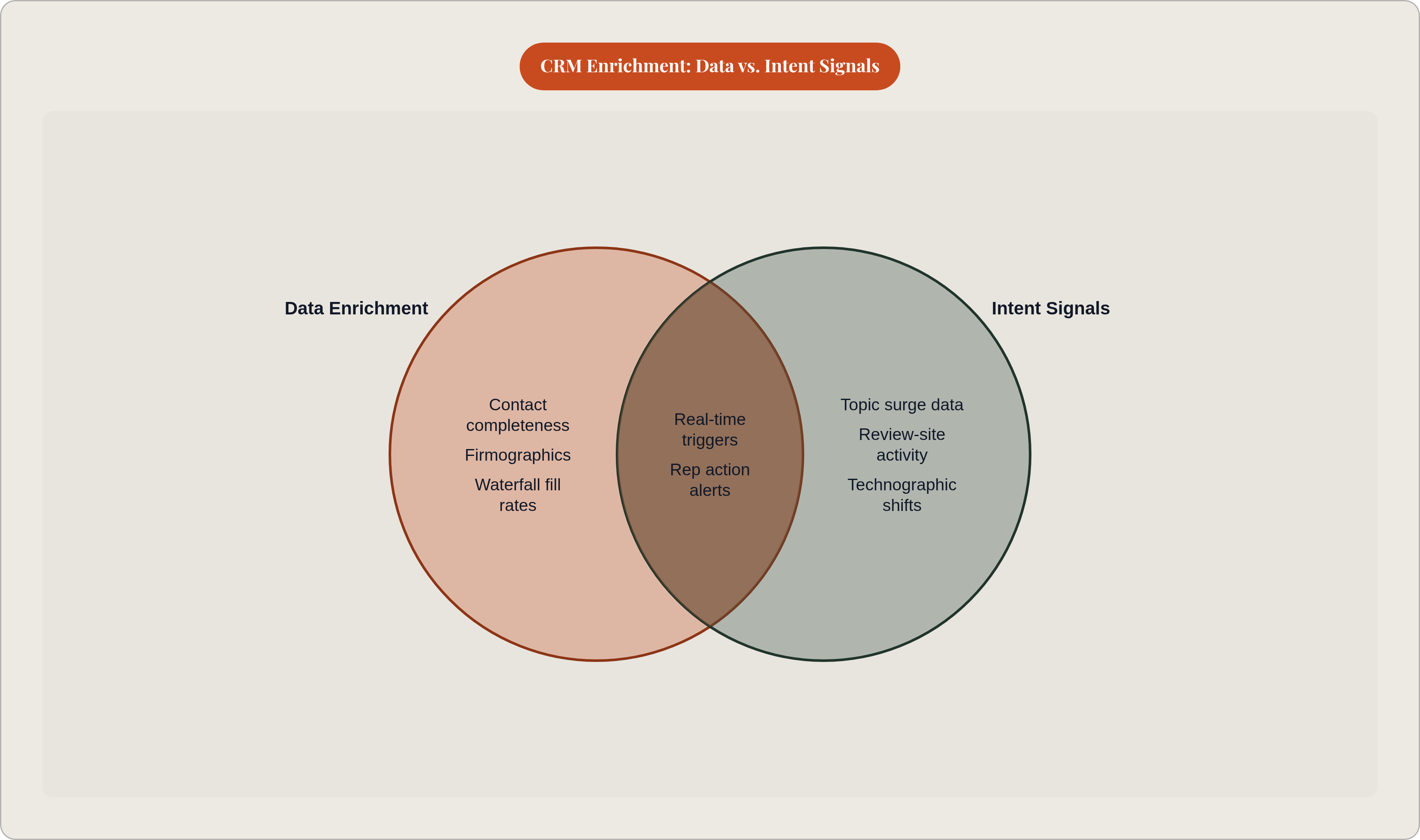
Not every enriched field carries the same weight. A correct job title is nice, but a signal that someone is actively shopping your category right now is the difference between a cold call and a conversation somebody was hoping to have. The best enrichment doesn't just complete a record; it tells you when to knock.
There are roughly four flavors of signal worth knowing:
First-party signals are the gold standard because they come straight from your own turf: website visits, content downloads, demo page views. Someone looking at your pricing page twice in a week isn't being subtle.
Third-party topic surge data works differently. Providers track topic consumption across large networks of B2B websites, and when a company's reading habits on a relevant subject spike above their normal baseline, that account gets flagged as "surging," even if they've never once visited your site. It's a bit like noticing your neighbor suddenly buying a lot of moving boxes, since you don't need them to tell you what's coming.
Review-site signals are further down the funnel than almost anything else. Someone comparing vendors on G2 has already decided they have a problem and is now deciding who solves it best. Accounts showing intent on review platforms aren't casual browsing — they've already decided they have a problem and are now deciding who solves it best.
Contextual and technographic signals round it out. A new VP of Sales getting hired often precedes a tech purchase, because new leaders like to make their mark, and that mark usually involves swapping out a tool someone else picked. A company dropping one piece of software and adding another can mean a budget just opened up, or a competitor just got shown the door.
Why does any of this matter so much right now? Buyers complete around 60% of their buying journey before they ever talk to a salesperson, and 94% of buying groups have already ranked their preferred vendors before that first call happens. Translation: the rep who shows up first, with the right context, has a structural head start that's very hard to claw back later.
And here's where most teams quietly fail. In practice, many B2B teams fail to capture ROI from their intent data investments, often because the signals sit in a spreadsheet or a Slack channel nobody checks until Thursday rather than because the signals themselves are weak. The account that surged Monday has already booked demos with two competitors by then. Speed isn't a nice-to-have here, it's the entire point.
How the main enrichment platforms compare on criteria that matter to sales teams
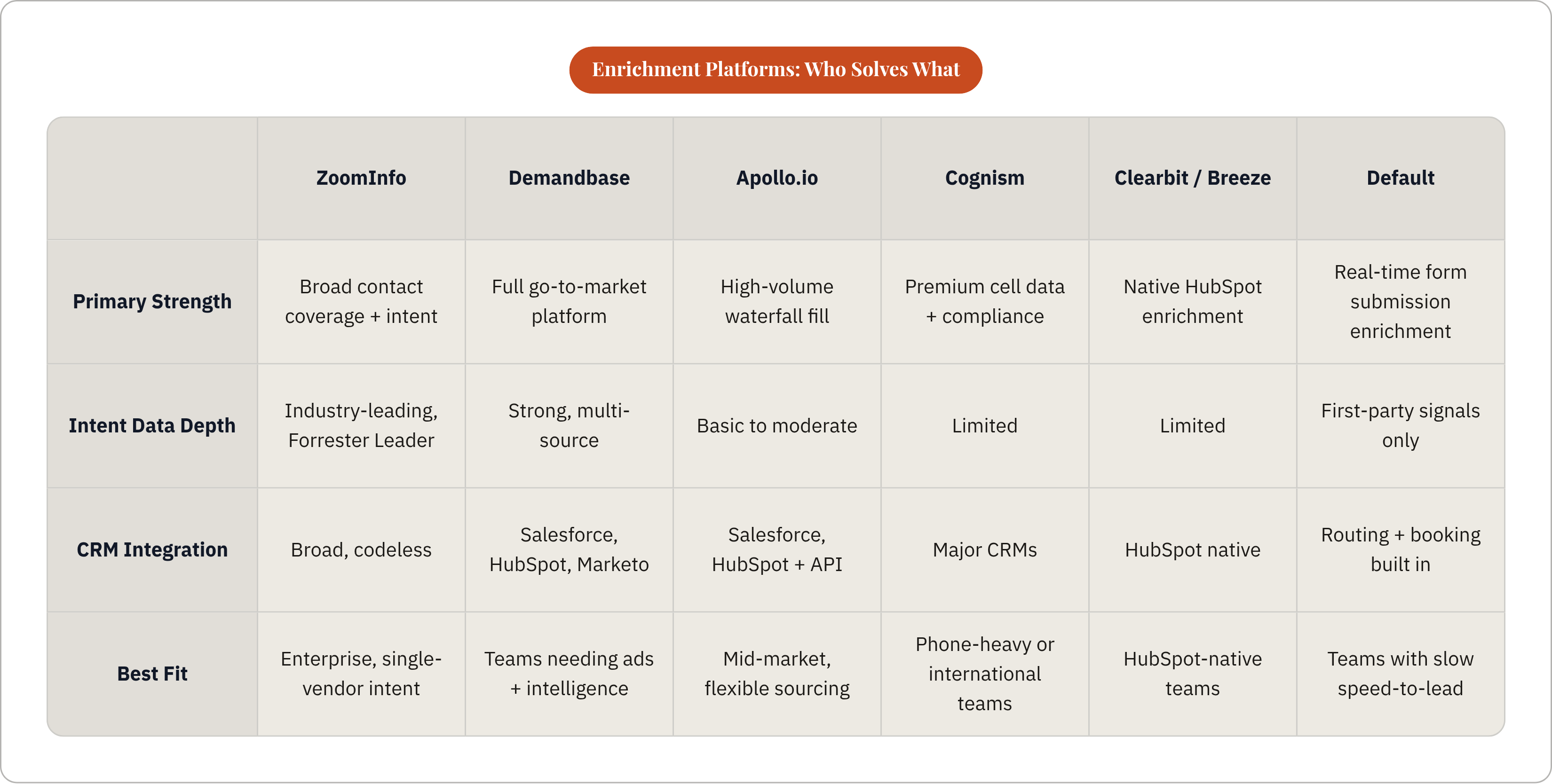
This isn't a ranking. It's a map of who's good at what, because the right tool depends entirely on which problem you're actually trying to solve.
ZoomInfo runs a database north of 321 million professional contacts, pulled from 60 different data providers through a single, codeless interface. It handles deduplication, normalization, and lead-to-account mapping, and its intent data chops are well-documented: Forrester named it a Leader in its Wave for Intent Data Providers B2B in Q1 2025, with top scores across all 8 evaluation criteria, and G2 ranked it No. 1 in Buyer Intent for Summer 2025. Best fit: enterprise teams that want broad coverage and intent data under one roof rather than stitched together from three vendors.
Demandbase bills itself as a full go-to-market platform, not just an enrichment tool: account identification, intent data, advertising, and sales intelligence all live in the same system. Its Data Integrity module updates Salesforce, HubSpot, and Marketo automatically, validated against more than 40,000 data sources, with coverage over 100 million companies and 176 million B2B contacts. One case study is worth sitting with: a company that had merged four organizations into one CRM ended up with six duplicate account records for every real account. After running Data Integrity, they cut account records by 85%, contacts by 66%, and got over 80% of their reps using the platform daily, which is a company getting its CRM back.
Apollo.io has a database over 210 million contacts and 30 million companies, and its calling card is waterfall enrichment: trying multiple data sources in sequence until it finds a fill, rather than giving up after one provider comes up empty. Native enrichment for Salesforce and HubSpot comes standard, plus an API for custom setups. Best fit: mid-market teams that want high volume and flexible sourcing without an enterprise price tag.
Clearbit, now folded into HubSpot as Breeze Intelligence, works as credits-based enrichment native to the HubSpot ecosystem. It activates right on contacts, companies, form submissions, and workflows, with no separate login required. Best fit: teams already living in HubSpot who'd rather not bolt on a whole new vendor relationship.
Cognism carves out a niche in premium cell phone data and compliance, which matters a lot more than it sounds like once you're selling across borders with different privacy rules in every country. Entry pricing starts around $60 a month per user. Best fit: phone-heavy outreach teams or anyone running an international motion where a compliance misstep isn't just embarrassing, it's expensive.
Default is built around the speed-to-lead problem specifically, enriching right at the moment of form submission, routing to the correct rep, and booking the meeting, rather than running as a batch job overnight. Best fit: teams where the gap between "someone filled out a form" and "a rep actually called them" is a measurable leak in the bucket.
Some tools sit at the intersection of intent signals and outreach enablement, connecting content engagement to rep-level action so enrichment shows up as actual talking points for the call rather than just a fuller contact card. Best fit: revenue teams that want signals tied directly to a next action, not just a nicer-looking dashboard.
Whichever direction you lean, the same five questions apply across every tool on this list: how many sources feed it, how often it refreshes without a human nudging it, how deep the intent signals go beyond basic firmographics, how cleanly it writes back into your existing CRM, and how fast it actually enriches, at the moment something happens or days later in a batch.
What separates teams that get ROI from enrichment from those that don't
Here's the uncomfortable truth: the tool is never the bottleneck, since the workflow around it is what actually determines the outcome.
Enriched records help reps skip the research phase and close deals faster, but only when that enriched data automatically triggers an action. If the record just sits there, quietly more accurate than it was yesterday, nothing happens. That's the most common failure mode in this entire category: enrichment runs perfectly, the record updates, and rep behavior doesn't change one bit because nothing connected the new data to a next step.
Intent signals are the clearest example. A signal that fires and lands in a dashboard nobody opens carries roughly the same practical value as no signal at all. Teams that actually get value here build automated alerts, so when an account surges on a relevant topic, a specific rep gets pinged within hours, with a plain-English reason attached. Strong first-party signals, like a demo page visit, deserve a response measured in hours, while third-party signals get a little more slack, maybe a day or two, but not a week.
Then there's the marketing-sales alignment problem, which sounds like corporate wallpaper but is actually load-bearing. If marketing and sales don't agree on what counts as a real, actionable signal, the data gets ignored by one side or acted on inconsistently by the other. A job posting for a VP of Revenue Ops means something completely different at a 50-person SaaS startup than it does at a large manufacturer, and generic thresholds miss that every time.
Data hygiene, finally, is a habit, not a project. The Demandbase case study above didn't happen because someone made one bad decision; it happened because a messy CRM accumulated quietly over years of mergers and neglect. Salesforce's own research puts the scale of this industry-wide: 91% of CRM data is incomplete, stale, or duplicated at any given moment. Enrichment tools fix that only if they're set to run continuously. Run it once, pat yourself on the back, and walk away, and you're back to square one within a year, which anyone who's cleaned a garage can confirm.
The evaluation questions worth asking before committing to a tool
Before you sign anything, figure out which link in the chain is actually broken, because "we need enrichment" is too vague to act on.
If the problem is basic contact completeness, missing emails, dead phone numbers, prioritize database size and waterfall-style multi-source fill rates. If the problem is watching competitors beat you to accounts that are clearly in-market, prioritize signal depth and how fast that signal reaches a rep's inbox. If the problem is specifically at the top of funnel, where leads convert on a form and then wait days for anyone to follow up, prioritize tools built around real-time enrichment at the moment of submission, not batch updates that catch up later.
None of this is complicated once you frame it that way. The complicated part is being honest about which problem you actually have, instead of buying the tool with the longest feature list and hoping it fixes everything by accident.