Interpreting Buyer Intent Signals Without Overreacting to Noise
Median intent data accuracy sits at 0.51, so treat signals as clusters, not isolated triggers.

Start with a number that should make anyone running an intent program genuinely uncomfortable. Median precision for topic-based third-party intent signals, across dozens of real deployments assessed by The Starr Conspiracy's 2024 ABM Operations Audit, sits at 0.51. Roughly half the accounts your platform flags as "in-market" aren't in-market in any meaningful sense. That's not a vendor-specific bug. That's how topic-level inference works, structurally, by design.
And that's before you factor in the dark funnel.
A growing share of early-stage research now happens inside tools like ChatGPT, Perplexity, and AI Overviews. Those interactions are completely invisible to traditional intent platforms. Gartner found that B2B buyers spend only 17% of their buying journey in direct contact with suppliers. The other 83% is self-directed research that vendors simply can't observe. Layer on the fact that the typical buying committee has eight to twelve people, and any single vendor is piecing together scattered fragments of a distributed, mostly hidden process.
Topic surge data has a specific flaw that's easy to underestimate. A company surging on "email deliverability" is either deep into a platform evaluation, or it's one curious marketer doing background reading before a team meeting. The signal tells you what they're researching. It does not tell you whether they plan to buy, from whom, or when. That's a category signal, not a purchase signal. The distinction matters more than most teams treat it.
Vendor benchmark data makes this murkier. Most vendors don't disclose sample size, fielding period, or how they define a "surge" in the first place. Cross-vendor comparison is close to meaningless as a result. The practical takeaway: no single signal source should be treated as independently actionable. Everything that follows is built on that premise.
Where buyers actually are in the process when signals appear
Here's the part that reorders how people think about this. According to a 2025 Buyer Experience Report, 94% of buying groups have already ranked their preferred vendors before their first conversation with a seller. And 77% ultimately bought from that preliminary favorite.
Most of the intent signals surfacing in your platform represent accounts that are already deep into a private evaluation. These are not buyers at the start of a journey. They are buyers who are nearly done with one you didn't know was happening.
Buying cycles are also compressing. The same report found average global cycles shrank from 11.3 months in 2024 to 10.1 months in 2025. The window between "actively researching" and "vendor selected" can be as short as two to four weeks for mid-market deals.
This reframes the calibration problem. Acting slowly on a real signal is just as costly as acting on a false one. Which means the challenge is genuinely two-sided: filter out noise, yes, but also respond to real signals before the window closes. Those two goals pull in opposite directions. The only way to manage that tension is knowing which signals are worth prioritizing before you need to decide.
A working hierarchy of signal types by fidelity
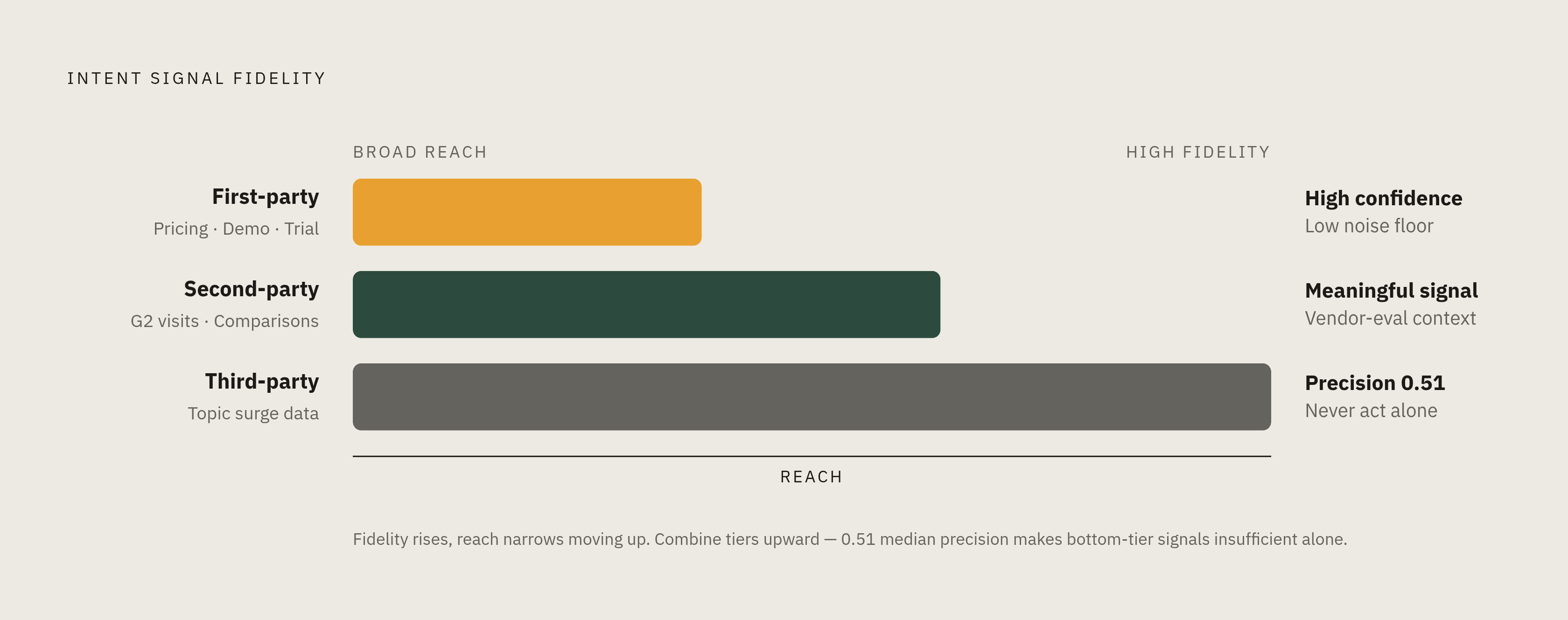
Not all signals are created equal. Treating them as equivalent is one of the most common and expensive mistakes in the space. Here's how they actually stack up.
First-party signals: highest fidelity, limited reach
These are behaviors on your own properties. Pricing page visits. Product trial activations. Demo requests. Repeat visits from the same account within a short window. Documentation deep-dives. You control the collection methodology, so the noise floor is low. The accounts generating these signals have already found you, which means confidence is high.
The limitation is real, though. First-party signals are blind to accounts that haven't discovered you yet. They confirm. They don't discover.
Second-party signals: high confidence, mid-funnel
This is behavior on review platforms. G2 profile visits. Competitor comparison reads. Category shortlist activity. These signals are valuable because the context is explicit. A buyer reading a head-to-head comparison on G2 is doing active vendor evaluation, not casual browsing. The fidelity here is meaningfully higher than topic-level third-party data.
Third-party signals: broad reach, inherent noise
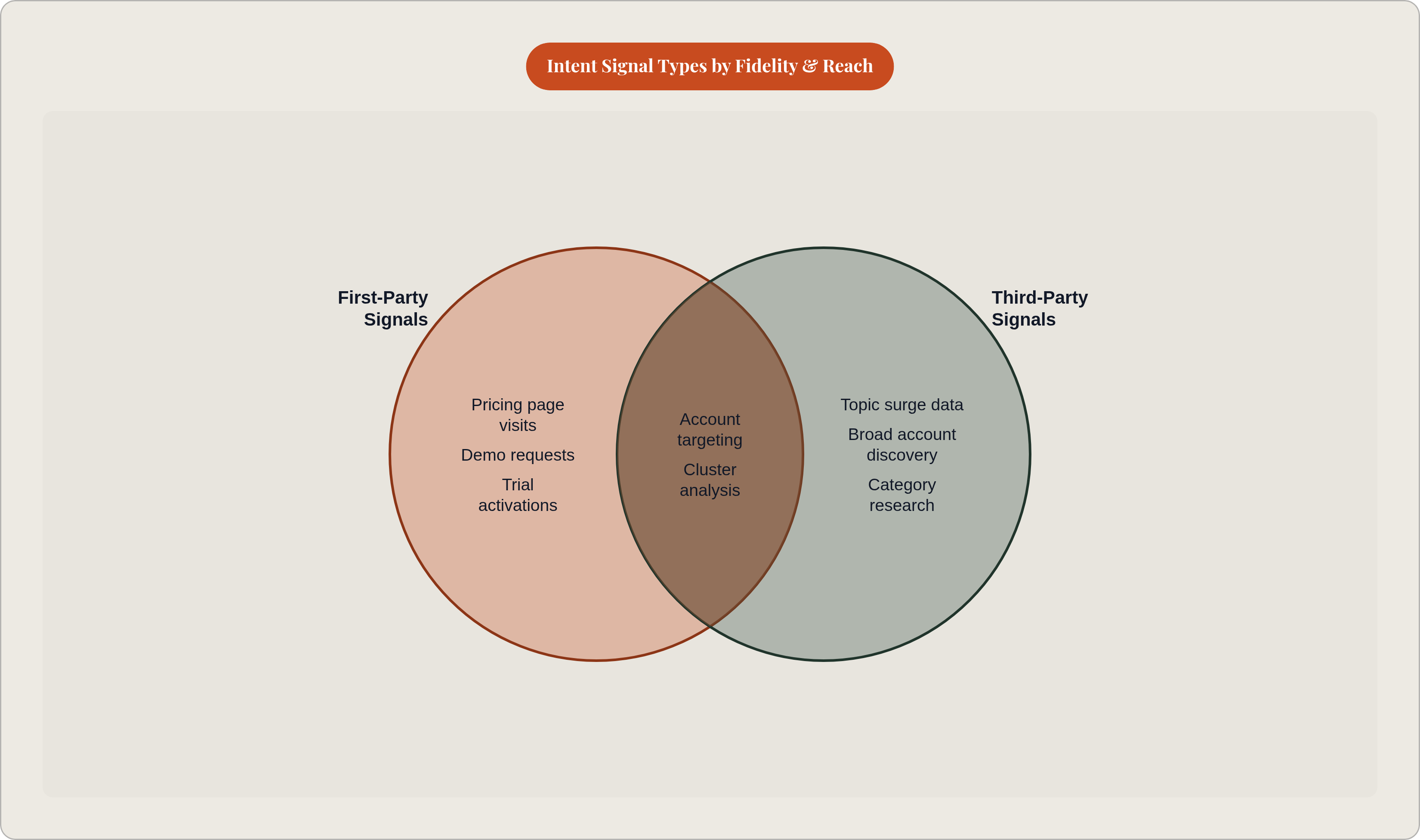
Topic surge data from third-party platforms tells you a company is researching a category. It does not tell you they want your product specifically. This tier is useful for surface area, for finding accounts that haven't found you yet. But precision is structurally low, as the 0.51 median figure makes plain.
Third-party signals should never be acted on in isolation. They're inputs to a bigger picture, not triggers on their own.
The principle connecting all three tiers
No tier is sufficient alone. Combination is what creates conviction. One more distinction worth making explicit: account-level intent tells you a company is interested. Buying group intent tells you who inside that company is driving the research. Without persona-level clarity, routing and personalization stay guesswork, especially when you're dealing with a committee of ten or more people pulling the conversation in different directions.
Why signal clusters, not individual data points, are the right unit of analysis
Research on intent data deployment shows that a significant majority of flagged accounts fail to show any corroborating activity in CRM or marketing automation within 30 days of signal receipt. That finding explains, almost by itself, why single-signal routing fails so consistently.
A single signal rarely justifies a sales call. A pricing page visit, taken alone, means something happened. It doesn't tell you much about what. But a cluster from the same account within a defined time window is a fundamentally different kind of evidence.
Here's a concrete example. A VP of Sales visits your pricing page. A Director of Revenue Operations downloads your integration guide. A CFO attends your webinar. All three happen within two weeks. That pattern is a strong predictor of genuine in-market activity. Any one of those events in isolation? Not so much. The difference isn't the individual data points. It's the density and diversity of the pattern. One signal is a coincidence. Three signals from three different stakeholders across two weeks is a buying committee in motion.
What makes a cluster meaningful rather than accidental:
- Multiple signals from different stakeholders at the same account (buying group breadth)
- Signals spanning different tiers, for example a topic surge confirmed by a G2 profile visit confirmed by a pricing page view
- Recency: signals concentrated in a short window carry more weight than the same signals spread over months
Practically, teams should define a minimum cluster threshold before routing to sales. Two or more corroborating signals from the same account within 14 days is a reasonable starting point. Adjust from there based on your cycle length and deal size.
This framing also explains why tracking 30 signal types without a response process is worse than tracking 5 with a same-day action plan. Breadth without structure doesn't increase signal quality. It multiplies noise.
A tiered response framework that matches action to signal strength
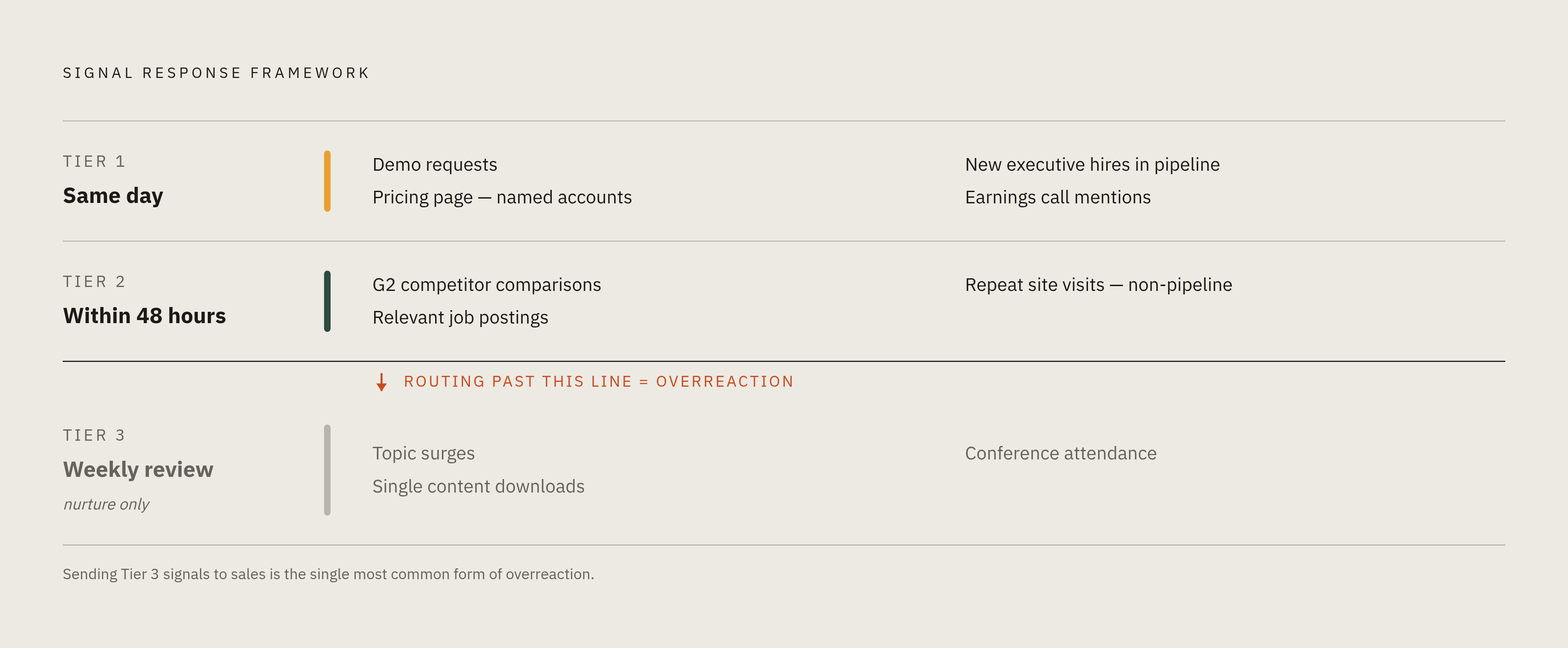
Signal decay is the operational risk nobody talks about enough. A signal three weeks old isn't intelligence. It's history. A job posting is most actionable in its first week. An earnings call mention matters most in the 30 days after publication. Freshness is part of fidelity, full stop.
With that in mind, here's a practical tiered structure.
Tier 1: Same day
- Demo requests
- Pricing page visits from named target accounts
- New executive hires at accounts already in pipeline
- Earnings call language that maps directly to your value proposition
These are high-fidelity signals. The cost of delay is a closed window. Route them fast and have a response ready before you need it.
Tier 2: Within 48 hours
- G2 category research and competitor comparison activity
- Relevant job postings indicating a new initiative
- Repeat website visits from accounts not yet in pipeline
- Competitor website visits
These warrant personalized outreach. They don't need emergency escalation. But they shouldn't sit in a queue for a week either.
Tier 3: Add to nurture, review weekly
- Topic research surges
- Single content downloads
- Conference attendance
- General industry news engagement
These are leading indicators. Worth tracking. Direct sales contact is not warranted. Routing Tier 3 signals to sales is the single most common form of overreaction in the intent data space. It burns rep time, and more importantly, it trains reps to distrust the entire feed. Once that trust is gone, it's genuinely hard to rebuild.
Start narrow. Build around five to seven signal types most relevant to your specific buying cycle. Add sources only after your team has built consistent response muscle around the core set.
Competitor research signals as a distinct and higher-confidence category
Forrester's 2025 research found that 92% of B2B buyers start with at least one vendor already in mind, and 41% have selected a preferred vendor before formal evaluation even begins. Competitor research signals are often the only visible evidence of a comparison process that's otherwise completely invisible to you. That's why they deserve their own category.
When a company searches for "[competitor name] alternatives" or reads a head-to-head comparison, they are not expressing general category curiosity. They are in active vendor evaluation. The context is explicit in a way that topic-level surge data almost never is. That justifies a faster and more specific response than most teams default to.
The contract renewal angle makes this even more useful. Most B2B contracts renew annually. If you can identify when a competitor's customer is approaching renewal, you can time outreach to land roughly 90 days before that date, when buyers start seriously evaluating alternatives. Competitor intent signals combined with technographic data surface this window before the account has filled out a single form.
What the response looks like in practice:
- Equip sales with a sequence built around competitive positioning, not generic outreach
- Surface a comparison landing page or competitive battlecard through retargeting to known stakeholders at the account
- Prepare comparison content, migration guides, and third-party validation in advance, so the credibility work is already done before a rep picks up the phone
The same logic applies on the retention side. A customer surging on competitor comparison content while their login frequency drops is an early warning for customer success, not just a new business signal for sales. Catching it early is the difference between saving the account and reading the churn report later and wondering what happened.
What multi-signal approaches actually deliver when implemented correctly
The performance gap between single-signal and multi-signal approaches is real. Blending third-party topic signals with first-party engagement data improves MQL-to-SQL conversion by 34% versus third-party signals alone, per 2024 Company Surge data. Intent-prioritized accounts convert at more than double the rate of non-prioritized accounts. Pipeline velocity lifts when signals trigger coordinated multi-channel plays rather than one-off outreach.
The timing multiplier is underrated. The same outbound message that earns roughly a 3% reply rate from a cold list earns 15 to 25% when it reaches an account actively researching a solution. The message didn't change. The timing did. Relevance is a function of when, not just what.
Real companies have seen this play out. Ascent Risk Management grew pipeline by 175% by prioritizing outreach around in-market accounts identified through ZoomInfo's signal layer. Smartsheet saw an 84% increase in MQLs after aligning demand generation around intent-driven account targeting. Neither result came from a single signal source. Neither came from routing every signal to sales. The lift is specifically attributable to cluster-based prioritization and tiered response.
Research cited in SPOTIO's sales statistics points to 35 to 50% of B2B deals going to the vendor that responds first to a buying signal. Speed inside the right tier matters enormously. Speed applied to noise doesn't matter at all.
The CRM and attribution gaps that undermine signal-based execution
You can build a solid framework and still fail at execution. The infrastructure problems are real and widespread, and they don't get talked about enough relative to how often they're the actual root cause.
Validity's 2025 CRM data research found that 76% of CRM users report less than half of their organization's CRM data is accurate and complete. Thirty-seven percent report losing revenue directly because of poor data quality. A promising signal attached to an outdated contact, an incorrect company mapping, or an irrelevant buyer persona is not a sales opportunity. It's a misdirected rep and a wasted window.
The attribution problem compounds this. The majority of B2B marketing teams still rely on last-touch attribution, per RevSure's research. Last-touch models systematically misrepresent how buying decisions actually form. They credit the final touchpoint and ignore everything that moved the deal forward before it. In a multi-signal world, that's like handing the trophy to whoever crossed the finish line and ignoring everyone who ran the first 25 miles.
What this means practically:
- Intent data is only as good as the account and contact data it's attached to. If your CRM is dirty, your signal routing will be wrong even when your signals are right.
- Attribution models that collapse a complex buying journey into a single touchpoint make it nearly impossible to understand which signal combinations actually drove pipeline. You can't optimize what you can't measure accurately.
- Teams that skip data hygiene and jump straight to intent programs typically see early results that don't hold. The signal layer looks broken. Usually the infrastructure underneath it is.
The fix isn't glamorous. Clean the data. Define ownership for signal response. Build attribution that captures the full journey. These aren't exciting problems, any of them. But they're the problems that decide whether the rest of this actually works, or whether it just sounds good when you explain it, which is why platforms like Letterdrop, a content marketing and sales enablement tool that ties content output directly to pipeline and revenue attribution, are designed to keep those two layers connected rather than treating them as separate problems.