Competitor Intent Data in B2B Sales
Review-site signals pinpoint competitors in active evaluation before the buyer decides.

Intent data, at its core, is behavioral signals that suggest an account is actively researching a topic, a product category, or a specific vendor. Competitor intent data is the slice of those signals that tells you an account is looking at a rival right now. They're reading "alternatives to [your competitor]" pages. They're comparing pricing. They're on G2 checking out your competitor's reviews.
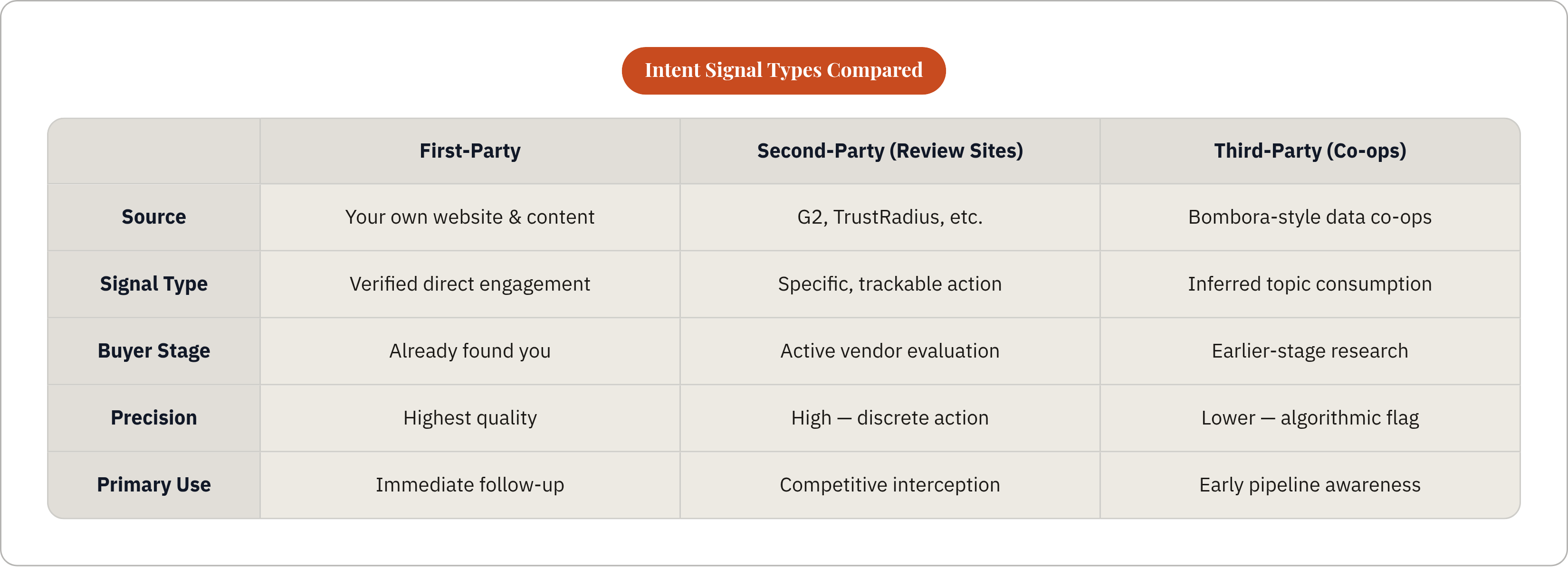
There are three layers of signals, and they are not created equal:
- First-party signals come from your own website and content. Highest quality. The buyer already found you. Start here.
- Second-party signals come from review and comparison platforms like G2 and TrustRadius. Buyers here are in active vendor-evaluation mode, not casually browsing. Tools like Letterdrop, a platform that ties content creation and distribution to revenue, help teams build and distribute content that generates first-party engagement signals from target accounts before outreach begins. G2 alone captures nine distinct signal types from over 100 million software buyers.
- Third-party signals come from data co-ops that aggregate research behavior across thousands of B2B websites. Earlier stage, broader signal, less precise.
One thing most teams miss: the majority of intent providers deliver signals at the account level only. If you want to know which actual person at the account is doing the research, you need to layer in contact-level data separately. That's a real cost driver worth budgeting for upfront, not discovering mid-contract.
The distinction that matters most for competitive use is this: review-site signals capture a discrete, verifiable action. Someone clicked on a comparison page. Third-party topic signals are inferred. Someone consumed enough content about "network security" that an algorithm flagged the account. The former is closer to a purchase decision. The latter gives you earlier context. Both are useful. Neither is sufficient alone.
One more layer worth acknowledging: none of this captures what's happening inside ChatGPT, Perplexity, or Google AI Overviews. Queries in those tools leave no footprint in any current intent platform. The so-called "dark funnel" of private research is getting wider, not narrower, which is exactly why stacking multiple signal sources beats relying on any single feed.
How Accurate These Signals Actually Are in Practice
The vendor materials are not going to tell you this part clearly, so here it is plainly.
The market narrative around intent data is confident. The actual accuracy benchmarks are messier. Independent research puts median precision for topic-based third-party intent signals at roughly 0.51, meaning about half of flagged accounts show no corroborating behavior anywhere else. Other studies have found that the majority of organizations using intent data report fewer than 70% of flagged accounts showing any matching activity in their CRM or marketing automation within 30 days of the signal. That is a lot of noise.
The causes are not mysterious:
- Bidstream-sourced data. Many providers pull signals from ad exchanges rather than direct publisher relationships. Noisier, harder to verify.
- IP-to-company matching. Remote work and shared networks create real errors when a provider tries to attribute a web visit to a specific company.
- Signal latency. Data arriving two weeks after the behavior occurred describes a buyer who has already moved on.
Here is the honest framing though. Even imperfect signals improve outcomes when you use them to prioritize rather than to trigger fully automated action. Intent-prioritized accounts consistently convert to closed opportunity at rates well above non-prioritized accounts in controlled comparisons. Combining third-party topic signals with first-party engagement data also meaningfully outperforms either source alone.
Intent data is a prioritization tool. Treat it like one. The teams burning money on it are the ones treating every flagged account like a confirmed hand-raise and letting automation take over from there.
Competitor intent signals from review sites outperform broad topic signals on precision because they reflect a specific, trackable action rather than an inferred pattern. That is where to anchor your confidence.
The Timing Window That Makes Competitor Intent Valuable
Most B2B buyers start their research with at least one vendor already in mind. A significant share have already selected a preferred vendor before formal evaluation even begins. So the useful window is not "before the buyer has heard of anyone." It is the active evaluation phase, when the shortlist is forming but preferences have not hardened yet.
That window is short. Mid-market B2B buying cycles can move from "actively researching" to "vendor selected" in as little as two to four weeks. Add a 14-day signal delay plus a week of internal routing, and you are delivering a competitive play after the decision has already been made. You showed up after the lights went out — like a doctor who arrives after the patient has already checked themselves out.
Freshness is not a nice-to-have. It is basically the whole game.
What the window actually looks like in practice:
- An account spikes on competitor-related searches or visits a competitor comparison page.
- That signal reaches your sales team within days, not weeks.
- A rep connects with a buyer who is actively weighing options and has not committed yet.
Compare that to traditional cold outbound, where a rep is essentially guessing which accounts are in an active cycle. Competitor intent signals remove most of that guesswork. The buyer is already moving. You are not interrupting someone who is not interested. You are entering a conversation that has already started.
The same logic applies to retention. A customer quietly researching alternatives is sending a signal before they have said a word to anyone on your team. Intent data can surface that to customer success before the renewal conversation turns into a rescue mission.
The signal's value is almost entirely time-dependent. The same data point that enables interception on day three is background noise by day twenty-one.
How Revenue Teams Structure a Response When a Competitor Signal Fires
The signal type should drive the response, not just the account identity. This is where a lot of teams get sloppy.
- Competitive spike (account visiting rival comparison pages, reading "alternatives to" content) → direct sales touch with competitive positioning materials
- Category research signal (broad topic surge, no specific competitor identified) → marketing nurture sequence, educational content
- Demo page revisit or pricing page return → same-day calendar drop, real-time Slack alert to the rep
Best-performing teams trigger a coordinated response to a competitive spike. Not a single email. A sequence:
- Outbound touch from the rep with a relevant proof point or comparison asset
- Tailored ad sequence in the channels that account actually uses (LinkedIn, Reddit).
- Executive alignment play if the account is enterprise-tier and the deal size warrants it
A concrete example: a cybersecurity SaaS team monitoring intent sees a target account's team searching "network intrusion solutions" and visiting competitor pages. That triggers a comparison guide offer by email plus an outbound prospecting sequence built around that specific pain. Relevant, timely, grounded in what the buyer is actually doing right now.
Routing speed matters as much as the playbook itself. A signal sitting in a marketing queue for a week is wasted. Competitive signals need a defined response SLA. Same-day is the standard that high-performing teams hold themselves to, and it is harder to hit than it sounds.
Intent signals also have a useful re-engagement application that teams underuse. Accounts that went dark sometimes quietly re-enter the market. A shift in their research topics or renewed review-site activity can flag a dormant account coming back to life before they reach out to anyone. That is often a warmer opportunity than cold new prospects.
The Provider Landscape and What Distinguishes the Tools That Deliver
The major platforms in this space include Intentsify, Demandbase, ZoomInfo, G2, and Informa TechTarget, and they are not interchangeable.
Here is what actually differentiates them for competitive interception specifically:
- Intentsify aggregates signals across multiple providers and applies AI refinement. A good fit for teams that want normalized signals without managing a mess of vendor relationships.
- ZoomInfo's Guided Intent identifies topics historically correlated with closed-won deals in your specific pipeline. Moves prioritization from generic category research to deal-predictive signals.
- G2 captures buyers specifically in active vendor-selection mode. Nine signal types including Alternatives, Compare, and Competitive. If review-site precision is the priority for your interception play, this is where it lives.
- Informa TechTarget skews toward IT and technology buyers. Better fit for tech-sector GTM teams than general B2B.
On pricing: the range runs from roughly $7,000 to over $150,000 annually. The cheapest tool is frequently the most expensive once you account for the surrounding stack you need to actually act on its signals.
The consolidation trend is also worth watching. HG Insights acquired TrustRadius in 2025, merging review-based intent with technographic data. HubSpot absorbed Clearbit into Breeze Intelligence. Fewer standalone tools, more bundled solutions. When evaluating a bundled platform, check specifically whether it covers review-site competitive signals, not just broad topic intent. That layer is the most likely to get buried in a bundle pitch.
A simple selection heuristic: prioritize signal freshness and source specificity over breadth. A narrow, accurate competitive signal is worth more than a broad topic surge that takes two weeks to arrive and covers half your addressable market.
Why Content Is What Makes a Competitive Interception Actually Land
The signal identifies the moment. It does not create the message.
A rep reaching an active evaluator with generic outreach wastes the window. Buyers mid-evaluation are more skeptical, not less. They are actively comparing vendors and looking for reasons to eliminate options. A templated "just checking in" email is a reason to eliminate you. Full stop.
What actually earns attention during a competitive intercept:
- Relevance to the specific competitor being evaluated. Not category-level positioning. Not generic "why us" messaging. If the account is evaluating Competitor X, the content should address that comparison directly and specifically.
- Evidence the seller understands the buyer's situation. Subject-matter credibility signals that you are an advisor worth talking to, not another vendor trying to book a discovery call.
- Assets that reframe evaluation criteria. The goal is not to assert that you are better. It is to shift what the buyer is measuring. An ROI calculator or a structured comparison that reframes the evaluation criteria does more work than a feature matrix.
Distribution matters as much as the content itself. The right comparison guide served to the wrong channel at the wrong moment does not intercept anyone. Research consistently shows omnichannel campaigns generate dramatically higher pipeline than single-channel approaches. That finding should end any internal debate about whether multi-channel execution is worth the effort.
The alignment implication here is structural:
- Marketing has to build competitive content assets before the signals fire. Not in response to individual deals after a rep asks.
- Sales has to have a clear routing path and a content library they can actually use within the signal's useful window.
- The intent data layer connects those two workflows. It is the trigger that makes pre-built content relevant at exactly the right moment instead of randomly throughout the year.
The Measurement Gap That Prevents Most Teams From Knowing If Any of This Is Working
Here is the part that almost never shows up in vendor pitch decks.
Most teams cannot accurately measure whether their competitive intent programs are working, because they have not set up the baseline conditions that would let them know. This is not a technology problem. It is a discipline problem.
The measurement gaps show up in predictable places:
Attribution is broken by design. A buyer who received a competitor comparison guide by email, saw a LinkedIn ad, and then got a call from a rep will often get attributed entirely to whichever touchpoint came right before the form fill. The intent signal that triggered the sequence gets no credit. Neither does the content. So the program looks less effective than it actually is, and teams cut it.
Control groups are almost never set up. To know whether competitor intent signals are actually accelerating pipeline, you would need to deliberately not act on some signals and compare outcomes. Almost no team does this. Without it, the conversion rate comparisons that vendors cite are directionally useful but impossible to replicate in your own pipeline without that structure in place.
Signal-to-outcome mapping requires clean data. Knowing which signals preceded which deals requires that the signal be logged against the account record when it fires, with a timestamp, and that the deal outcome be linked back to it later. Most CRM hygiene is not good enough to support that chain. Signals get logged inconsistently. Contacts do not match. Accounts are duplicated.
Velocity metrics get ignored in favor of volume. Even when teams measure pipeline, they usually measure how much was created, not how fast it moved or how it closed. Competitor intent plays are most defensible when the metric is deal velocity and win rate against a specific competitor, not raw pipeline numbers.
What better measurement actually looks like:
- Tag every account where a competitive signal fired and track win rate and velocity separately for that cohort
- Log the signal type (review-site versus third-party topic versus first-party revisit) to identify which sources are driving real outcomes
- Track which content assets were used in the response sequence and tie them back to deal results
- Run a deliberate pilot with a defined test group and a holdout group, even a small one, before scaling spend
The teams that skip this step tend to end up in the same place: they run the program for a year, cannot prove ROI clearly, and either scale it for the wrong reasons or kill it for the wrong ones. The intent data vendors will not solve this for you. They will give you dashboards showing signal volume. The work of connecting those signals to outcomes in your own pipeline is yours to do.
None of this is a reason to avoid competitor intent data. It is a reason to run it like a real program rather than a one-time software purchase you hope does something.