Demand Generation vs Lead Generation in B2B

Let's get the definitions straight, because most org charts, budget decks, and job descriptions blur these terms into mush. They are not the same thing.
Demand generation builds market awareness and appetite for your solution. It operates before most buyers know they have a problem or are ready to act. Within demand gen, there are two sub-functions worth naming:
- Demand creation targets buyers who don't yet recognize the problem. These are people who aren't looking for you or anyone like you. They are the vast majority of your market.
- Demand capture targets buyers who have the problem in mind but haven't raised their hand yet. They know something is off. They just haven't started a vendor search.
Lead generation captures contact information and intent signals from prospects who are already interested. It activates people that demand gen has already warmed up.
Here's the structural point that gets missed constantly: demand gen encompasses lead gen, not the other way around. Lead gen is a downstream function. The channels map out this way:
- Demand gen channels: ungated content, brand-led paid media, LinkedIn thought leadership, podcasts, webinars, SEO-driven education
- Lead gen channels: gated assets, demo request flows, trial sign-ups, SDR outreach to accounts showing intent, paid search on high-intent queries
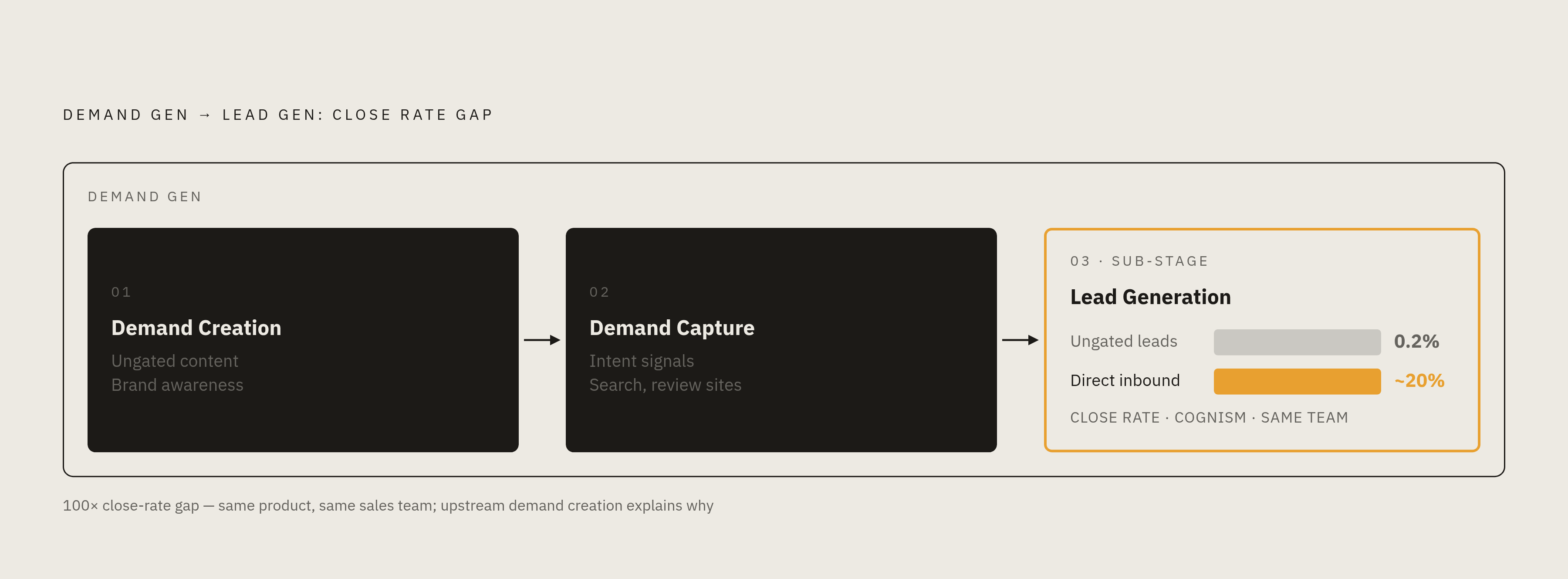
Neither works in isolation. Demand gen without lead gen generates awareness that never converts. Lead gen without demand gen collects contacts who aren't ready to buy. And if you want a real-world illustration of what that looks like at scale, look at what Cognism was dealing with before they overhauled their strategy: serious lead volume from content, a close rate of roughly 0.2% on those leads, and a close rate of nearly 20% on direct inbound inquiries. Same company, same product, same sales team. One group had buying intent. The other had just clicked something.
The leads existed. The demand did not.
Why the B2B Buyer's Behavior Makes Demand Gen the Necessary Starting Point
At any given moment, roughly 95% of the business market isn't actively looking for a solution. That is the population demand gen exists to reach. You can't skip them and just wait for the 5% who are actively shopping, because by the time someone fills out a form, 70% of their buying journey is already done. According to 6sense's 2025 Buyer Experience Report, 94% of buying groups have already ranked their preferred vendors before they initiate first contact with any vendor.
They have a ranked list before they talk to anyone.
The average B2B purchase cycle now runs longer than eleven months. Most of that time is self-directed research, not conversations with vendors. McKinsey's 2024 B2B Pulse Survey, covering more than 3,800 decision-makers across 13 countries, found that buyers now use an average of ten interaction channels across the full buying journey. That's double what they used in 2016. A typical enterprise purchase involves six to ten stakeholders, each independently consuming content throughout evaluation.
What this means practically:
- A team running only lead gen is fishing in the 5% pond, and so is every one of their competitors
- A team that builds demand gen first earns familiarity and preference during the long self-serve research phase, so that when buyers do surface, they already have a vendor in mind
- Forrester's 2025 projections point toward more than half of large B2B transactions being processed through digital self-serve channels as Millennial and Gen Z buyers take on more purchasing authority. The direction of travel is toward more self-direction, not less.
The buyers are doing the research with or without you. Demand gen is how you show up during that research instead of getting skipped entirely.
How Demand Gen Creates the Conditions That Make Lead Gen Work
The handoff works like this: demand gen builds familiarity, category awareness, and latent preference. Lead gen captures that preference at the moment it becomes active intent.
Without the demand gen layer, lead gen collects contacts from people who don't understand the problem well enough to buy. This is what produces the bloated MQL lists that make marketing teams look busy and sales teams feel misled. With it, the same lead gen motion reaches people who already trust the brand, understand the category, and are further along their own decision process. Conversion rates go up. Deal velocity improves.
Cognism's pivot illustrates the mechanics directly. Shifting investment to ungated content, brand-led paid media, and LinkedIn influence produced a 4x increase in inbound pipeline, with higher win rates and shorter sales cycles. The leads that came in were warmer because demand gen had already done the pre-work. Same lead gen motions. Different inputs. Dramatically different outputs.
LinkedIn's 2024 B2B Marketing Benchmark Report recommends a 60/40 budget split favoring demand gen. That ratio reflects the relative weight of building a market versus capturing from it. You spend more time farming before you harvest.
ABM as a Bridge Between Both Functions
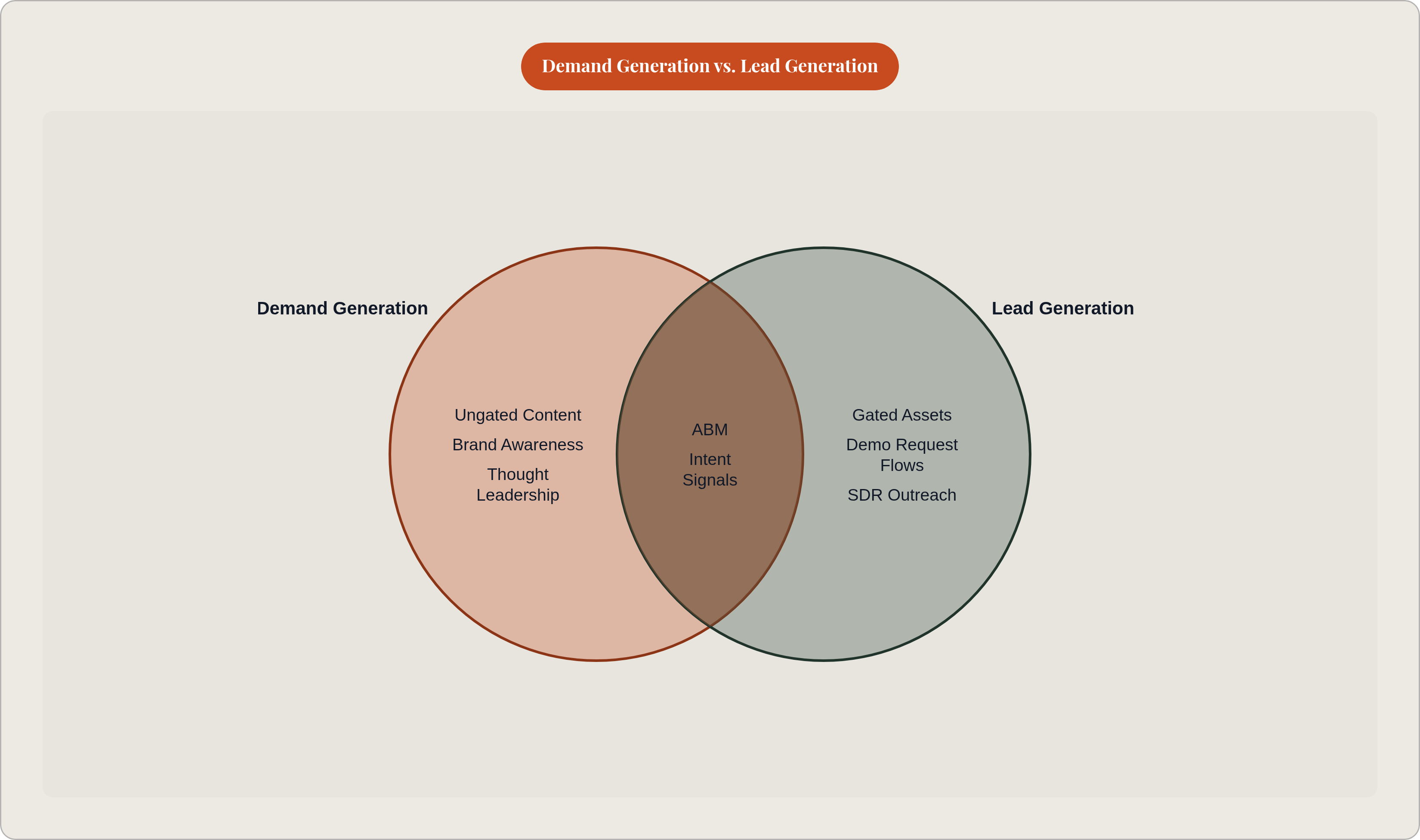
Account-based marketing blurs the line between demand gen and lead gen intentionally, and that's actually the point. ABM applies demand gen content and lead gen activation at the account level. Personalized enough to function as lead gen. Broad enough within a target account to build demand across the whole buying committee.
Teams running ABM track significantly more metrics than those without, per 6sense's 2025 Marketing Attribution benchmark. That's not a coincidence. ABM forces measurement discipline that standalone demand or lead gen often lacks, because you're tracking a specific account through the full motion rather than watching aggregate numbers move up and down.
Reading Intent Signals to Know When a Buyer Has Crossed from Demand to Lead Territory
Knowing that 95% of the market isn't actively looking is useful context. It doesn't help you do anything specific on a Tuesday afternoon. What you actually need is a signal that a particular account has moved into active evaluation, so lead gen outreach lands at the right moment rather than too early or embarrassingly late.
Intent signals break down by type:
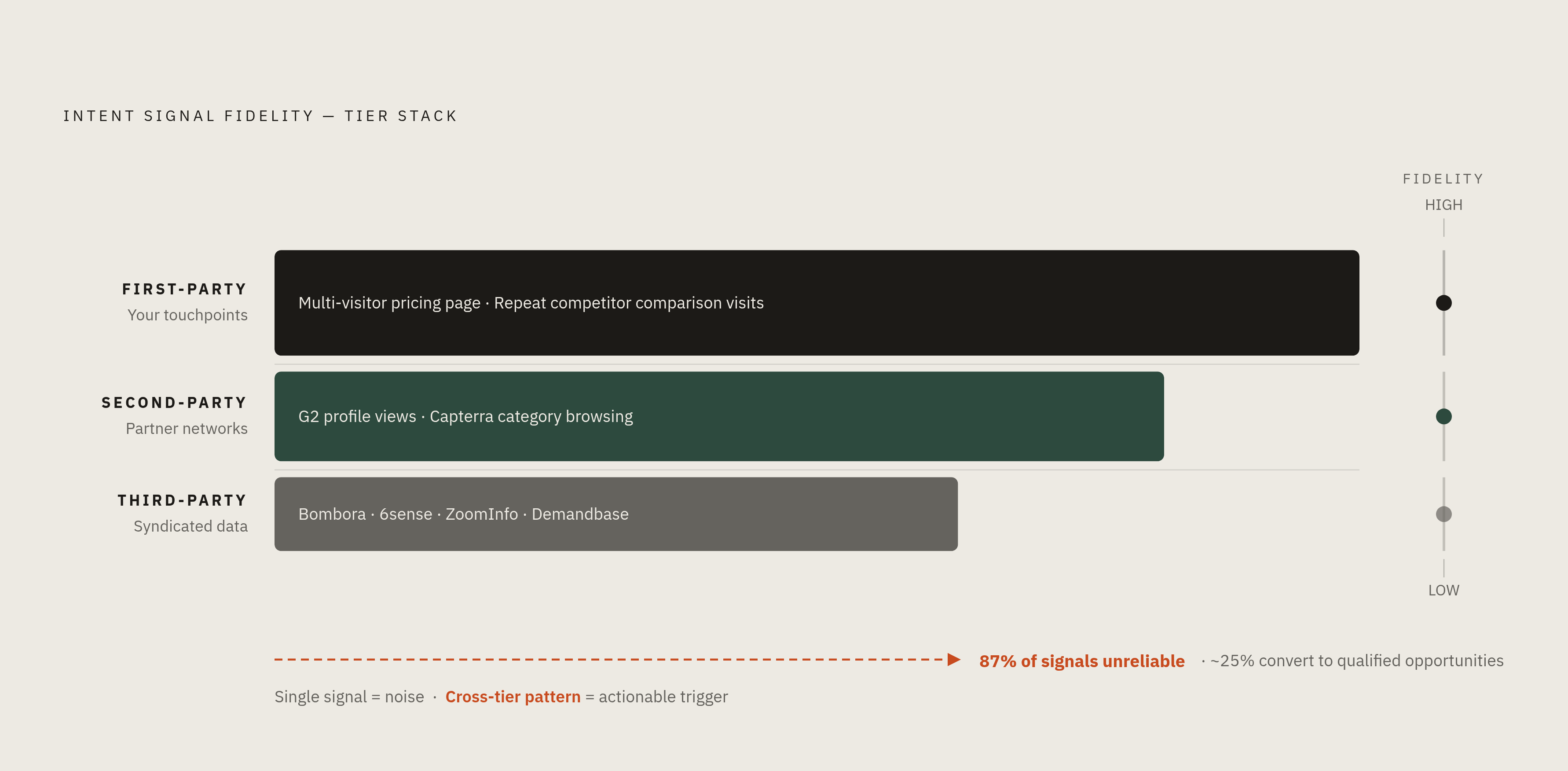
First-party signals (highest fidelity): Multiple people from the same account visiting your pricing page in the same week. A single visitor returning to a competitor comparison page several times in a short window. These are actions on your own property. The intent is unambiguous.
Second-party signals: Activity on G2, Capterra, or similar review platforms. Particularly useful for catching buyers mid-evaluation, when they're actively comparing vendors and reading what customers actually say.
Third-party signals (from platforms like Bombora, 6sense, ZoomInfo, Demandbase): A company consuming content about a specific solution category at an elevated rate across a large publisher network. Useful for surfacing accounts that are researching but haven't visited your site yet.
A Caveat on Signal Quality
Per DemandScience benchmarks, 87% of organizations report unreliable or inflated intent signals, and only about a quarter of signals convert to qualified opportunities. No single signal justifies a sales touch. Patterns across multiple signals do.
One pricing page visit is noise. Multiple people from the same account visiting pricing, then hitting a comparison page, then downloading a case study in the same week is a pattern worth acting on.
Speed matters too. The window between active research and vendor selection can be as short as two to four weeks for mid-market deals, which means slow internal processes can eliminate any advantage the signal gave you. The same outreach message earns roughly a 3% reply rate from a cold list and a 15-25% reply rate when it reaches an account actively in research mode. The message is identical. The timing is the variable.
Competitor Research Signals as the Highest-Value Lead Gen Trigger
A buyer searching "Competitor X pricing" or "Competitor X alternatives" has already decided they need a solution in this category. The only open question is which vendor wins.
That's what makes competitor-intent signals categorically different from general category signals. The demand gen work is already done, either by the competitor or by the market itself. The buyer is in lead gen territory immediately. You don't need to educate them. You need to intercept them.
The keyword clusters that flag active competitor evaluation:
- "[Competitor] + pricing": A price-sensitive buyer who may be sticker-shocked and scanning for alternatives
- "[Competitor] + alternatives": A buyer actively expanding their consideration set or already looking to switch
- "[Competitor] vs. [Your Brand]": A buyer in a direct bake-off who has already found you
The play here is a coordinated response. Triggered LinkedIn ads plus a personalized sales sequence, deployed the moment an account shows a spike in competitor research activity. Marketing and sales move simultaneously, not sequentially. By the time a deal gets passed down the line in the old handoff model, the window may already be closing.
Thought Leadership as a Mid-Evaluation Intercept Tool
Per Edelman-LinkedIn 2024 research, 54% of decision-makers said a competitor's thought leadership made them realize there were other suppliers with a better grasp of their challenges. Content doesn't just generate awareness at the top of the funnel. It can actively dislodge a competitor's position mid-evaluation.
A buyer who is leaning toward your competitor reads something you published that reflects their situation better than anything the competitor has said. That is a shift in preference, mid-cycle, driven entirely by content.
The same research found that 70% of decision-makers said thought leadership had at least occasionally led them to question an existing supplier relationship. Strong content both opens competitor accounts and protects your own. It works offensively and defensively at the same time.
Measuring Whether the Demand-to-Lead Handoff Is Actually Working
Here's the uncomfortable structural reality: only 23% of B2B marketers can accurately attribute revenue to channels, per Salesforce Q3 2024. And 56% can't accurately attribute ROI to their content efforts, per CMI's 2025 data. Most teams are running a sequential strategy they cannot actually measure end-to-end. That is a real problem, and it doesn't get talked about enough.
Why Legacy Metrics Obscure the Relationship
MQL counts measure hand-raises, not intent or fit. A massive MQL database can coexist with a thin pipeline when demand gen hasn't done its job upstream. 6sense's 2025 Marketing Attribution and Contribution benchmark explicitly classifies leads and MQLs as legacy measures. The shift in the field is toward pipeline- and revenue-oriented measurement, and it's overdue.
Single-touch and basic multi-touch attribution, used by nearly 90% of marketers, create bias toward easily tracked touchpoints. They miss the multi-stakeholder, multi-channel reality that the data consistently describes. If a buyer consumed six pieces of ungated content over eight months and then filled out a demo request, the demo form gets the credit. The eight months of demand gen work that made them ready to fill it out gets nothing. That's not a measurement strategy. That's just counting what's easy to count.
Metrics That Actually Reveal Whether the Sequential Model Is Working
- Marketing-sourced pipeline contribution: Forrester Q2 2024 benchmarks this at 42% for North American B2B tech. If you're well below that, your demand gen probably isn't feeding the pipeline.
- Time-to-close for content-engaged vs. non-content-engaged deals: Gartner Q1 2024 found a 23% faster close time for deals where prospects engaged with content during the sales cycle. That's a direct efficiency argument.
- MQL-to-opportunity conversion rate: SiriusDecisions 2024 benchmarks this at 13%. Significantly below that usually means lead quality issues, which usually means demand gen isn't doing its job upstream.
- Content-influenced opportunities: Not just content-sourced leads, but opportunities where content played a role somewhere in the cycle. This is a more honest measure of content's actual contribution.
The opportunity-level shift worth making: move your attribution focus from contacts in a database to opportunities in the pipeline. Revenue shows up in deals, not in lists of names.
One last cost note, because it matters. Per SaaS Capital's 2025 benchmarks, the median SaaS company spends $2.00 to acquire $1.00 of new ARR, and that number is up 14% since 2023. When acquisition costs are rising, measuring what actually drives pipeline isn't optional. It's how you justify where the money goes and make the case to keep spending it.
How Sales and Content Teams Execute the Sequential Model in Practice
The structural requirement is simple to say and genuinely hard to do: demand gen and lead gen can't be optimized independently. The handoff between them needs a shared definition of what "ready" looks like and a shared system for acting on it when it happens.
The Demand Gen Execution Side
- Ungated educational content that addresses the problem before buyers frame it as a purchase. Blog posts, original research, podcasts, LinkedIn thought leadership. The goal is to be useful before you are relevant.
- Distribution through channels where the 95% actually spend time, not just channels that are easy to track. If your distribution strategy is "post it and hope it gets indexed," you are not doing demand gen.
- Thought leadership that builds seller credibility alongside brand credibility. Per Edelman-LinkedIn 2024, roughly 60% of decision-makers said strong thought leadership makes them more willing to pay a premium. More than 75% said it prompted them to research products they weren't originally considering. That is demand creation working the way it's supposed to.
The Lead Gen Execution Side (Triggered by Intent)
- Gated assets and demo flows for buyers showing decision-stage signals. The gate isn't arbitrary friction. It's a way to identify buyers who are actually ready.
- SDR outreach personalized to the specific signal, not a generic sequence. "I noticed several people from your team have been looking at [topic]" is categorically different from "Hope this finds you well." One of those gets deleted immediately.
- Coordinated plays: marketing-triggered ads and sales email sequences launched simultaneously when competitor intent signals spike. Marketing and sales moving together, not passing a baton.
The Seller's Role in Demand Gen
Individual reps who share original insight and sector-specific content on LinkedIn are doing demand gen work. They build familiarity with buyers who aren't in-market yet, so that when those buyers do surface, they already associate a name and a perspective with the vendor. HubSpot's 2025 data found that companies with active thought leaders see 2.7x more qualified leads than competitors without.
Qualified leads are a lead gen metric. The driver is a demand gen activity. That tension is the whole argument, and it shows up in the numbers every time.
Teams that separate demand gen and lead gen into siloed functions keep producing the same result: volume without conversion, activity without pipeline, reports that look fine until someone asks why deals aren't closing. Teams that treat them as one sequential motion, with intent signals as the handoff trigger, build something that actually compounds. That's the system. Run it in order.