First-Party vs Third-Party Intent Data for Outbound Prioritization
Stack third-party signals with first-party data to find and time your outbound targets.

Outbound teams waste enormous energy chasing the wrong accounts in the wrong order. The fix isn't better messaging or more send volume. It's better signal logic. First-party and third-party intent data each answer a genuinely different question, and once you understand which question each one answers, you can stack them into a prioritization system that puts the right accounts in front of your reps at the right moment. Everything else in this piece is just context for that.
Before we get into it, one thing worth clearing up: "intent data" is not one thing. It's a layered ecosystem with sources that behave very differently from each other.
- First-party data is what you collect directly. Site behavior, content downloads, pricing page visits, CRM history, and the content-to-pipeline attribution that platforms like Letterdrop are built to surface.
- Second-party data comes from platforms like G2 and TrustRadius. It's their data, shared with you. Still relatively high-fidelity.
- Third-party data is aggregated behavior across large networks of B2B websites. Bombora's Company Surge product, for example, tracks content consumption across thousands of sites organized into topic clusters.
Each layer answers something slightly different. The confusion happens when teams treat them as interchangeable. They are not.
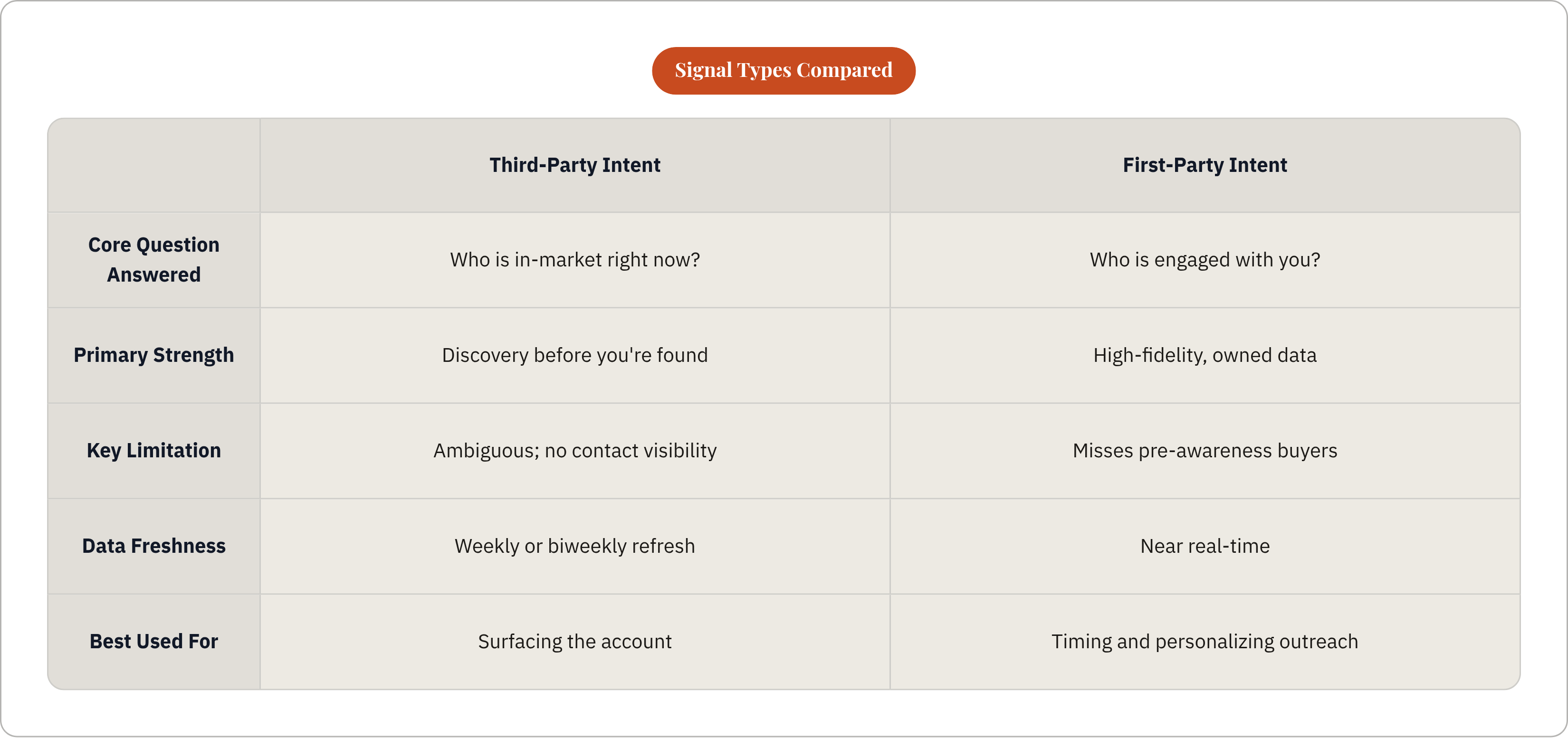
Third-party signals are genuinely useful for one specific job: finding accounts that are in-market before they've touched anything you own. If a company is surging on "revenue operations software" across dozens of B2B sites, that's a real signal worth knowing about. The problem is that the signal is also pretty ambiguous in practice, and that ambiguity bites teams constantly.
A company surging on "cloud security" could be:
- A genuine buyer evaluating vendors
- A competitor doing market research
- A journalist writing a story
- A grad student writing a paper
Same signal fires for all four. There's no way to know from the surge data alone. You're essentially finding a footprint in the sand and trying to figure out who left it, why they were there, and whether they're coming back.
There's also the account-level reporting gap. Most third-party providers report at the company level only. The actual human inside that account doing the research? Invisible. Finding that person requires layering in contact-level data on top, which is where a big chunk of the real cost lives.
Speed is the other killer. Intent platforms often refresh weekly or biweekly. That sounds fine until you realize that mid-market buying windows can compress to just a few weeks between active research and vendor selection. A 14-day data lag, plus however long it takes to route the signal internally, can eliminate the window entirely. The signal fires Monday. Your rep sees it Thursday. Two competitors have already booked demos.
Third-party data is a discovery tool. It tells you who is in-market at scale. It reveals nothing about who is engaged with you specifically, which contact to reach, or when to reach them.
Why First-Party Data Alone Misses Most of the Market
The trap with first-party data is that it's high-fidelity, fully owned, and invisible to competitors. Those are all real advantages. The catch is it only captures accounts that have already found you.
The selection bias this creates is severe. Research from Gartner shows B2B buyers complete somewhere between 70 and 80 percent of their purchase journey before they ever engage a sales rep. Gartner also found that a large majority of buyers now prefer a rep-free experience, doing their evaluation through channels that vendor tracking simply cannot reach. Private Slack communities. Peer networks. AI search.
That last one is moving fast. Research from late 2025 found that 60% of B2B buyers now use tools like ChatGPT, Perplexity, or Gemini to build vendor shortlists before engaging any vendor directly. When a buyer asks an AI assistant a category question and gets a summarized answer, they form impressions about vendors without visiting a single website. Your analytics sees nothing. The visit never happened.
Forrester's 2024 Buyers' Journey Survey found that 92% of B2B buyers enter the purchasing process with at least one vendor already in mind. Forty-one percent have a single preferred vendor selected before formal evaluation even begins. If your outbound strategy is built purely on first-party signals, you are systematically missing the accounts that form preferences before they find you. Per that data, that's most of them.
First-party data is essential for timing your outreach and personalizing your messaging. It just can't solve the discovery problem that third-party data is built to address.
The Dark Funnel Is Real, and Neither Signal Type Can See Into It
Both data types share the same structural constraint. They can only observe activity that happens on the open, tracked web.
Neither captures the Slack thread where someone asked their network for vendor recommendations. Neither captures the ChatGPT query. Neither captures the analyst PDF someone forwarded through email or the peer recommendation that happened over lunch. Those are often the moments where vendor preferences actually form, and both signal types are completely blind to them.
So what can teams actually do about it? A few proxies hold up reasonably well:
- Self-reported attribution on demo request forms. Asking "how did you hear about us?" is low-tech, but it captures channels no pixel ever sees. People will tell you if you ask.
- Brand search volume via Google Search Console. Rising search volume for your brand name is a leading indicator that awareness is building somewhere you can't directly track.
- Direct traffic quality analysis. A spike in high-fit accounts arriving without a referrer often signals word-of-mouth or AI-sourced research.
- Win/loss customer interviews. The only method that reliably reconstructs the full pre-purchase journey. Buyers will walk you through the whole thing if you structure the conversation right.
- AI visibility monitoring. Checking how ChatGPT, Claude, and Perplexity describe your category, your brand, and your competitors is still an emerging practice. It's also becoming necessary.
These proxies don't replace intent signals. They fill in the portion of the journey that neither signal type can reach.
The Stacking Logic: Why Two Signals Are Worth More Than the Sum of Their Parts
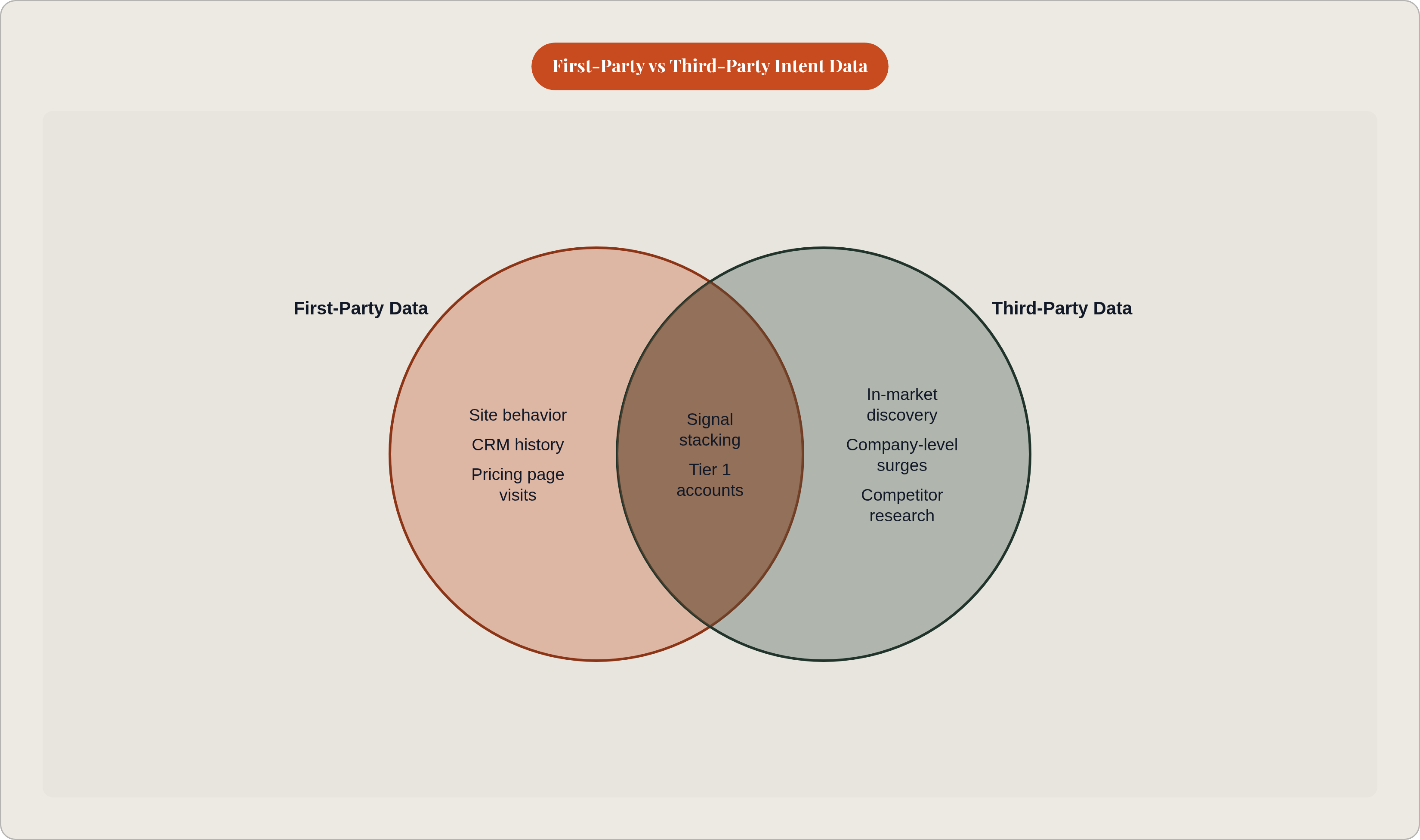
The core idea is simple. Third-party signals surface the account. First-party signals confirm it and time the outreach.
No single signal is reliable enough on its own to justify a direct sales touch. A company visiting your homepage once is not a buying signal. It's noise. But a company that visits your homepage, then your pricing page, then reads three competitor comparison posts, then shows up on G2 browsing your category? Now you're looking at something. Not a single thread anymore.
Here's a concrete example of how this plays out. An account posts a VP of Revenue Operations role. That same account visits a competitor's pricing page. Then someone from that account downloads your ROI calculator.
Each signal on its own is mildly interesting. The job posting suggests organizational change. The pricing page visit suggests active evaluation. The calculator download suggests someone is building a business case internally. Together, they tell you there is a live buying conversation happening right now, not weeks ago. That's worth fast, personalized outreach. A drip sequence that queued up three weeks ago and has no idea what the account has been doing since will miss it entirely.
Contextual triggers add a third dimension:
- Job postings for VP of Sales or Head of Revenue Operations signal organizational change that typically precedes technology purchases. Companies that are hiring into a function are usually also thinking about the tools that function needs.
- Leadership changes (especially new C-suite hires) bring new strategies and new budgets. A buying window opens before any active research shows up in your data at all.
Accounts showing both first-party and third-party signals simultaneously convert at meaningfully higher rates than accounts showing either signal alone. That's not a controversial claim. It's just what happens when you stop guessing and start stacking.
Building a Tiered Prioritization System That Your Reps Will Actually Use
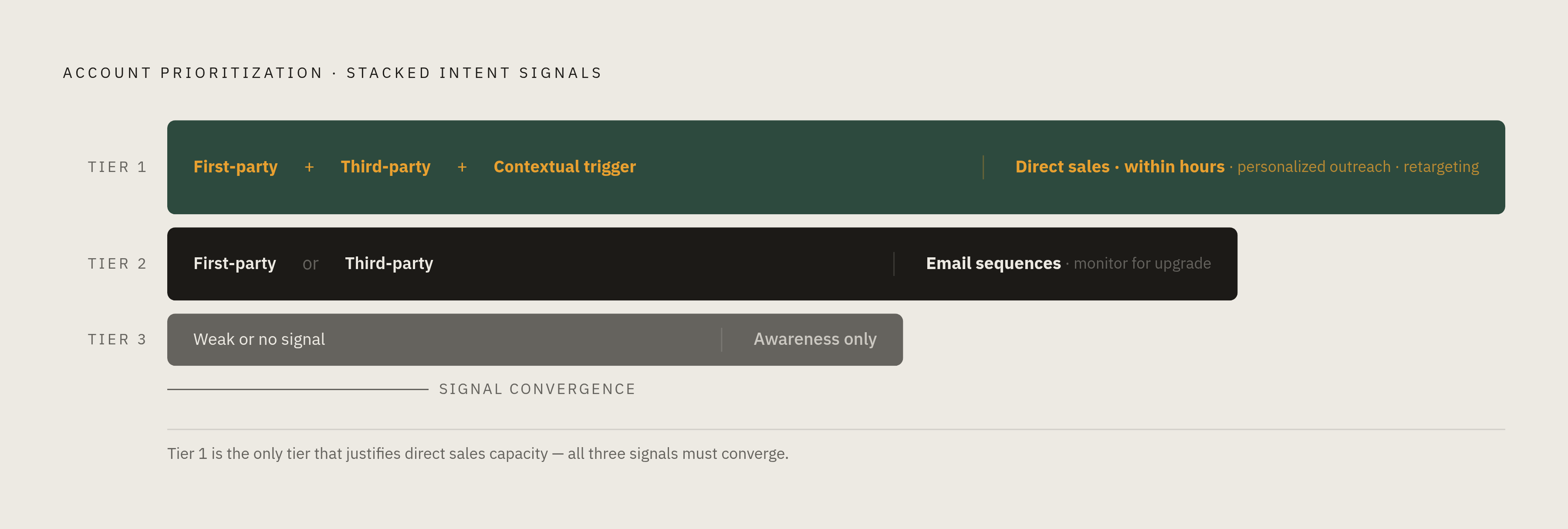
Signal stacking produces a confidence gradient, not a binary yes/no. The right way to use it is to build tiers rather than dump everything into a flat list and let reps sort it out.
Tier 1. High-fit accounts with active signals on both sides. Both first-party and third-party signals are firing, ideally with a contextual trigger also present. Route these to direct sales with personalized messaging and supporting ad retargeting. SDRs should get a real-time or daily list with context on what the account is engaging with and a recommended messaging angle. The response window here is hours, not days.
Tier 2. Medium-fit or moderate-signal accounts. Third-party signal present but no first-party confirmation yet. Or first-party signal alone without visible external category research. Route into targeted email sequences and relevant content. Watch for the signal to upgrade before you spend direct sales time here.
Tier 3. Low-fit or weak-signal accounts. Early or ambiguous signals. ICP fit uncertain. Add to awareness campaigns. Direct sales capacity should be reserved for higher tiers.
The signal package your reps receive for Tier 1 accounts should include:
- Which pages or content the account has engaged with (first-party context)
- Which topics the account is surging on externally (third-party context)
- Any contextual triggers like job postings or leadership changes
- A recommended messaging angle based on the signal combination
Signal-triggered outreach generates meeting rates in the 4 to 10 percent range versus 0.5 to 2 percent for cold list outreach, per data from Unify. Even the floor improvement justifies the operational investment on its own.
Where Competitor Intelligence Fits Into the Stack
Beyond general category research, intent data can reveal which specific competitors a prospect is actively evaluating. That's a different signal than knowing someone is broadly in-market, and it deserves different treatment.
G2 and TrustRadius review site behavior is bottom-of-funnel by nature. Someone comparing alternatives on G2 is not casually browsing your space. They are deep in an evaluation. G2 category-level data can show when prospects are visiting competitor profiles specifically, which tells you a shortlist is actively forming.
Third-party signals can also flag accounts researching competitor pricing pages, downloading vendor comparison guides, or surging on competitor brand terms. That is the moment they are forming opinions. Before they finalize anything. Research from 2025 found that 95% of deals land with a vendor already on the buying group's day-one shortlist. Late-stage interception means interrupting a comparison that is already underway. For mid-market deals, the window between "actively comparing" and "selected a vendor" can be as short as two to four weeks.
When competitor signals are present, messaging should lead with competitive differentiation, not generic category education. The buyer already knows the category. They don't need you to explain what your space does. They need to know why you're the better choice versus the specific alternatives they're currently looking at. That's a very different conversation.
There's also a re-engagement use case that's easy to overlook. Closed-lost accounts that resurface on competitor comparison content or review sites are signaling re-entry into the market. Treat them as Tier 1 with a re-engagement sequence, not cold outreach. They already know you. The conversation just needs a reason to restart.
The ROI Numbers Are Real. The Vendor Claims Are Not.
About 91% of B2B marketers use intent data. Only 24% report exceptional ROI, per DemandScience's State of Performance Marketing report.
That gap is not a data quality problem. It's an execution problem. Teams act on signals slowly, route them poorly, and fail to pair them with verified contact information. The data is often fine. The system built around the data is what breaks down.
Some benchmarks worth keeping in mind:
- Signal-triggered outreach generates 4 to 10% meeting rates versus 0.5 to 2% for cold static-list outreach (Unify).
- Signal-based sequences see reply rates of 15 to 25% versus the 3 to 5% industry average for cold email.
- Proactive signal-driven deals close at a 33 to 41% win rate versus 18 to 25% for reactive buyer-initiated deals (Unify).
Those numbers are solid. The vendor ROI claims built on top of them are where things get genuinely slippery.
When a vendor tells you "intent-flagged accounts close at three times the rate," ask about the methodology. Most of these claims don't include a proper control group. The honest explanation is fairly boring: accounts that show up in your intent data are already over-represented among in-market buyers. They're also over-represented in your closed-won population for reasons that have nothing to do with the tool. The causal claim gets overstated. Correlation is doing most of the work. Treat vendor ROI claims as directional, not precise.
On pricing: intent data tools range from roughly $7,000 to over $150,000 per year, per Martal's 2026 B2B Data Industry Report. The cheapest tool is frequently the most expensive once you add the full stack you actually need to act on it. Verified contacts. A routing system. Fast response capacity. The data alone does not generate pipeline.
The programs that actually convert investment into pipeline pair signal detection with verified contacts and fast outreach. The data tells you who and when. The routing and response system is what does the actual work.