Personalization at Scale in Signal-Triggered Outbound
Reach out when your signal fires, not three days later when competitors have already won.

Buyers make up their minds before a sales rep ever gets an email into their inbox. Most of the decision is locked in by the time outreach lands, and "personalization at scale" is usually a timing problem wearing a copywriting costume. Teams that treat it as a copy problem keep polishing subject lines while the deal gets decided somewhere they're not watching.
Cold email reply rates sit around 3.43%. Teams responded by sending more email, which is like responding to a leaky boat by adding more water. Buyers spot a mail-merge from orbit now, and a first-name token doesn't read as effort; it reads as a company that didn't bother checking what's actually going on at the account. Tying outreach to something true and current about the buyer's world, at the moment it's true, fixes this, and most teams still get it backwards by scaling the wrong half of the equation.
What signal-triggered outbound actually means, and what it doesn't
Signal-triggered outbound means the email exists because something specific, timestamped, happened at that account. A database saying the person is a VP at a 200-person software company is enrichment, and enrichment is not a signal, no matter how many vendors sell it as one. Enrichment gets you "Hi [Name], I saw you're a VP at [Company]," a fancier way of saying nothing at all.
Compare that to: "Hi [Name], I noticed you just posted three SDR roles after closing your Series B." Same number of words typed, completely different effect. One reflects a purchased database, while the other reflects attention paid to the account.
People use "signal" and "intent score" interchangeably in meetings, and that habit causes real damage downstream. An intent score is a rollup, a number sitting in a dashboard telling you an account is "warm." A signal is one specific thing that happened, with a date on it. Scores sit around looking impressive, while signals are supposed to move.
This isn't mainly a tooling problem. Most teams already have plenty of signal data flowing in; the failure happens after it arrives. According to Sopro's 2026 State of Prospecting research, only 43% of B2B teams change their messaging when a signal fires, and many simply forward the signal to sales with zero context, like handing someone a ringing phone and walking away. A signal without a matched message and a deadline attached is noise with a timestamp on it.
The signal taxonomy revenue teams need to map before building playbooks
Signals come in three types, and lumping them together will wreck a playbook before it starts.
First-party signals are the gold standard: website visits, content downloads, product usage. The buyer came to you, so the intent is about as real as it gets. Industry research found roughly 58% of B2B tech companies capture and use this data, though "capture" and "use well" are two different verbs, and most companies are only doing the first one.
Third-party signals happen off your turf: review activity on G2 or Capterra, topic research spread across content networks. These catch a buyer before they've ever visited your site, which is exactly why they matter, since you get a head start most competitors don't have.
Contextual signals are organizational: a new VP of Sales, a funding round, a hiring spree, a mention on an earnings call. None of these prove someone's shopping. They prove something changed, and change tends to create budget or pain, sometimes both at once.
None of the three, alone, tells the full story. A company reading category content on a third-party site and posting three job openings for the role you sell into looks nothing like an account that's just quietly reading. Layer the signals and the picture sharpens.
There's a newer wrinkle worth naming directly: a lot of early research now happens inside ChatGPT, Perplexity, and AI search overviews, invisible to the intent platforms built for the last decade of buyer behavior. No single feed sees everything anymore, so stacking sources matters more than it used to. Teams still relying on one feed are working from an incomplete map without knowing it.
Quality is the real bottleneck, more than volume ever was. A December 2025 DemandScience study of 750 senior marketing leaders found 87% believe their intent signals are unreliable or inflated, and only 26% of signals turn into qualified opportunities. The real question for any given signal is whether it tells you something actually changed at the account, or just confirms they exist in your target market. Most signals only do the second thing, and treating them like the first is where budgets go to die.
How signal quality translates into response rate differences
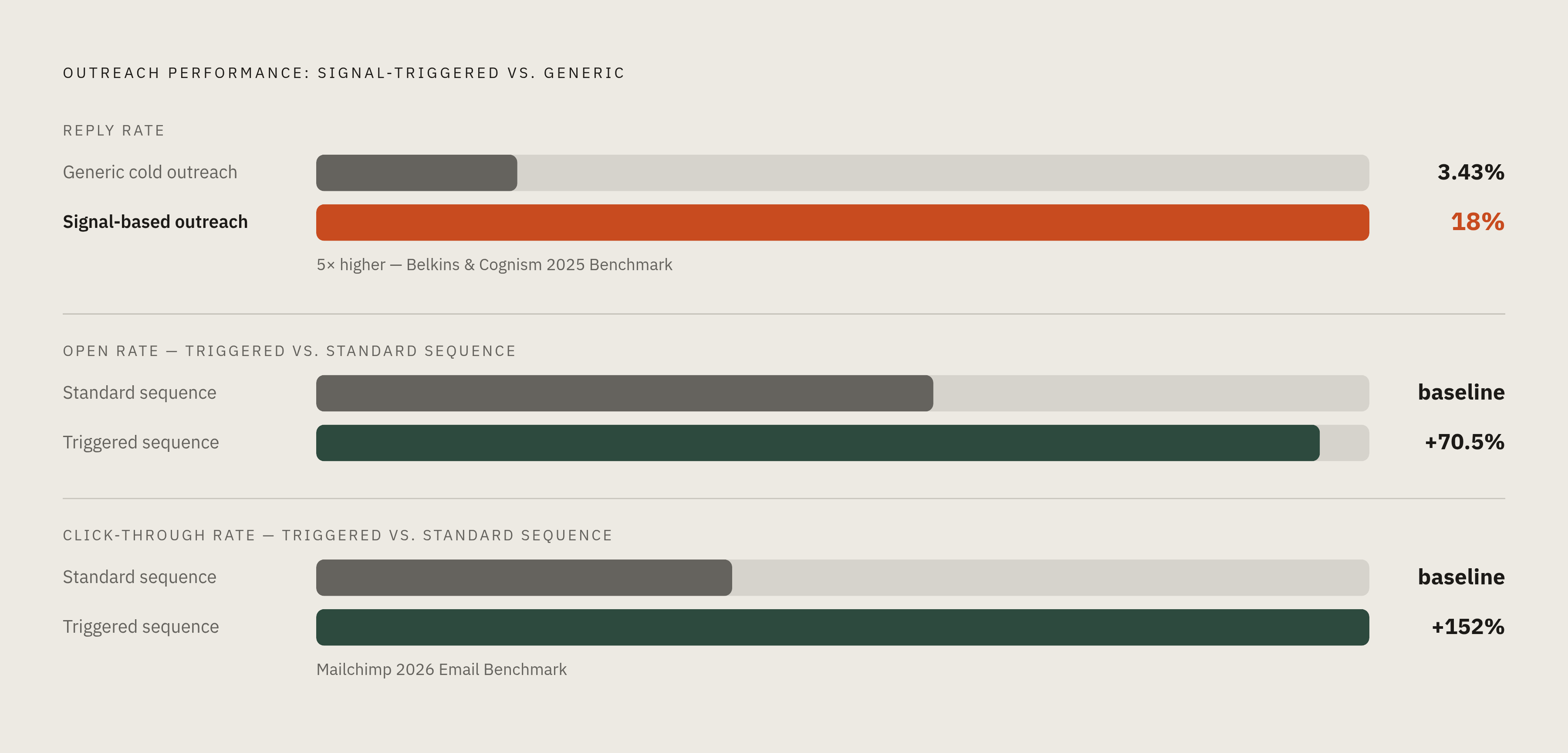
Line up the numbers and the gap is almost embarrassing. Generic cold outreach sits at 3.43% reply rate, and signal-based outreach, tied to a real event with a matched pitch, hits 18%, per Instantly's 2026 Cold Email Benchmark Report. That's five times the baseline, and only about 5% of senders bother to personalize every email they send. The gap sits wide open for anyone willing to do the work most people won't.
Outreach's 2025 Sales Data Report backs this from another angle: triggered sequences get a 70.5% higher open rate and a 152% higher click-through rate than standard sequences. That's a structural edge, not a rounding error.
Speed matters as much as accuracy. Research from Growth List found the first seller to reach a decision-maker after a trigger event is roughly 5 times more likely to win the deal than whoever shows up later, and acting within minutes of a strong signal can push conversion odds up 9x. A great email sent three days after the trigger fired loses to a decent one sent within the hour, more often than teams want to admit.
Research eats the clock, which is why most teams don't move fast even when they know they should. The average rep spends around 45 minutes digging into an account before writing one outreach email, while top performers have cut that under 5 minutes, using AI to pull signals together and draft a first pass, leaving the human to edit and hit send. Speed paired with relevance is what makes fast outreach work at volume.
Competitor intent as the highest-leverage signal in the stack
If you can only prioritize one signal type, make it competitor intent, and don't overthink the choice. An account actively comparing you against a competitor has already answered the "are they in-market" question. The only thing left up for grabs is who wins, which is a much better problem to have than wondering if there's a deal at all.
Buying groups lock in early, which is exactly why this matters. Nearly all buying groups have their requirements defined before the first sales conversation even happens, and most end up buying from whoever they favored early. Competitor intent signals are the shot at getting on that shortlist before it hardens into a done deal.
Several intent platforms surface competitive signals — accounts visiting competitor pages, comparison pages, and alternatives pages — giving teams a real, usable window rather than a vague hunch. Because this activity tends to occur before a deal closes, there's a much bigger pool of accounts to work if you're watching the right feed.
The sharpest version of this combines two data types. Technographic data tells you who currently uses a competitor's product, while intent signals tell you who's actively looking at alternatives right now. Put them together and you get a list worth working: accounts searching "[Competitor] alternatives," reading comparison pages, bingeing category content. Since timing outreach to when accounts are actively evaluating alternatives, with sharp proof points, changes your odds by a lot.
One catch worth stating plainly: the message has to match the specific competitor being evaluated. A generic "switch to us" pitch misses even when the timing is perfect. Several platforms surface this kind of signal at scale, and the right fit usually comes down to what CRM you're already running and how deep the buying-group data needs to go.
The signal-to-send workflow: how teams operationalize this without drowning in tooling
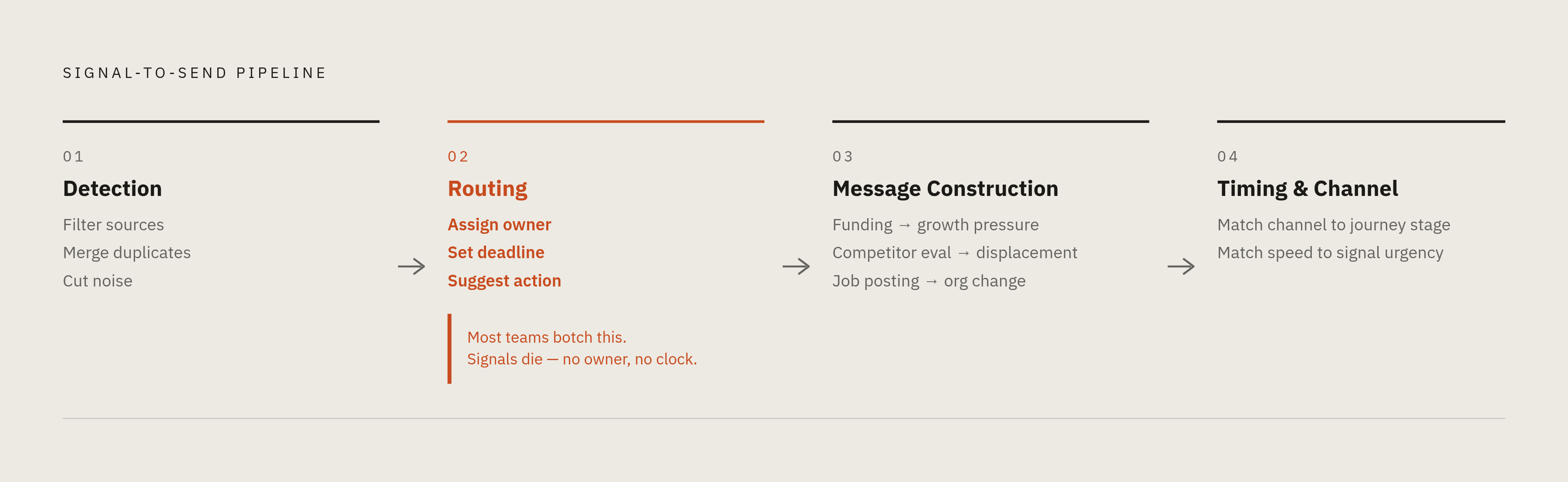
Every working signal-to-send process covers four stages, in order, and skipping one breaks the rest.
Detection comes first: which sources feed in, how duplicates get merged, how noise gets filtered. Routing follows, and it's the stage most teams botch, since a signal with no owner, no deadline, no suggested action just dies quietly in someone's dashboard. Every signal needs to trigger a specific action, with a clock attached to it.
Message construction is stage three, and this is where signal type has to dictate message angle rather than the other way around. A funding signal points toward a growth-pressure pitch, a competitor-evaluation signal points toward displacement, and a job-posting signal points toward an org-change angle. Different signal, different frame, every time, no exceptions.
Last comes timing and channel. Where the buyer sits in their journey decides whether the first touch is an email, a LinkedIn message, a phone call, or direct mail, and how fast that first touch needs to go out.
The piece that makes all four stages workable without hiring twenty more reps is AI-assisted research. Cutting prep time from 45 minutes to under 5 makes the whole approach affordable per rep rather than a novelty reserved for top accounts. Scale, here, means running more precise plays across more accounts at once without the message quality dropping as volume climbs.
Watch for the failure mode that swallows most programs: routing every signal into the same generic sequence regardless of what kind of signal it is. That's the exact trap the 44% of teams fall into who, per Sopro's research, do little more than forward signals to sales with no framing. Intent-prioritized accounts convert at more than double the rate of non-prioritized ones (21.3% versus 8.4%, per a 2024 B2B buying study), and median sales cycles shrink by 28 days when signals actually drive how outreach gets built. The workflow is what turns a signal from a data point into a number that moves.
Where most signal programs break down and how to diagnose the failure
Start with the number that should make every VP of Marketing squirm a little: 87% of organizations, per the DemandScience study, say their intent signals are unreliable or inflated, and only 26% of signals convert to a qualified conversation. Most of the industry's signal spend produces almost nothing, which points to a discipline gap more than a tooling gap.
Three failure modes show up again and again. Signal inflation is the first: behavioral data that looks like buying intent on a dashboard but is really just research, curiosity, or a competitor doing recon. The diagnostic question is simple: do these signals correlate with actual pipeline movement, or just with top-of-funnel noise that feels productive to track?
Second, no deadline attached to the signal. A rep sees "Account X is surging on relevant topics" and has no idea what to do with that, so nothing happens, and the signal quietly expires, unread and unacted on.
Third, treating every signal like it carries equal weight. A single page visit is not the same as a comparison-page search, and without scoring and triage logic, teams pour effort into weak signals while the strong ones sit untouched.
Adoption of third-party intent data climbed fast (industry benchmark surveys put usage at 71% of B2B marketers in 2024, up from 55% in 2022), yet, per Sopro's numbers, only 43% of teams change their messaging based on what a signal actually says. High adoption, low follow-through, and those two numbers shouldn't sit that far apart. The right audit question isn't how many signals came in this month; it's what share of the signals acted on turned into a real conversation.
The dark-funnel problem compounds all of this. As more research shifts into AI chat tools that leave no trackable trail, any team relying on a single signal source will systematically undercount accounts that are further along than they appear.
What personalization at scale looks like when the signal infrastructure is working
When this works, buyers don't say "they knew my name." They say something closer to "they seemed to know exactly what we were dealing with." Personalization at scale is outreach that shows up at the right moment, references something real, and speaks to a pressure the buyer actually feels right now, distinct from the pressure a sales deck assumes they feel.
The revenue case backs this up. The 2025 BCG Personalization Index, covering 200 brands, found personalization leaders grow revenue 10% faster each year than laggards, and every dollar a leader invested in personalization returned $3 over five years, versus 50 cents for laggards. Separate 2025 B2B marketing benchmark data found a 23% lift in pipeline velocity when signals trigger coordinated, multi-channel outreach instead of one lonely email sitting in an inbox.
The window for all of this is shrinking, not growing. Average buying cycles compressed from 11.3 months in 2024 to 10.1 months in 2025, and buyers show up earlier in their research and decide faster once they arrive. The gap where signal-triggered outreach can actually change an outcome keeps getting narrower, which means the teams still moving slow aren't just behind, they're running out of window entirely.
That has a direct implication for how marketing and sales split the work, and most orgs still get this split wrong. Finding and prioritizing signals is a marketing infrastructure job, while turning those signals into the right message at the right time is a sales enablement job. Neither half works without the other, and the strongest revenue teams treat signal ownership as shared: marketing surfaces and ranks the signals, sales acts on them fast and reports back what converted, and that feedback loop is what makes the whole system sharper over time. Platforms built at that intersection, like Letterdrop, which connects content and sales enablement into a single revenue motion, are designed precisely for this handoff. The teams still running this as separate departments with separate spreadsheets are the ones losing deals to whoever called first.