Measuring Outbound Pipeline Attributed to Intent Signals
Tagging intent signals properly connects them to revenue, not just prospect lists.

Intent data spending hit $4.5 billion in 2026, growing at nearly 16% a year, according to Mordor Intelligence. Third-party intent adoption climbed from 55% of B2B marketers in 2022 to 71% in 2024. Only 24% of teams report exceptional ROI from any of it, per Demand Gen Report's 2025 benchmark. Here's what most teams get backwards: they treat that gap as a data quality problem. Nobody built the chain that connects a signal to a rep's outreach to a closed deal, and without that chain, an intent platform is just an expensive way to generate a prospecting list.
What intent signals actually are and why signal type determines what you can measure
Intent signals come in three types, and each one comes with a hard ceiling on what you can prove with it.
First-party signals are the ones already sitting in your own systems: CRM activity, website visits, email opens, form fills. Easiest to tie to a named account, because the data never left your building.
Second-party signals come from review sites. A vendor watches buyer behavior across thousands of researchers and hands you named-account data, scored daily by buying stage. Third-party signals are the least direct of the three: topic surge scoring, built from content consumption across a network of publishers you don't control. That tells you a company is interested in a topic. It doesn't tell you who at the company, or how seriously, so you need to stack it with other signals before a rep should act on it.
Only 58% of B2B tech companies actually capture and use first-party intent from their own website, content, and product usage, according to a 2024 State of B2B Marketing Operations report. That's the tier with the best fidelity, and most companies are leaving it half-built. Building an expensive third-party feed on top of that gap is like installing a security camera in the driveway while leaving the front door unlocked.
Tag every signal the moment it lands: source type, date detected, account ID. Skip that step and the chain snaps before it starts, which brings up the harder problem underneath all of this.
How much of the buying journey happens before your team sees any signal at all
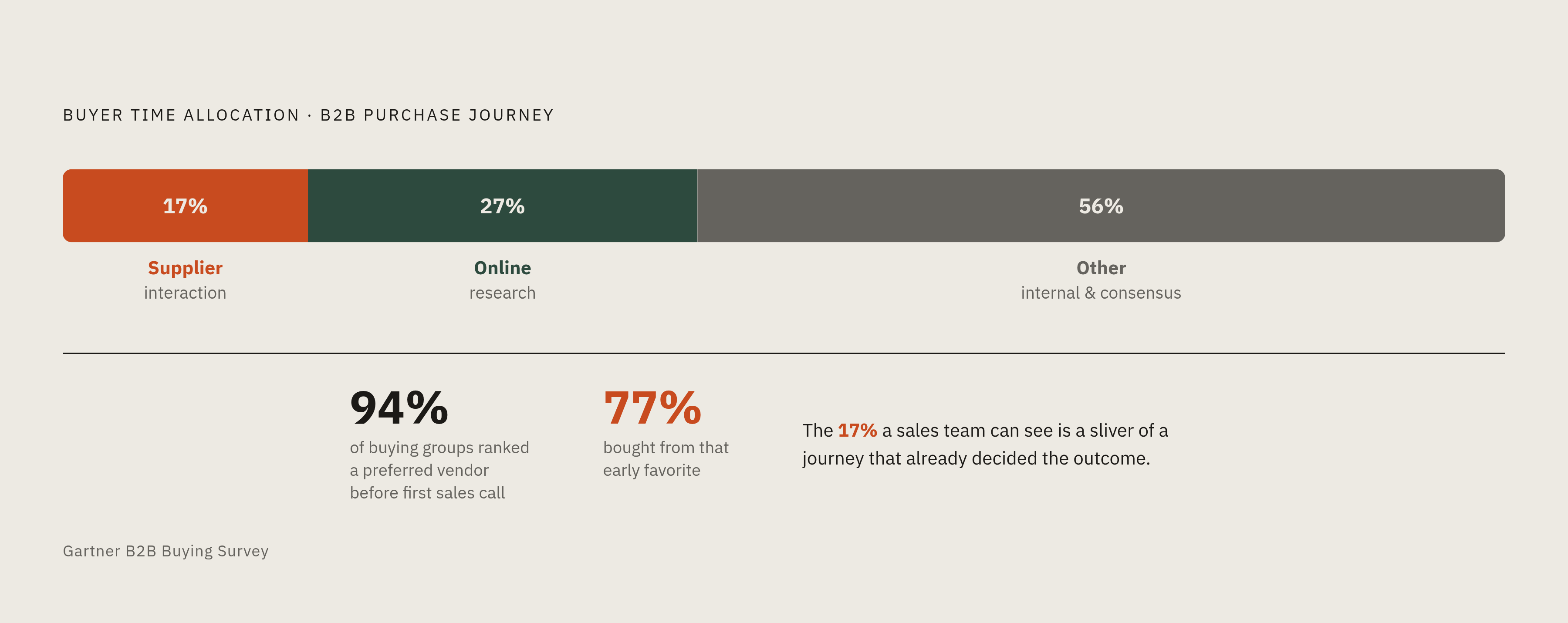
Most of it. Buying groups pick a favorite vendor before they ever talk to a sales rep, and a 2025 buyer experience report found 94% of buying groups had already ranked their preferred vendor before that first conversation. They bought from that early favorite 77% of the time.
Gartner's research backs this from a different angle: B2B buyers spend just 17% of their journey actually interacting with suppliers, and another 27% researching independently online. A typical buying group works through 13 pieces of content along the way, almost all of it anonymous.
So if detection starts the moment someone fills out a form, that's catching one of the last touches, long after the earliest and most decisive research happened with nobody watching. Any model built on form fills as the primary signal source will show heavy late-touch influence and next to nothing early. The camera was pointed the wrong way the whole time, missing the research that happened earliest and mattered most.
The CRM infrastructure that makes signal-to-deal attribution possible
Three tags, attached before the outreach ever reaches the prospect, or the whole exercise is just guessing with extra steps.
Signal source names the exact trigger: pricing page visit, competitor research, topic surge, review-site category view. Signal date gets timestamped to when the signal was detected, not when the rep finally got around to acting on it. That gap between detection and action is worth measuring on its own. Account ID linkage attaches the signal to the account record, not a single contact, because without it there's no way to measure pipeline attribution at the level a sales leader actually cares about.
Every opportunity that spawns from a signal-triggered sequence carries those three tags through the whole deal lifecycle, first email to closed-won or closed-lost. Skip the tagging discipline and correlation is the best you get, along with a shrug when someone asks which signal type actually drives revenue.
Start with five to seven signal types tied closely to the buying cycle: pricing page visits, demo requests, relevant job postings, executive changes, competitor research, funding events, earnings call language. That's plenty. Tracking everything on day one just buries the useful signals under noise.
And give it time. The median stretch from signing an intent platform contract to seeing the first qualified pipeline contribution is 94 days, according to a 2024 ABM operations audit from The Starr Conspiracy. Build the infrastructure, then wait three months before drawing conclusions from it.
The metrics that actually measure signal-triggered outbound performance
Open rates and click rates measure whether the email sent. They say nothing about whether the signal worked. Drop them as headline metrics; they're vanity numbers wearing a performance-metric costume.
What actually connects a signal to a dollar figure:
- Reply rate by signal type, the first real evidence of engagement over inbox delivery
- Meeting booked rate by signal type, the first outcome that's actually revenue-proximate
- Opportunity creation rate, the share of signal-triggered meetings that turn into qualified pipeline
- Pipeline value attributed to signal-triggered plays, tracked in dollars by signal source
- Time from signal detection to rep action, which shows where response speed is bleeding opportunity
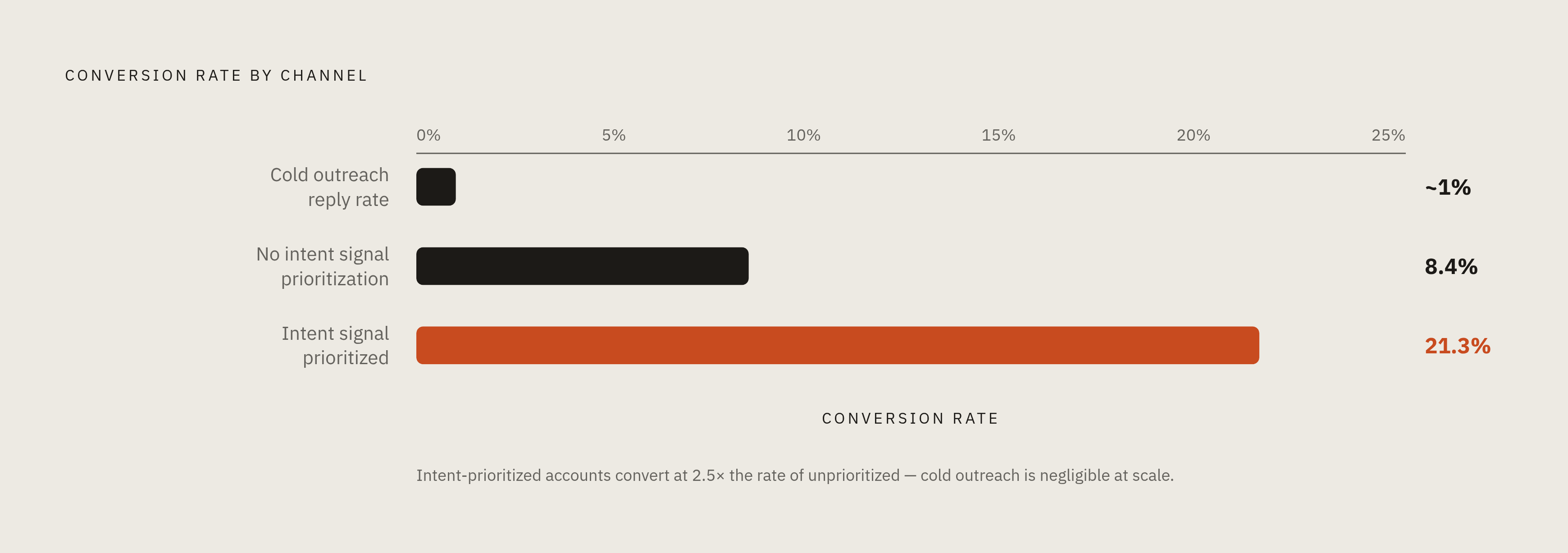
The gap between prioritized and unprioritized accounts is not subtle. Accounts prioritized by intent signals converted to closed opportunity at 21.3%, against 8.4% for accounts that weren't, per a 2024 B2B buying study covering January through September. Orchestrating multiple channels off a single signal, instead of firing one email and hoping, produced a 23% lift in pipeline velocity in a 2025 B2B marketing benchmark.
Now weigh that against the baseline. Woodpecker's 2025 State of Cold Email analysis puts average B2B cold outreach reply rates between 0.5% and 2%, with broad sequences to purchased lists landing under 1%. Intent-triggered outreach should clear that bar by a wide margin. The size of that gap is exactly the number worth bringing into a budget conversation.
How competitor intent signals fit the attribution model and why they deserve their own tracking tag
Competitor signals are the sharpest trigger in the whole model, full stop. An account reading competitor comparison guides, sitting in on a competitor's webinar, or checking review sites for alternatives is already mid-decision, and the window to get in front of it is short.
Recall that 77% figure: buyers pick a favorite before talking to a rep, and usually stick with it. Catching a competitor-research pattern before that preference locks in is the single highest-value moment in the entire signal stack, and treating it the same as a generic "competitor intent" tag wastes the opportunity.
Speed decides most of the outcome here. Published speed-to-lead research suggests acting within minutes of a strong buying signal can make a lead up to nine times more likely to convert. Wait 72 hours and the advantage is gone, handed to whoever responded first.
Tag competitor signals with the actual competitor's name, not a generic label. Naming names lets a team see which competitive matchups it wins from fast signal interception and which it loses, and tells the content team exactly which comparison pages need building or sharpening.
Comparison landing pages, alternative-positioning email sequences, and battlecards shared mid-deal all need to show up as tagged touches in the deal record, something visible in the system rather than a detail the rep half-remembers doing three weeks later. That's the only way the content assist survives past the deal close.
One more use for this same setup: a customer whose competitor-comparison research spikes while product login frequency drops is showing a pre-churn pattern. Tag it separately, but run it through the same system.
Building the signal scoring layer that tells reps which accounts to work first
A single signal, alone, usually means nothing. One homepage visit is noise, not intent. A pricing page visit stacked on a review-site category view stacked on competitor comparison content is a pattern, and patterns are what should pull a rep's attention, not individual blips.
Build scoring rules around combinations, not isolated events, and weight each signal type against historical conversion data rather than gut feel. First-party signals from your own site should outweigh third-party topic surge on its own, because the fidelity is higher and there's less guesswork baked in.
Set score thresholds that map directly to action: high score triggers immediate, personalized outreach; mid score drops into a nurture sequence; low score just gets watched. This matters more than it sounds like it should, because attribution only holds up if reps actually follow the model. Let a rep cherry-pick accounts outside the scoring system, and the signal-source tag on that deal becomes fiction; you can't credit a signal for driving outreach the signal never actually drove.
Budget shapes how elaborate this needs to get. G2's 2024 Buyer Behavior Report put median enterprise intent data spend at $312,000 a year, against $84,000 for mid-market. A simple three-tier scoring model is a perfectly reasonable place to start before spending real money on anything fancier.
What good attribution results look like after six months of clean data
Six months is the floor for drawing real conclusions from tagged pipeline data. Given that 94-day median ramp mentioned earlier, the first couple of months in any dataset are incomplete cohorts. Don't read too much into them; they simply aren't finished yet.
After six months, the output should look like this: a ranked table of signal types by pipeline contribution, conversion rate, and average deal size. A separate view showing which combinations of signals, not single signals, drive the best signal-to-close rate. Rep-level data on who acts fastest and whether that speed actually correlates with winning. And a record of which content showed up in the timeline of signal-triggered deals, which is where content attribution finally meets pipeline attribution.
A few published numbers help set expectations. Bynder used AI-powered intent data to identify in-market accounts and saw a 2.5 times increase in outbound pipeline, with ROI showing up within four months. Anrok generated more than $300,000 in pipeline within three months from signal-triggered outbound. Perplexity booked $1.7 million in pipeline and more than 80 enterprise meetings in three months, without a dedicated BDR team running the plays.
Treat vendor claims of 10x improvements over cold outbound with real skepticism. Those numbers come from a company's best campaign, in a category with strong intent coverage, measured over a short window that flatters the result. Read published case studies as the ceiling, not the expected outcome for an ordinary program.
The attribution model isn't a report that sits in a folder collecting dust. It's the input for next quarter's decisions: which signals to prioritize, which content to build more of.
How the attribution model connects sales outbound and marketing content investment
Content shows up in two places inside this record. It's a signal trigger when a prospect reads a comparison page before a rep ever picks up the phone. It's a sales assist when a rep sends a case study or battlecard partway through a sequence. Both need tagging, because that's the only way a content team proves its work touched pipeline instead of just traffic.
Most teams still can't see this. Most teams still default to last-touch attribution, even though buyers touch dozens of points across a long sales cycle. Last-touch erases almost all of content's contribution to a signal-triggered deal. So it's no surprise that measuring content ROI remains one of the most widely cited headaches in B2B marketing. The model built in this piece solves that as a side effect, because it produces a deal-level timeline where every content touch is visible and dated.
The payoff is practical, not theoretical. When the data shows accounts consuming a particular comparison page convert to pipeline at a noticeably higher rate, that's a clear signal: build more of that content, and push it earlier into the sequence for similar accounts.
Pipeline attribution has become a standard expectation in quarterly marketing reviews. This model answers that question before anyone has to ask it twice.
The end state is one system. It tells sales which accounts to call today, tells marketing which content earns its keep, and tells leadership which dollar of spend turned into closed revenue. Intent signals are the wiring underneath all three answers.