LinkedIn Prospecting Using Intent and Engagement Signals
Read behavioral signals to prioritize prospects actually evaluating solutions.

LinkedIn works better than most sales channels for one reason: people show up to do their job, not to kill time scrolling. That single fact changes everything about how prospecting should work on the platform, and most reps still haven't caught up. This piece breaks down how to read behavioral signals (profile views, comments, job changes, competitor research) and actually act on them, instead of blasting the same connection request to everyone with a pulse and a job title.
Start with scale, because the numbers explain the opportunity. LinkedIn has about 1.3 billion registered members and roughly 310 million who show up monthly. But the number that actually matters is this: close to 80% of B2B leads generated through social media come from LinkedIn specifically. That means the signal-to-noise ratio is already tilted in a rep's favor before any filtering happens.
Here's the part that cuts both ways, though. LinkedIn is transparent. A prospect can see a rep's profile, mutual connections, and posting history before deciding whether to respond to anything. That transparency punishes low-effort outreach hard, and it rewards reps who've actually put a point of view out into the world. The channel doesn't reward volume. It rewards people who look like they know what they're talking about, because on LinkedIn, everyone can check.
What intent signals actually are — and what separates signal from noise
An intent signal is something a person or company does that suggests they're moving through a buying decision. Not a job title. Not a company size that happens to match your ideal customer profile. An actual action.
These signals stack into three tiers. First-party signals are things like website visits, content downloads, and form fills. They're high-confidence but low-volume; not many people fill out a form on a given Tuesday. Third-party signals cover stuff like review site activity and topic research tracked off-platform. They come in bigger numbers but tell you less about any one account. Then there are contextual signals: job postings, leadership changes, language on an earnings call. These get ignored constantly, and they're some of the best predictors of budget actually moving.
Here's where most reps mess it up: one engagement means nothing. A single like on a post is noise. A pattern of engagement, across several related pieces of content, in a tight window of time, that's signal. Treat a like on an educational blog post like it's evaluation-stage intent, and a rep ends up reaching out too early, which tends to poison the account before it's even open.
Job postings deserve a specific warning here. A company posting a job to replace someone who left looks identical, on LinkedIn, to a company posting a job because they're expanding a team. Same signal, completely different meaning. Only the second one tells you there's new budget in motion; the first one just tells you someone quit.
The progression worth tracking looks like this: search intent, then content engagement, then competitive research, then a demo request. Each stage calls for a different move from the rep, not the same email with a different first line. And it's worth being straight about what LinkedIn signals are good for: they're precise but they're not plentiful. Think of them as a prioritization tool, not a lead-gen machine that fills a pipeline by itself.
The LinkedIn signal taxonomy reps can act on
Profile views are the entry-level signal, and context decides whether they mean anything. A prospect who views a rep's profile after seeing their content, or after a mutual connection mentions them, is showing real curiosity. It's low commitment, but it's genuine. A prospect who views a rep's profile right after that rep engaged with their post is a different animal: they checked the rep out in response. That's a confirmation signal, and it's worth more.
One more filter matters here. A profile view from someone in a relevant role at a target account is worth far more than a view from a recruiter, a peer, or someone just scrolling.
Content engagement gets misread constantly. A reaction alone (a like, a thumbs-up) is weak. What matters is where the engagement happens. A comment on a bottom-of-funnel post, something like an ROI comparison or a "how to choose a vendor" breakdown, tells you someone's actually evaluating. Comments that raise a question or push back on something signal more intent than a comment that just says "great post." And if the same person keeps commenting on similar topics over time, that's often a sign of internal research happening somewhere behind the scenes, maybe even active internal debate.
Timing matters too. Comments posted in the last week deserve priority. Reply rates fall off fast once that window closes, because buying cycles move quickly and attention moves on.
Connection behavior tells its own story. A prospect connecting with several people at a rep's company, across sales, product, and customer success, often points to active evaluation underway. Even more telling: a prospect connecting with people at multiple competing vendors at the same time. That's someone running a comparison, whether or not they've told any of those vendors yet.
Job changes create a real window, too. New executives tend to audit their existing vendor stack in their first 90 days on the job, which opens a genuine re-evaluation period. The signal that matters is specific: a buyer in a relevant function moving into a company that fits the rep's target profile, not just any title change showing up in a feed.
LinkedIn's Sales Navigator has its own built-in intent layer, and it's worth understanding what it actually measures. Buyer Intent data rolls up more than 180 distinct signals into a single account-level score. That includes activity on LinkedIn itself (profile views, page follows, reactions), engagement with ads (InMail replies, lead gen form completions), and off-platform activity picked up through LinkedIn's Insight Tag. There's a category interest filter, too, that surfaces buyers researching a solution space who haven't settled on a vendor yet, which is a genuinely useful early-intercept tool.
One catch worth flagging: a rep's own outreach can inflate that Buyer Intent Score. If a rep sends five InMails to an account, the account's score goes up partly because of the rep's own activity, not because the buyer suddenly got more interested. Reading the score accurately takes some discipline. Also worth knowing: this feature sits behind the Advanced and Advanced Plus tiers of Sales Navigator. Lower-tier plans don't get Buyer Intent or Current Account Lists at all.
How competitive signals reveal buyers already deep in evaluation
Competitive intent is a different animal from general interest in a category. General interest means someone's exploring whether they have a problem worth solving. Competitive intent means they've already decided they do, and now they're deciding which vendor solves it.
A handful of behaviors give this away. Downloading a competitor's guide, showing up to a competitor's webinar, engaging with a competitor's LinkedIn posts, these all say the same thing. So does connecting with multiple people at rival companies, especially people in sales or product roles. Engaging with "vendor A versus vendor B" content, on any platform, is another tell. And visiting comparison pages on sites like G2 or TrustRadius is about as unambiguous as intent signals get; that's not early research, that's active buying.
There's a catch, though, and it's a real one. A big chunk of competitive research happens somewhere no vendor can see it. Buyers ask ChatGPT or Perplexity to compare tools. They post in private Slack communities. They DM a peer on LinkedIn and ask what they use. None of that shows up in a CRM. Call it the dark funnel, because that's basically what it is: real research, invisible to the people who'd benefit from seeing it.
Community activity is an emerging piece of this puzzle. When someone asks a category question in a relevant Slack group or LinkedIn Group, they've basically raised their hand and said "I'm in-market," without ever visiting a vendor's site. Tools like Common Room exist specifically to pull these cross-community signals together into something a rep can act on.
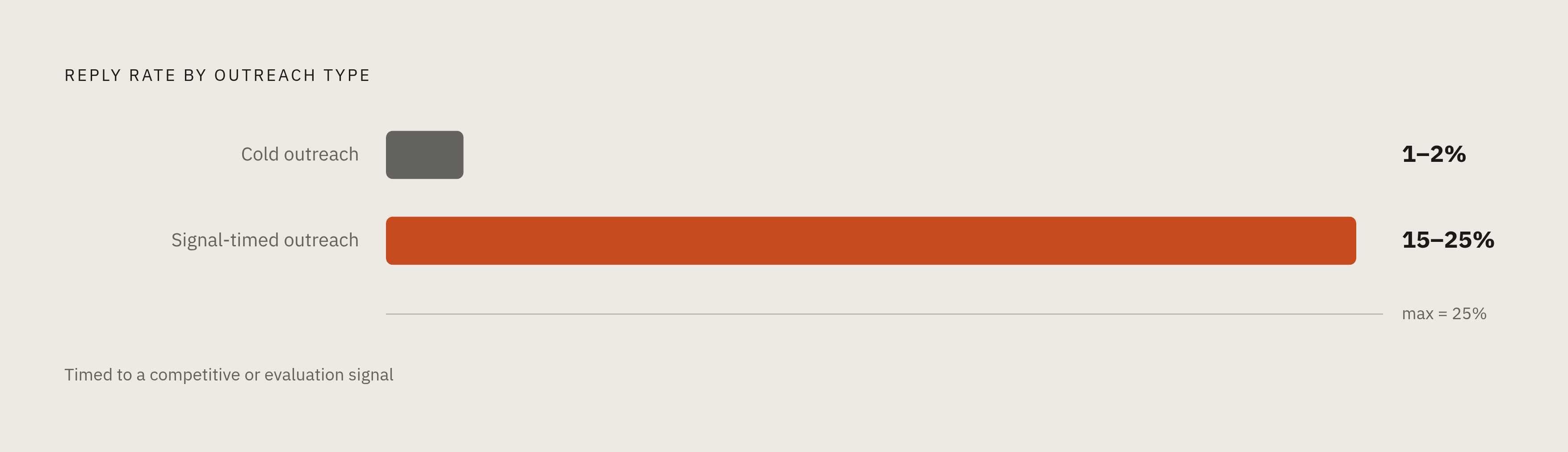
This moment, the competitive evaluation stage, is the highest-leverage point to show up. The buyer has already started the journey, but no vendor has locked in the relationship yet. Whoever shows up here with something useful, not a generic pitch, tends to win a disproportionate share of these deals. Companies that build intent data into their sales process see conversion rates rise by 37% and acquisition costs drop by 25%, according to reporting on B2B intent programs. That's not a marginal bump; that's a structural advantage. Outreach timed to a competitive or evaluation signal lands response rates between 15% and 25%, compared to the 1% to 2% that generic cold sequences typically pull.
How fast to move when a strong signal fires
Speed matters more than most sales orgs admit. When a strong cross-platform signal fires, the window to act is measured in hours, not days.
Here's the number that should scare complacent teams straight: prospects reached within one hour of a cross-platform signal, say, visiting a company's website right after viewing a rep's LinkedIn profile, are 7 times more likely to have a meaningful conversation than prospects reached even a day later. That's not a small edge. That's the difference between landing the meeting and never hearing back.
Competitive signals raise the stakes even further. If someone's viewing G2 comparison pages or sitting in on a competitor's webinar, that evaluation window closes fast, especially once a rival vendor gets a foot in the door first.
What actually slows teams down usually isn't complicated. Signal data sits inside a tool nobody checks except once a week. There's no agreed threshold for what counts as a signal worth acting on. And when an account throws off multiple signals, nobody's clear on whether the SDR or the AE owns the follow-up. All three of these are fixable with process, not more tooling.
A workable fix: build a tiered system. Tier 1 might be competitive comparison activity plus a profile view in the same week, worth a same-day response. Tier 2 might be a bottom-of-funnel comment with no profile view, worth a response within a day or two. Tier 3, a single reaction or lone profile view, can wait. Attach a response time to each tier and everyone knows what to do without a meeting about it. And remember the decay problem: a comment from ten days ago carries a lot less weight than one from yesterday. Fresh signals should always bump stale ones to the back of the line.
What to say when you reach out — matching the message to the signal
The message needs to show a rep noticed something specific, without sounding like they've been keeping a file. There's a real difference between "I saw you were researching this" and "I noticed you viewed my profile," and prospects can tell which one is which instantly.
Match the message to the signal itself. A profile view from someone at a target account calls for a light opener, something built around shared context: a mutual connection, a piece of content they posted, recent news at their company. Not a callout of the view itself; nobody wants to hear that. A comment on a bottom-of-funnel post deserves a reply to the actual substance of what they said, publicly, followed by a direct message that builds on that exchange rather than starting cold. Competitor webinar attendance or comparison-page activity calls for leading with something useful, a differentiation point or a comparison resource, not a pitch. They're already evaluating; give them something that helps the evaluation instead of interrupting it. A job change into a target account is worth acknowledging directly, paired with something relevant to their first 90 days, not a demo request three sentences in.
Generic outreach that ignores the signal entirely is worse than no outreach at all. It burns the window and tells the prospect the rep either didn't notice or didn't care enough to say anything about it.
There's a quieter benefit at play here too. A prospect who's already seen a rep's posts shows up to that first conversation already knowing where the rep stands on things. That shrinks the credibility gap every cold message has to climb over. Social selling leaders create 45% more opportunities and are 51% more likely to hit quota, according to LinkedIn Sales Solutions, and 78% of social sellers outsell peers who don't use social media in their sales process.
One warning worth repeating: don't turn signal-awareness into a performance. Referencing someone's LinkedIn activity in a way that sounds like surveillance kills trust faster than a boring, generic opener ever could. Signal awareness should shape tone and timing quietly. It shouldn't become the actual content of the message.
Why seller credibility on LinkedIn determines whether outreach even gets opened
LinkedIn works differently than email in one important way: before anyone replies to anything, they check the sender out. Profile, post history, mutual connections, company page, all of it gets a once-over before a single word gets typed back. The profile does half the selling before the rep says anything.
That transparency helps reps who've built a visible point of view and hurts everyone else. There's no hiding behind a subject line here.
There's a bigger structural problem sitting underneath all of this, too: the hidden buyer. According to the 2025 Edelman-LinkedIn B2B Thought Leadership Impact Report, which surveyed nearly 2,000 professionals globally, more than 40% of B2B deals stall because of internal disagreement among the people involved in the buying decision, finance, legal, compliance, procurement, who are all researching independently before any of them talk to a vendor directly.
That same report found 63% of these hidden buyers spend more than an hour a week reading thought leadership content, and 95% of professionals surveyed said that content directly shapes their purchasing decisions. Which means a rep's posts are reaching people the rep has never once messaged. Ninety-one percent of these hidden decision-makers said good thought leadership helped them spot problems or needs they hadn't even recognized yet. Content that names the problem before pitching the fix builds a kind of trust that makes a cold message feel a lot less cold once it arrives.
The takeaway for reps is straightforward: posting consistently about real problems, not product features, does the trust-building work before any outreach message ever gets sent. It compresses a phase of the sales cycle that used to take multiple calls into something that's already halfway done by the time the rep says hello.
Building the content presence that makes signal-based outreach land
LinkedIn's algorithm in 2026 favors personal profiles over company pages by design. It penalizes posts with outbound links, and it rewards posts that hold attention and get engagement early after posting. All of that favors a rep sharing a real opinion over a company account sharing a press release.
A useful content mix looks something like this: the majority of posts should focus on the problems buyers actually deal with, written from the buyer's seat, not the vendor's. Around 25% should cover frameworks or ways of thinking through those problems, methodology first, product mentioned only if at all. The remaining 15% or so can cover the company and product directly, specific customer outcomes, honest breakdowns of how something works. That last bucket earns its credibility from the first two; it doesn't work on its own.
On format: plain text posts with a real point of view, short videos where someone explains something conversationally, and carousels that break down a complicated topic step by step are the strongest performers in 2026. Video, in particular, keeps climbing according to LinkedIn's own platform data.
Cadence matters more than most people think. Two or three solid posts a week beats a daily post that took five minutes to write. The algorithm rewards depth, and a rep who shows up three times a week with something worth reading builds more credibility over a quarter than one posting something forgettable every single day.
Executive voices carry outsized weight here, too. Posts from CEOs and senior leaders get roughly 7 times the impressions and 4 times the engagement of posts from a company page. Where a rep can get an executive to back up their point of view publicly, that amplification reaches further than anything the rep could post alone. And there's a distribution math problem worth knowing: employees, collectively, have about 10 times more first-degree connections than their company's page has followers. Individual reps reach further than the brand does, every time, at the network level.
The payoff shows up further down the funnel than most reps expect. Seventy-nine percent of hidden buyers said they're more likely to advocate internally for a vendor whose thought leadership they'd found genuinely useful. That means the content isn't just working on the person a rep messages directly; it's working on people in the buying group the rep never talks to at all.
Combining signals into a prioritization system rather than a daily fire drill
Signal-based prospecting without any system attached to it just becomes chaos with better-sounding justifications. Swapping "spray and pray" for "signal chasing" doesn't help if reps are still reacting to whatever popped up in their feed that morning.
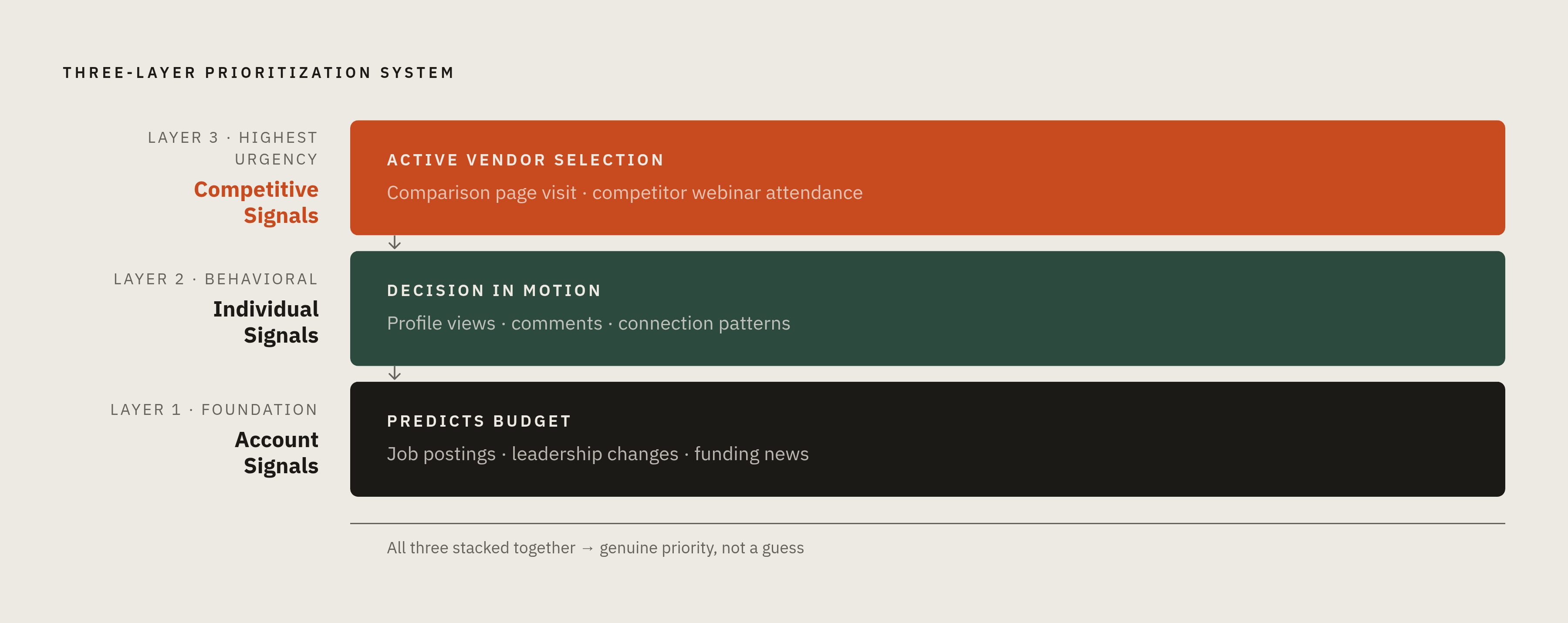
A workable daily review needs to run across three layers, not one. Start with account-level signals: job postings, leadership changes, funding news, the contextual stuff that moves slowly but predicts budget. Layer in individual behavioral signals next: profile views, comments, connection patterns, the things covered above that show a specific person moving through a decision. Then overlay competitive signals last: comparison page visits, competitor webinar attendance, the events that tell you someone's not just interested, they're actively choosing.
None of these layers replace the others. An account showing budget movement with no individual engaged yet isn't ready for outreach; it's ready for research. An individual showing strong personal engagement at a company with no budget signal might be a champion worth nurturing, not closing. Stack all three, and a rep gets a genuine priority list instead of a gut feeling dressed up as strategy. That's the whole point of treating signals as a system: it turns "who should I call today" from a guess into a decision anyone on the team could reproduce.