Cold Email Deliverability and Signal-Based Targeting Interaction
Strong deliverability and smart targeting must work together, or cold email fails at scale.

Cold email is not dead. That claim gets repeated so often it has become background noise, and it's wrong in a useful way: cold email has split into two populations that look nothing alike. One group sends messages that book meetings, consistently, week after week. The other group sends messages that get their domains blacklisted, torching months of outbound in a single bad sprint. Cold email has split into two populations based on whether a team has built two things at once: a technical deliverability foundation and signal-based targeting. Building only one causes the system to fail.
The old model, the one built on pure volume, broke for reasons that have nothing to do with fashion or fatigue. Google and Yahoo tightened sender authentication rules. Spam filters got sharper at spotting the fingerprints of mass outreach. Buyers, meanwhile, built up a kind of allergic reaction to anything that smells like a template. All three shifts happened around the same time, and together they raised the floor for simply reaching an inbox. At the same time, the ceiling rose too: enrichment data, real-time trigger alerts, email verification, and multi-inbox sending tools all got better, and teams using them pulled ahead of everyone still running the old playbook. The rest of this piece works through both halves of that split, and why treating them as separate problems is the mistake that sinks most outbound programs.
The technical floor that every cold email program must clear before anything else
Deliverability used to be a nice-to-have. Now it's the cost of entry. Fail it, and nothing else matters, not the copy, not the targeting, not the clever subject line someone workshopped for twenty minutes. A brilliant email that lands in spam has the same effect as no email.
Start with authentication, because Google has said it outright: messages sent from unauthenticated domains might be marked as spam or rejected. SPF or DKIM is required for every sender, and both SPF and DKIM are required for anyone sending in bulk, with DMARC added on top for bulk senders specifically. Yahoo runs its own version of the same bar: one-click unsubscribe is mandatory, opt-out requests need to be honored within two days, and complaint rates get watched closely for bulk senders. Valid forward and reverse DNS and headers that actually follow the standard spec complete the baseline. Not a competitive edge. The baseline.
Domain architecture matters just as much as the DNS records sitting behind it. Cold outreach should never run through a company's primary domain. If a secondary domain gets blacklisted, that's a contained fire. But when the main domain gets blacklisted, every invoice, every password reset, and every real conversation with a real customer goes down with it. The fix is simple: buy secondary domains that look like close, recognizable cousins of the primary one, so a recipient can glance at the sender address and still connect it to the real company. Use one sending address per domain, spread volume across several domains instead of hammering one, and treat each domain like its own bank account for reputation.
Warmup is where a lot of teams quietly cut corners, treating it as a one-time ramp instead of a standing practice. It should run continuously, with something like 15% of total sending volume dedicated to warmup traffic at all times, not just in the first two weeks of a new domain's life. Automated warmup networks simulate the kind of organic engagement, opens, replies, getting pulled out of spam folders, that inbox providers use to build trust in a sender over time. Volume needs to scale up gradually, adjusted based on actual inbox placement tests rather than some fixed 30-day calendar someone found in a blog post.
List hygiene closes the loop. Every hard bounce tells the receiving server that the sender is reaching addresses that don't exist, which reads as a strong spam signal. Verify every address before it enters a sequence. Drop hard bounces immediately. If addresses keep soft-bouncing, suppress them instead of letting them ride along. Purchased lists are a special kind of trap here, often loaded with spam trap addresses that trigger blacklisting. Build lists from LinkedIn Sales Navigator instead, because the data comes from people who keep their own profiles current, so it stays fresher and more accurate.
Four practices that actively damage deliverability despite appearing in mainstream advice
Some advice that still circulates in outbound playbooks is actively working against the teams following it. Spam filters now specifically target the things that used to pass for best practice, and cutting them out often does more for deliverability than adding new infrastructure ever will.
Open tracking pixels sit at the top of this list, because they're the one everyone still defends. Tracking pixels are one of the common signals spam filters use to flag mass outreach and phishing attempts, even though reputation, authentication, and engagement history carry more weight in that scoring than any single pixel does. Apple's Mail Privacy Protection pre-loads email content through Apple's own proxy servers, registering an "open" for every message delivered to an Apple Mail user whether that person reads it or not, so the data those pixels collect isn't even trustworthy anymore. So teams are taking on real deliverability risk in exchange for an open rate number that was already broken. The fix is to drop open tracking on cold outreach entirely and measure what actually matters: replies and meetings booked.
Links, attachments, and images in a first message create a second blind spot. Email service providers treat links, attachments, and embedded images in cold outreach as security risks, so those messages are more likely to get routed to spam before a human ever sees them. Plain text consistently outperforms HTML-formatted cold email on deliverability. Save the links and the rich formatting for after a prospect has actually replied, once the relationship has shifted from cold to warm.
Sending identical copy at scale is the third trap. If the exact same email goes out to hundreds of inboxes, spam filters learn to recognize the pattern fast, so variation techniques like spintax exist specifically to break that pattern up. This is where generic AI-generated outreach causes a double failure: buyers recognize the tone instantly, and filters flag the structure just as fast, so the same message gets rejected by machine and human simultaneously.
Scaling volume too quickly rounds out the list. Most senders ramp up faster than their domain reputation can support, and volume should instead build gradually, calibrated against placement test results rather than a fixed sending schedule copied from a template. A sudden spike in volume is itself a behavioral signal, and inbox providers weight sudden spikes negatively regardless of how clean the list behind them is.
Signal-based targeting and how to read signals without misusing them
Signal-based outreach doesn't work just because intent data proves someone is ready to buy. It works because intent data proves someone is researching a problem, and framing a message around a specific, recent signal shows relevance in a way that generic personalization simply cannot fake.
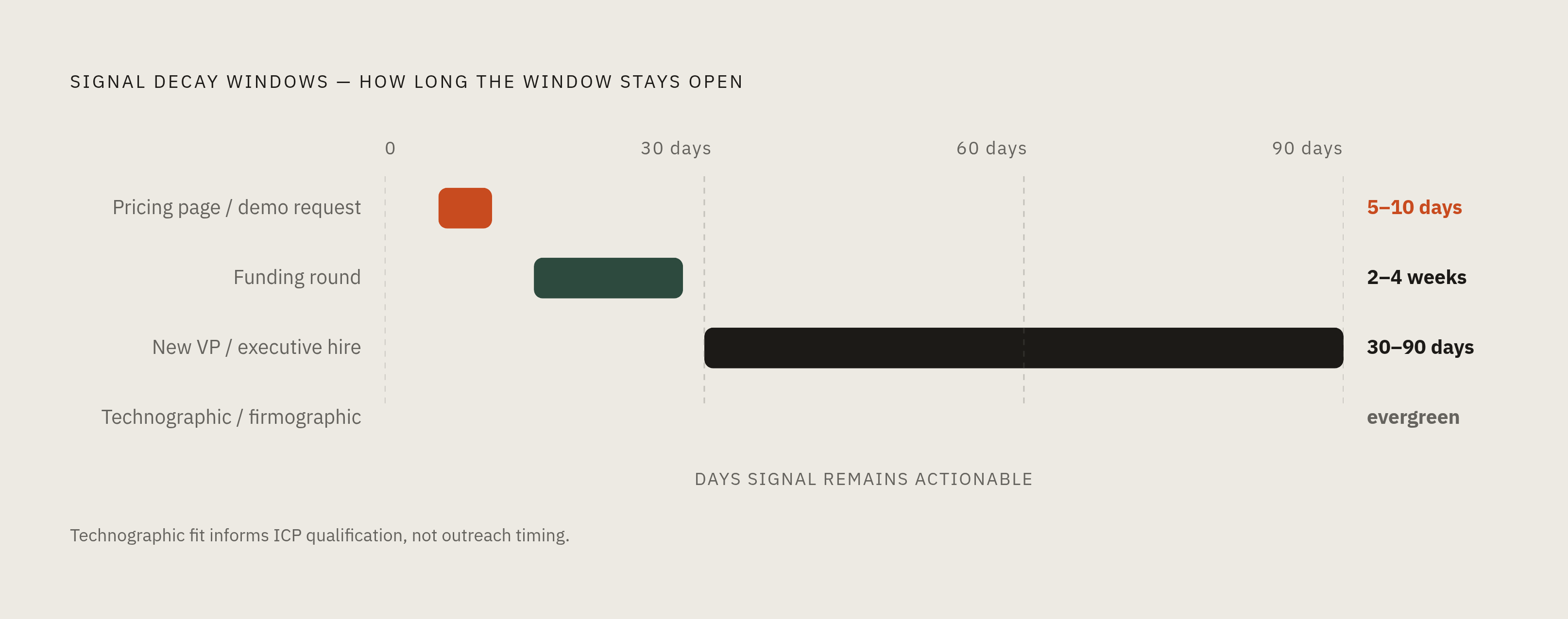
Signals sort into four tiers, and each one runs on a different clock. First-party signals, pricing page visits, demo requests, are the hottest and the most perishable, often requiring a same-day response before the window closes. Organizational signals, funding rounds, executive hires, hiring sprints, carry the highest precision and the widest window to act. A newly hired VP of Revenue Operations signals a mandate to rebuild process from the ground up, and that mandate gives a team weeks, sometimes months, to reach out with something relevant. Third-party intent signals, patterns in content consumption, surges around a particular topic, show research activity rather than declared intent. They're useful for deciding who to prioritize, not proof that someone is ready to sign. Technographic and firmographic signals move slowest of all, useful for confirming someone fits the ideal customer profile but useless for timing a message.
Signal decay is the variable most teams ignore completely. Decay windows vary sharply depending on the signal: pricing page visits go stale within 5 to 10 days, funding rounds within 2 to 4 weeks, and a new VP hire within 30 to 90 days. Acting on a signal after its window has closed produces outreach that feels out of step with where the prospect actually is, and that mismatch drags down reply rates and can trigger spam complaints. Signals have to be captured and acted on inside their own window, and that takes workflow discipline as much as it takes access to good data.
The payoff for getting this right comes down to specificity. Referencing the exact trigger, something like "I noticed you recently hired a VP of Revenue Operations," proves the message wasn't pulled from a batch. It demonstrates relevance and timing in the same sentence. Surface-level personalization, dropping in a name, a company, a line from someone's LinkedIn headline, has become a pattern buyers spot and dismiss on sight. Signal-based selling instead uses real trigger events, funding announcements, leadership changes, hiring surges, mentions on an earnings call, to prove both things at once.
Intent data doesn't confirm someone wants to buy. It confirms someone is researching. An account showing a surge of activity around "email deliverability" is working through a problem, not raising its hand for a product pitch. Lead with expertise in the problem the signal reveals rather than a pitch aimed at it. Signals tell a team who to prioritize and what to say. They don't mean the deal is already won.
How deliverability and signal-based targeting interact
Deliverability and signal-based targeting aren't two separate systems to optimize in parallel. How a team uses signals changes its deliverability outcomes directly, and how deliverability gets managed either multiplies the value of good signals or wastes them completely.
Start with volume. Signal-based targeting naturally produces lower-volume, higher-relevance outreach, and that lower volume happens to be one of the strongest deliverability levers you have. Volume-first prospecting generates the sending patterns, engagement deficits, and complaint rates that wreck sender reputation. If you filter down to accounts where a message is actually timely, the list shrinks automatically, and the same discipline that improves reply rates also improves deliverability health. A smaller, tighter list beats a high-volume blast on both counts, every time.
Engagement feeds straight back into deliverability scoring, fusing the two layers into one system. Inbox providers weight opens, replies, and removals from spam when they calculate sender reputation, and a list built from signal-selected prospects generates stronger engagement than a broad blast ever could. That sets off a flywheel: signal-based targeting drives higher reply rates, higher reply rates strengthen engagement signals, stronger engagement improves inbox placement, better placement means more messages actually arrive, and more arrivals create more chances to reply. Each turn of that wheel feeds the next one.
Generic outreach runs the same wheel in reverse. Low relevance produces low engagement. Low engagement degrades sender reputation. Degraded reputation lands messages in spam. Once a message is sitting in spam, copy quality stops mattering, because nobody reading it had a chance to open it.
CandorIQ's own remediation work shows what pairing both disciplines looks like in practice. The approach provisioned and warmed mailboxes automatically, validated every email address before it went out, and distributed sending volume across multiple domains instead of piling it onto one. Technical hygiene and controlled sending worked together, so domain reputation stayed protected even as volume scaled.
Signals decide who gets called first, not whether anyone gets called at all, and a rep reaching out to an account that has spent two weeks consuming competitor comparison content isn't cold-calling. That account is timely, and the message earns a different kind of reception because it arrives at the moment the buyer is already paying attention. Intent signals set priority inside a sequence; the discipline is concentrating outreach where it's most likely to land, not eliminating the outreach itself.
Competitor intent signals as the highest-value moment in cold outreach
A prospect actively comparing vendors, or approaching the end of a contract with a competitor, represents the single highest-leverage moment available in cold outreach. It's also the moment where signal timing and clean deliverability both matter most, because the window is narrow and the cost of missing it is high.
The buyer in this window is already moving. They have a problem they're actively trying to solve and a list of options they're weighing against each other. Relevance stops being the obstacle. Timing becomes the only thing that matters. A rep who sends a generic message during this window burns an opportunity that was already sitting open. A rep who acknowledges the evaluation directly, who frames the conversation around the buyer's actual situation, earns a meeting that would have otherwise gone to whoever else was paying closer attention.
Top-performing teams treat this as a playbook rather than a lucky break. When competitor install data, intent signals, and contract end dates all line up, the move is to reach out before the buyer formally opens an evaluation. The message names the incumbent vendor directly, frames the coming renewal as a natural point to reconsider, and gives a specific reason to look elsewhere. It's timely, grounded in the buyer's actual circumstances, and arrives at a moment when the buyer is already primed to consider something new.
The deliverability investment pays off most visibly here. Clean domains, properly warmed sending infrastructure, and volume timed to the signal rather than to a calendar all come together in exactly the moment where a single spam-folder miss costs the most. A perfectly timed message that never reaches the inbox is still a missed opportunity, and in this window, there usually isn't a second chance to send it again.