MEDDPICC Application in Signal-Prioritized Enterprise Deals
Use early buyer signals to find deals worth qualifying with MEDDPICC.

A sales leader trusts MEDDPICC to protect the pipeline from bad bets. That trust is well placed, but it misses something basic: MEDDPICC only scores deals that have already shown up. The framework's eight elements, Metrics, Economic Buyer, Decision Criteria, Decision Process, Paper Process, Identify Pain, Champion, and Competition, work like a diagnostic panel for a deal already on the table. None of them tell a rep which deal to go find. Enterprise sales usually involves six to ten decision-makers and a cycle that runs six months to two years. Chasing the wrong account for that long is not a minor miscalculation; it's a real budget problem. MEDDPICC helps an account executive catch up fast once a buyer has already done their own research, but catching up is still catching up: the buyer started the journey, and sales joined late. The eight elements aren't broken. A deal missing a validated Champion or a clear Decision Process is genuinely at risk, and the framework catches that correctly. The real shortfall sits earlier, in deciding which deals ever make it onto the scorecard.
What MEDDPICC measures across its eight elements
Each of the eight elements is aimed at one specific way a deal can quietly die, and knowing the target makes the gaps easier to spot and fix. Metrics turns a vague feature pitch into a number conversation, tracking the revenue gained, costs cut, or hours saved that the solution actually delivers. Economic Buyer identifies the one person who holds the checkbook and can say yes or no without asking permission from someone else. Decision Criteria lists the technical, financial, and operational boxes the buyer needs checked before they'll sign anything. Decision Process maps the sequence of approvals a deal has to clear, and at a large enterprise that usually means IT, legal, and an executive sign-off, each with its own timeline and its own way of saying "not yet." Identify Pain goes past the symptom the buyer mentions on a discovery call and gets at the actual business cost of doing nothing. Competition tracks every option the buyer is weighing, including other vendors, a homegrown build, or just sticking with what they already have, and that last option (the status quo) quietly kills more deals than any named competitor does. Score all eight on a simple scale, 0 to 2, or Red/Yellow/Green, and a sales manager gets a scorecard that shows exactly which element is the stuck wheel on any given deal.
The pre-pipeline gap MEDDPICC cannot close on its own
The biggest qualification decisions in enterprise sales happen before any of the eight elements can be scored, in the stretch of time when a buyer is reading, comparing, and forming opinions, but hasn't called anyone yet. B2B buyers now run their own research before they ever talk to a sales rep, so by default, the AE is walking into a conversation that started without them. At any given moment, only a sliver of the total market is actively buying, and whoever spots that sliver first gets the advantage, full stop on the clock starting late for everyone else. Enterprise deals make this worse because of scale: with six to ten people on a buying committee and a cycle that can stretch two years, that committee has been reading, debating, and narrowing its list long before sales gets an invite. The deals that never reach a MEDDPICC scorecard don't fail a qualification test, they're never seen, and a competitor who showed up earlier has often already shaped the Decision Criteria before the AE's first call even gets booked. A better framework doesn't fix that. What fixes it is a layer of signal intelligence that makes in-market buyers visible before they raise their hand, so MEDDPICC has the right deal in front of it at the right time.
Categorizing intent signals before mapping them to MEDDPICC
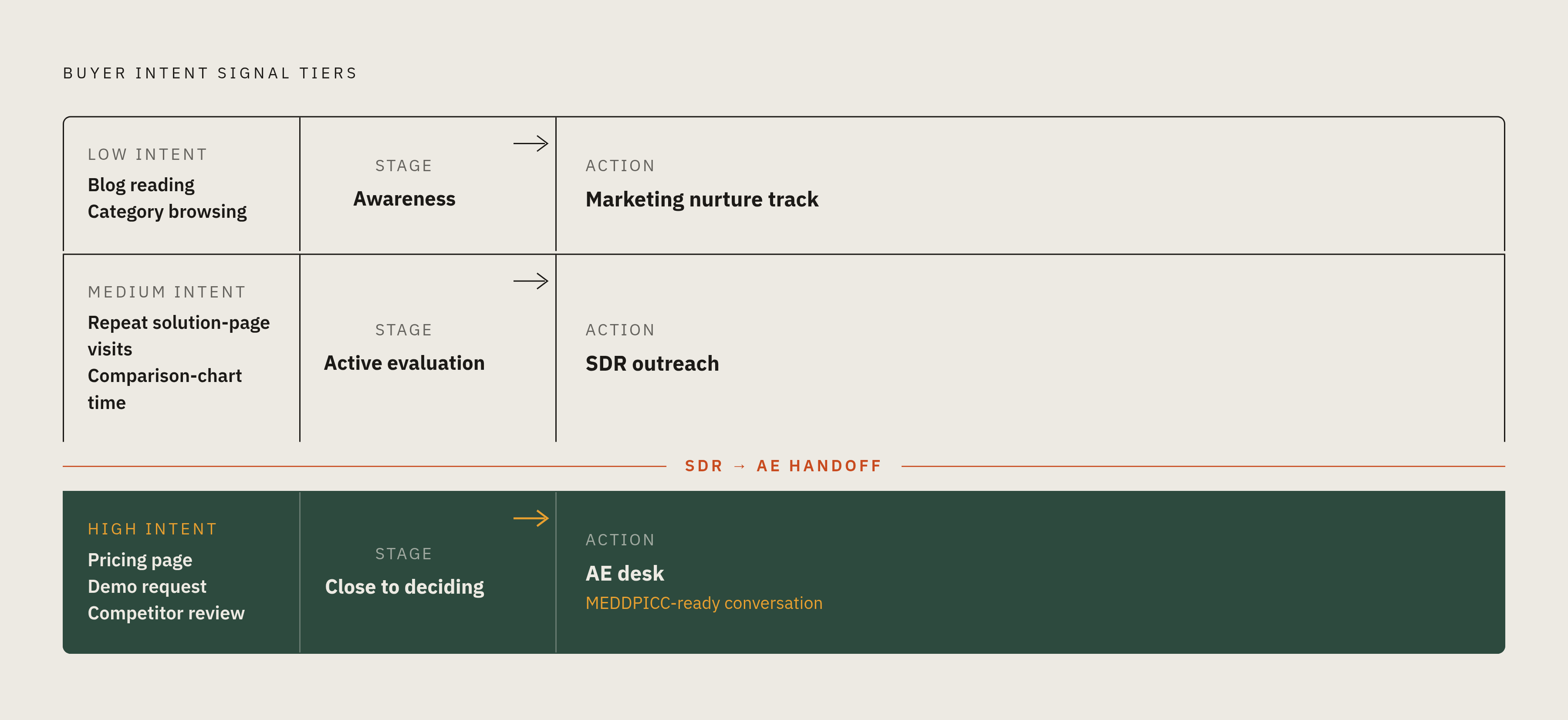
Not every signal a buyer gives off means the same thing, and sorting them correctly is the first job of any team trying to act on intent data instead of drowning in it. Low-intent signals, like someone reading an early-stage blog post or browsing category-level content, mean the buyer knows a problem exists. That's awareness, not urgency, and it belongs in marketing's nurture track, not an AE's call list. Medium-intent signals look different: repeat visits to a solution page, or time spent on a comparison chart, point to active evaluation and are a good match for SDR outreach. High-intent signals, like a pricing page visit, a demo request, or reading competitor reviews, mean the buyer is close to deciding, and those should land directly on an AE's desk with a MEDDPICC-ready conversation already drafted. Lifecycle signals form a separate bucket entirely: a sudden drop in product usage, or a competitor's customer approaching a contract renewal, belongs to customer success or to a competitive displacement play, not a cold outbound sequence. Stacking signals together works better than trusting any single one. Website behavior paired with a surge in third-party topic research, a champion changing jobs, and competitor review activity, together, cuts down on false positives in a way that one data point never can. Signal decay is the thing that wrecks all of this if ignored: buying signals go stale fast, sometimes within hours and sometimes over a few weeks depending on the type, and a team that waits too long to act on a hot signal is working off information that's already expired.
Wiring intent signals to each MEDDPICC element before the first sales call
Every one of the eight MEDDPICC elements has a signal type that can feed it information before a rep ever picks up the phone, and treating that mapping like a pre-call checklist cuts discovery time while making the first conversation sharper.
For Metrics, repeated visits to an ROI calculator, a case study, or outcome-focused content show which numbers the buyer is already trying to pin down. A rep walks into the first call anchored to the buyer's own math instead of reciting a generic ROI pitch, so Metrics shifts from something to uncover to something to confirm.
For Economic Buyer, a VP or CFO reading pricing pages, or a senior title showing up on a demo request, points to who likely holds the budget before outreach even starts. A champion changing jobs can also flag a shift in who the Economic Buyer is at a target account, which should trigger a second look at any deal already open there.
For Decision Criteria, the specific content a buying committee consumes, security documentation, compliance guides, integration pages, shows which boxes they're scoring vendors against. A rep who knows a committee has been reading compliance material can open with those criteria in the first meeting.
For Decision Process, how many different titles are engaging with content across a target account maps the shape of the buying committee before a rep asks a single question about it. One title engaging alone usually means an informal, early-stage look. Multiple departments engaging at once usually means procurement is already involved, telling a rep how to plan multi-threaded outreach across the account.
For Paper Process, signals like a competitor's contract renewal window approaching, or engagement with vendor comparison and security review content, show an account nearing the procurement stage. A rep who catches that early can map every step between a verbal yes and a signed contract well before committing to a close date, instead of discovering a six-week legal review the week they expected to close.
For Identify Pain, the category of content a buyer is reading is itself evidence of urgency. Someone digging into a specific operational failure has effectively already named their own pain point for the rep. MEDDPICC asks reps to connect surface symptoms to root-cause business impact, and signal data tells a rep which symptoms the buyer is living with right now, making that cost-of-inaction conversation far easier to have.
For Champion, a single contact who keeps coming back, sharing content internally, returning to the site across multiple sessions, downloading an ROI template meant for internal pitching, is already acting like a Champion before anyone has had a conversation with them. A real Champion puts their own reputation on the line to push a deal forward internally, so the job before the first call is simply figuring out who inside the account is already doing that work unprompted.
For Competition, review site activity, installed competitive tools, and engagement with comparison content tell a rep exactly who else is in the running. Competitive displacement timing sharpens this further: if a target account's current vendor contract is coming up for renewal, that window is fixed and knowable in advance, lining up precisely with what MEDDPICC's Competition element is trying to track.
Competitor intent signals need a separate, faster response protocol
A buyer reading a competitor's blog post is researching a category. A buyer already on a call with that competitor is close to signing something. Those two buyers need completely different response times, and treating them the same is how deals get lost quietly. Five signal types are worth tracking on their own, separate from the general intent taxonomy, including competitor tool installs across target accounts, upcoming contract end dates, competitive review activity, comparison-page engagement, and job changes among champions at competitor-adjacent accounts. A low-intent signal can sit in a nurture queue for weeks without damage. A competitor signal cannot. If a target account's incumbent vendor contract is nearing its end date, that's a fixed, known window, and reaching out after it closes means reaching out after the decision is already made. The same multi-signal stacking that sharpens general qualification applies here too, but the clock runs faster: a champion job change at a competitor's account, paired with a spike in comparison-content engagement, points to a specific and narrow window to engage, not a general trend to monitor. Competitor signals convert at a different speed, so they need a different queue, a different response time, and a rep ready to move the moment the signal fires.