G2 Buyer Intent Data for Competitive Interception
Catch prospects comparing you to competitors before they decide, right when it matters most.

G2 Buyer Intent data tells you which company is comparing you against a competitor right now, before that company ever fills out a form. That fact alone should change what sales and marketing teams do with it. Most people still treat intent data like a prospecting list, a way to dig up more names to call, when the real value shows up mid-cycle, when someone's already deep in a bake-off and you catch them before they've picked a side.
What buyers are actually doing before they ever talk to sales
Here's the uncomfortable part. Research on buying groups shows most of them rank vendors before making first contact, and they usually buy from whoever was already ahead when that ranking happened. So if your outreach kicks off with a demo request or a form fill, you're showing up after the votes are basically counted.
Buying committees aren't one person filling out a form anymore. They're five, eight, sometimes twelve people, and most of them never touch your website in a way you can actually see. The individual lead stopped being where the signal lives. The account is where it lives now, and that's a much messier thing to track.
It's getting messier still. A growing chunk of early research now happens inside AI chat tools, the kind of back-and-forth no intent platform on earth can see. G2's own research found roughly half of B2B software buyers start their research with an AI chatbot. Most of those same buyers still go read reviews and compare vendors on G2 before they ever pick up the phone with sales, though, and that's the window. It's narrow, it's specific, and it's about the only place left where you can watch someone make up their mind in something close to real time.
How G2 signals are tiered and what each tier actually tells you
G2 doesn't hand you one big "interest score" and call it done. It tracks profile views, pricing page visits, category research, alternatives page browsing, compare page visits, sponsored content clicks, and scores each account across two dimensions: buying stage and activity level.
Picture a funnel with two very different crowds standing in it. Direct product page visits and competitor feature comparisons are low-volume but high-intent, buyers deep in the weeds who deserve a call today, not next week. Competitor review pages and alternatives listings run the opposite way: high volume, lower odds any single account converts, but they catch people earlier, before the field has narrowed.
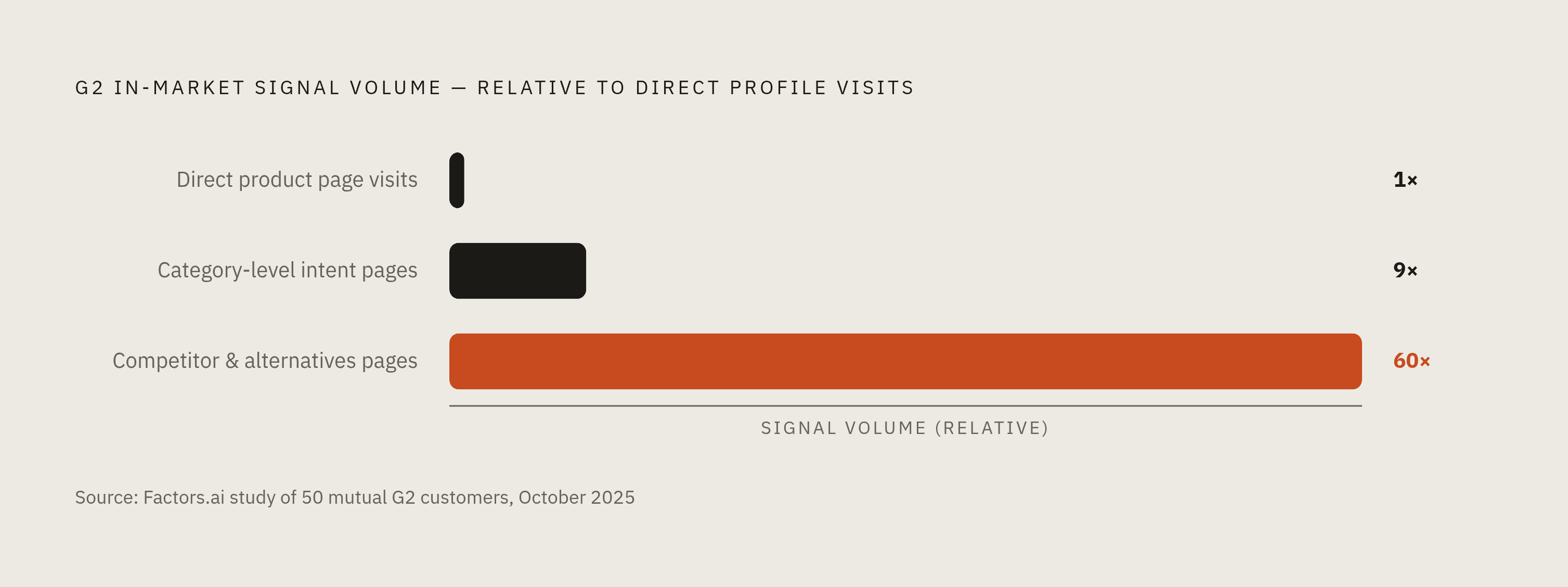
The gap between those two groups is bigger than most teams assume. Factors.ai looked at fifty mutual G2 customers in October 2025 and found category-level intent produces nine times more signals than visits to a vendor's own product page, and competitor review and alternatives pages produce something like sixty times the volume of direct profile visits. Most of the buyers in-market for something like yours are reading about your competitors, not you. Watch only your own profile, and you're ignoring almost everyone in the room.
Filtering by ICP and watching specific target accounts is what keeps that volume from turning into noise. And the payoff for doing it well is real: accounts showing G2 intent signals convert at 2.6 times the rate of accounts that show none. That's not a vague "probably helps." It's a multiplier you can actually build a prioritization model around.
What competitive intent signals add and why the August 2025 launch matters
Before August 2025, G2 could tell a vendor when an account looked at its own profile. It couldn't tell that vendor when the same account was over on a competitor's page, running comparisons, never once landing on the vendor's own listing. That was the blind spot, and it was a big one.
The August 2025 launch of Competitive Intent Signals closed it. Now a vendor sees when a prospect (or an existing customer) is browsing a competitor's profile, even if that account never showed up in the vendor's own G2 traffic. An account digging into a competitor isn't in "just looking" mode anymore. It's in decision mode, and the window to reach them runs in days, not weeks.
A June 2026 expansion pushed the same signal set across G2, Capterra, Software Advice, and GetApp. Early numbers suggest customers see 36% more accounts actively in-market, and a real chunk of those accounts were completely invisible to intent tools before this. Integrations with Slack, Salesforce, HubSpot, Demandbase, Snowflake, and LinkedIn mean the data drops straight into tools reps already live in, no separate dashboard required.
What came out of the beta program is worth sitting with. HubSpot users built the competitive signal into nurture flows and lead scoring. Slack users set up real-time pings the moment a target account viewed a competitor's page. RevOps teams piped the same data into CRM to flag churn risk right next to fresh pipeline. Same signal, two different jobs: go find new business, and go defend the business you already have.
The broader signal quality problem and where G2 fits in it
Intent data has a trust problem, and it's not a small one. A benchmark of 750 senior B2B marketers found 87% of organizations think their intent signals are unreliable or inflated, and only about a quarter of those signals ever turn into a qualified opportunity. That's a lot of noise for a market that hit $4.5 billion in 2026 and keeps growing at nearly 16% a year. Spending keeps climbing while satisfaction stays flat; only about a quarter of B2B teams call the ROI exceptional.
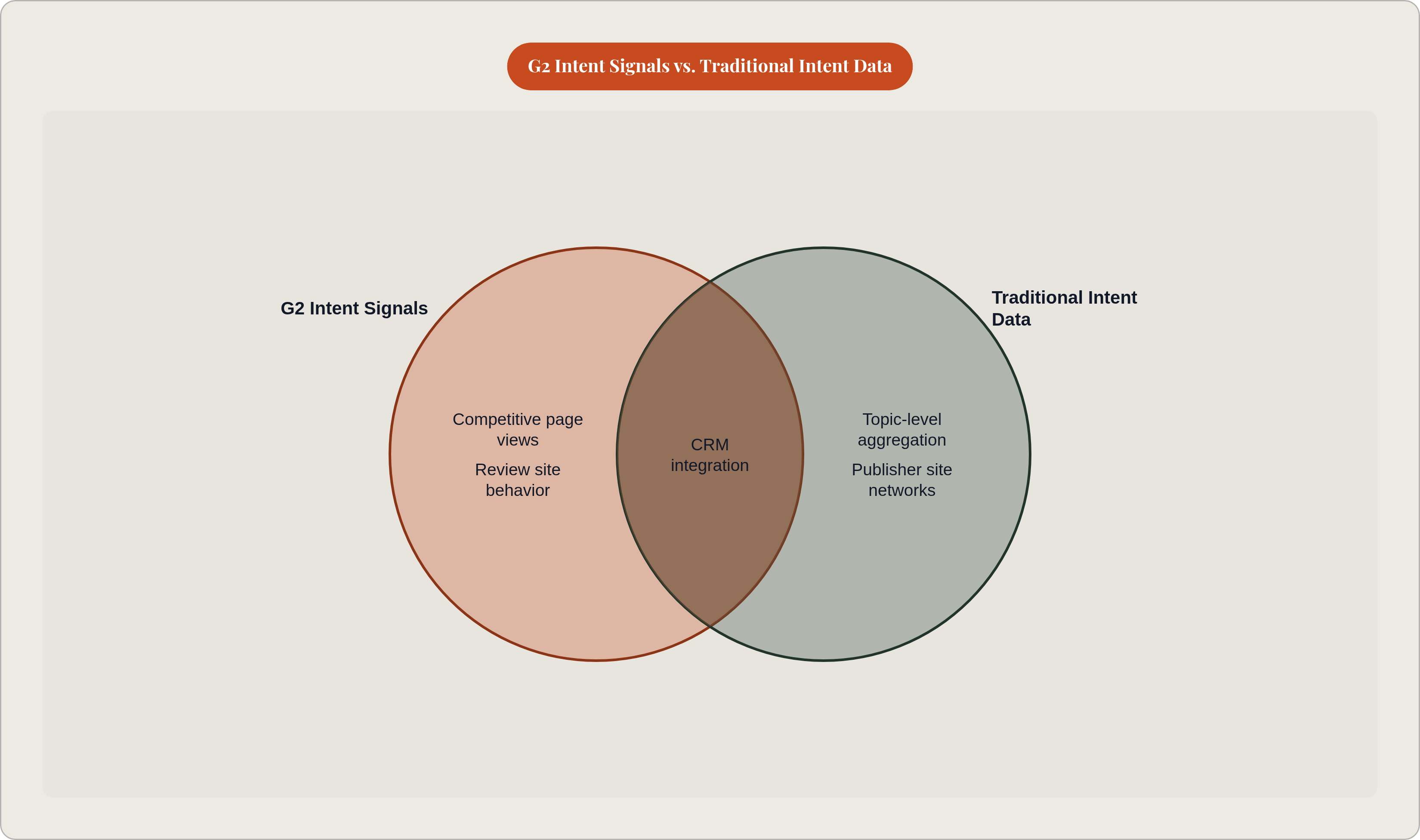
There's a whole landscape of tools chasing this problem, each from a different angle. Some aggregate topic-level signals from networks of publisher sites, good for catching early research but fuzzy once a buyer's actually comparing vendors. Others layer predictive modeling on raw signals to guess buying stage. Others build the signal straight into account-based marketing systems so it feeds the whole funnel instead of one team's dashboard.
G2 sits in a different spot because of where the behavior comes from. Nobody stumbles onto G2 while reading an unrelated article. They go there specifically to evaluate software. The intent is baked into the destination itself.
None of this means pick one tool and walk away happy. The honest fix for the signal-quality problem is layering: G2 for the mid-to-late funnel evaluation stage, topic-based tools for earlier research, separate monitoring for whatever's happening inside AI chat tools, because right now nothing sees that. And none of it matters if the signal fires and nobody does anything with it. That's a process problem as much as a data problem, maybe more so, and it's the one most teams skip right past.
How to map G2 competitive signals to specific sales and marketing plays
Speed changes the math here more than almost anything else. A cold email gets a cold reply rate. That same email, sent to an account actively comparing you against a competitor this week, gets something much better. Days decide whether the play works, not weeks.
Match the play to the tier. Alternatives-page and competitor-comparison activity, the high-volume mid-funnel stuff, calls for content, not a phone call: comparison guides, third-party reviews, case studies matched to that account's industry. Competitor pricing or feature-page visits, the high-intent late-funnel stuff, calls for a person: an SDR or AE reaching out directly, maybe pulling in an executive, offering a side-by-side walkthrough. A competitive profile view from an account with zero history with your brand should get treated like a brand-new prospect, routed into a nurture sequence with competitive framing before a rep ever picks up the phone.
Don't lean on one channel. Coordinating email, paid retargeting, and direct outreach around the same signal produces a meaningfully bigger lift in pipeline speed than any single channel alone, roughly a 23% bump per one 2025 benchmark. The prioritization itself pays off hard too: accounts prioritized by intent signal closed at 21.3% versus 8.4% for everyone else in one 2024 study, and those deals carried contract values about 18% higher on average, per a 2024 ABM audit.
Don't ignore the defense side either. An AE watching their existing accounts for competitor browsing gets an early warning most reps never had access to. A quick check-in call, a sneak peek at a feature about to ship, a QBR bumped up two weeks early, any of these can stop a quiet evaluation from turning into a lost account before you even knew there was a fight going on.
None of this works without the right assets already sitting on the shelf: comparison guides written for the actual "us vs. them" searches people run on G2, ROI or switching-cost calculators that reset the terms of the evaluation, customer stories from companies who looked at the same competitor and picked you anyway. Letterdrop is built around exactly this connection, surfacing the competitor signal and handing sales the matching content in the same motion, instead of treating the data and the assets as two jobs someone has to stitch together by hand later.
Why response speed is a structural requirement, not a nice-to-have
These signals expire. An account comparing two vendors today might have already made up its mind by Thursday. There's no slow-and-steady version of this play, and pretending otherwise just wastes the window.
OpenPhone is a good example of what slow actually costs. Before the company automated its intent routing, leads sat in a queue for days, with time-to-demo running around two and a half days on average. After automating it, speed-to-lead dropped by roughly two-thirds, and inbound conversion climbed by nearly a fifth. That wasn't a motivation problem that got solved with a pep talk. That was a plumbing problem, fixed with plumbing.
Telling reps to "move fast" on a hot signal doesn't do much if the signal arrives buried in a spreadsheet nobody opens until Monday morning. The automation has to handle three things without a human in the loop: route the account to an owner the second the signal fires, not after someone reviews a report; push an alert into Slack or email with enough context that the rep isn't logging into a second platform just to figure out what happened; pre-stage the right piece of content based on signal type and vertical, so nobody's building a comparison deck from scratch at 4pm on a Friday. This is infrastructure. It belongs to RevOps and marketing ops, not to a Slack message about hustling harder.
What marketing needs to build before the signals arrive
A signal firing into an empty content library is just an alert that goes nowhere useful. Interception is as much a content-readiness problem as a data problem, and most teams find that out the hard way, mid-deal, scrambling for something they don't have.
Three things need to already exist. Structured "us vs. them" pages that answer the specific objections buyers raise in reviews of that competitor on G2. Category-level content explaining how to evaluate the whole space, which does double duty: it helps the buyer, and it puts you in the position of explaining the rules instead of just being another name on the list. And proof that's actually specific to the account's industry, because a generic case study loses to a competitor's industry-matched one almost every time late in the evaluation.
There's data backing up how much content already matters here. A 2025 benchmark of 980 B2B marketers found a large majority say content helps generate demand and leads, and nearly half say it directly helps generate revenue. But most of those same teams can't point to which specific asset moved which specific account, and that's the real gap. Close to half of B2B marketers don't measure content ROI at all, and the attribution models most teams still lean on, single-touch, basic multi-touch, were never built to track an anonymous eight-person buying committee wandering through G2 pages together.
Connecting G2's signal data to content performance is how that gap closes. When a competitive signal fires and a specific asset goes out the door in response, you can trace the pipeline result back to both the signal and the content that supported it. That's a feedback loop, and it tells the content team exactly what to build more of instead of guessing in the dark. Letterdrop's pitch here is straightforward: proving content drove pipeline requires this same signal-to-asset-to-outcome chain, and it happens to be the same chain that makes the interception motion work at all.
Building a repeatable competitive interception motion from G2 signals
Five pieces have to work together, and none of them do much on their own. A signal layer, G2's competitive intent data filtered down to your ICP and target accounts, flowing into CRM and Slack in real time. A routing layer that assigns the account automatically based on signal type, not a weekly spreadsheet review nobody looks forward to. A content layer with assets already built and matched to each tier: comparison guides for the mid-funnel crowd, proof-heavy case studies for the late-funnel crowd, switching-cost content ready for churn defense. An outreach layer that coordinates email, paid, and direct rep contact around the moment the signal fires, not around whenever the next team meeting happens to land on the calendar.
And a measurement layer that closes the loop, tracing signal to asset to outreach to pipeline outcome, so the whole system gets sharper over time instead of running the same guesswork on repeat.
Build all five and the interception motion basically runs itself. Skip one, and you're right back to reading buyer behavior after the buyer's already walked out the door.