Mid-Cycle Buyer Interception Tactics
Catch buyers mid-evaluation by tracking where shortlists actually form, not just your website.

Here's a number that should bother you: 58% of marketing executives build shortlists primarily through their professional networks. Not Google. Not a retargeting ad. A Slack message from someone they trust. A name that came up three times at the same conference. A LinkedIn DM from a peer who's been burned by the wrong vendor before.
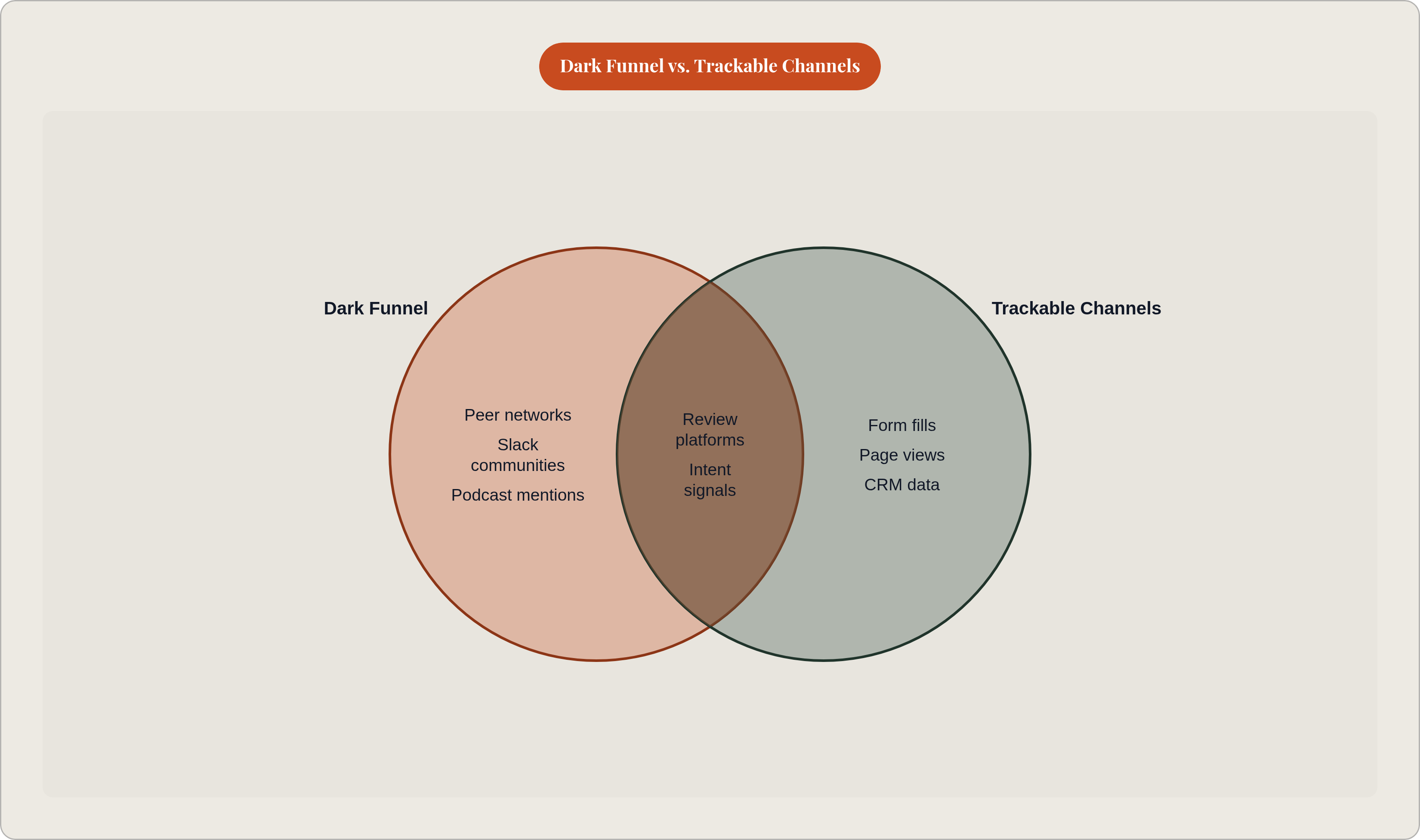
That's the dark funnel — every brand interaction a buyer has that never touches your CRM. Private communities. Reddit threads. Podcast mentions. Word of mouth at the dinner table after the conference session ends. None of it shows up in your attribution model. All of it shapes who makes the shortlist. The dark funnel is an iceberg: your CRM only ever sees the tip.
And there's a newer layer on top of that now. Roughly 60% of B2B buyers use AI tools like ChatGPT or Gemini to augment their vendor research, summarize content, and surface competitors (Google, 2025). A buyer can ask an AI to compare your category, get a synthesized answer, and never visit your website. No page view. No form fill. Nothing. The AI layer adds a new kind of invisibility to a funnel that was already hard to track.
Meanwhile, somewhere between 65 and 70% of informational search queries now end without a click to an external website. The surface area where conventional content can intercept a buyer is shrinking. Page views and form fills are capturing the visible tail of a research process that's already well underway. The shortlist is usually set by the time someone fills out your demo request form.
None of this means you abandon trackable channels. It means you build presence in the places where shortlists actually form. Peer networks. Review platforms. AI-generated summaries. Community conversations. The places where someone says "yeah, we used them and it was great" to someone who will remember that conversation eight months from now when a budget opens up.
Reading the Signals That Tell You a Buyer Is Comparing Options Right Now
Only 3 to 5% of your total addressable market is ready to buy at any given moment. Intent data is how you figure out which slice that is. But not all signals are worth acting on at the same speed.
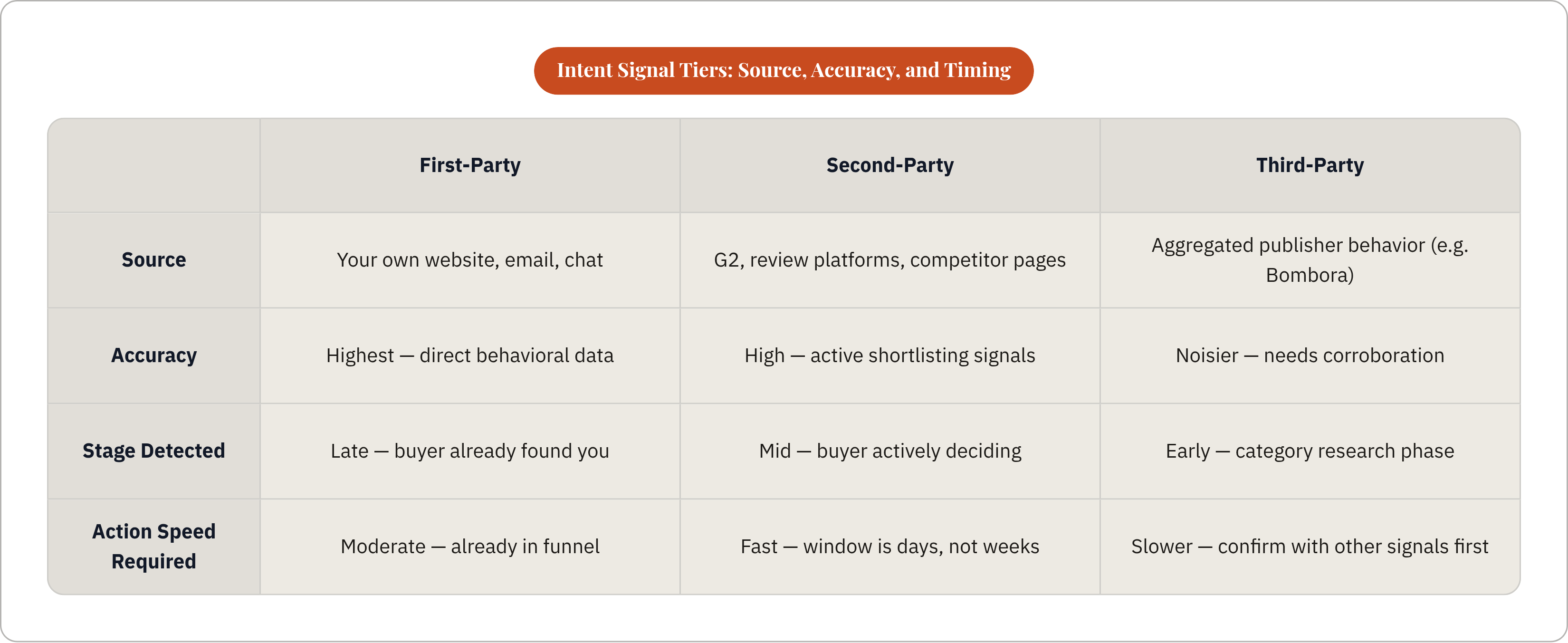
Think of it as three tiers.
First-party signals are actions on your own website, email, and chat. Highest accuracy. But by definition, limited to buyers who already found you. For dark-funnel evaluations, these signals show up late in the process.
Second-party signals are where the real interception opportunity lives. G2 profile visits, competitor comparison pages, review platform activity. When an account visits a competitor's G2 profile or reads a head-to-head comparison article, that is a near-real-time signal of active shortlisting. They're not browsing. They're deciding.
Third-party signals cover broader category research across the web. Tools like Bombora aggregate behavior from thousands of publishers. Useful for earlier-stage identification, but noisier. You need corroborating signals before acting on third-party data alone — otherwise you're just guessing with extra steps. Relying on a single third-party signal is like navigating by a star that is already dead.
Timing matters as much as signal type. A buying signal from three weeks ago is already stale. For mid-market deals, the window between "actively researching" and "vendor selected" can be as short as two to four weeks. You act fast or you don't act at all.
One more thing worth knowing. B2B buying decisions are made by groups. On larger deals, you're looking at ten or more people involved. Tracking only one person's behavior tells an incomplete story. Measuring engagement across the entire buying group is a more reliable indicator of deal momentum than any single contact's activity.
Trigger Events That Open a Natural Window Into a Competitor's Account
Competitive displacement is a specific game. You're not convincing someone they need a solution. They already have one. You're convincing them the solution they have is the wrong one.
Displacement campaigns convert at roughly three times the rate of net-new prospecting, and they tend to produce higher lifetime value customers. In mature, crowded categories, a growing share of winnable deals are sitting inside a competitor's account right now. The question is when those accounts are actually open to a conversation.
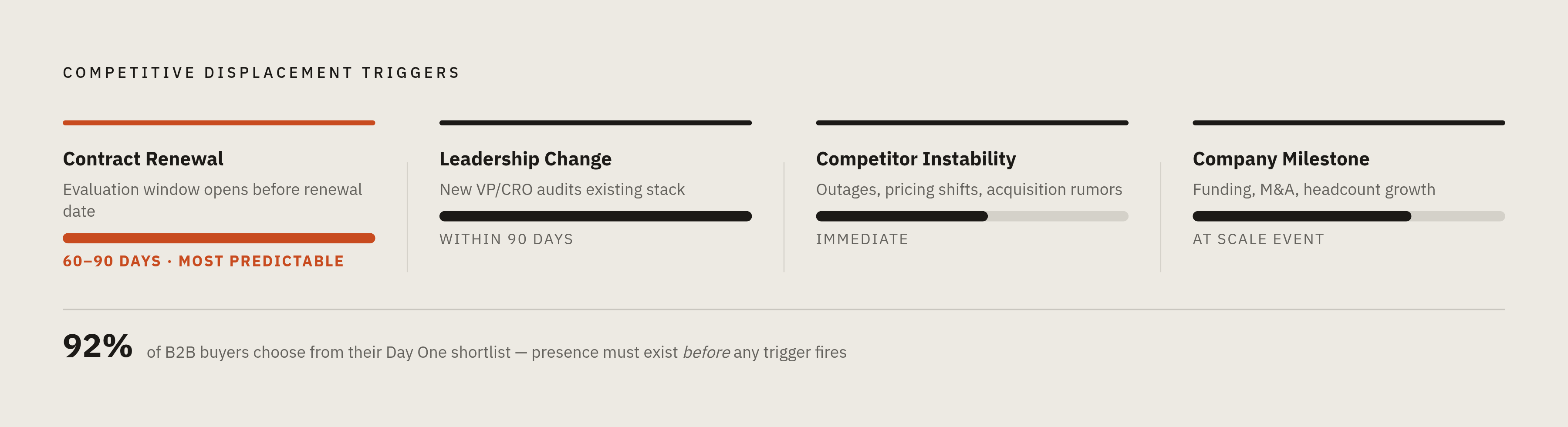
Four trigger events create reliable windows.
Contract renewal. Most B2B SaaS contracts renew annually. The evaluation window opens 60 to 90 days before that date. If you can identify renewal timing through a direct ask, LinkedIn research, or technographic data, you can time outreach to land when the account is actively deciding whether to stay or go.
Leadership change. A new VP of Sales, CRO, or Head of RevOps almost always evaluates the existing tech stack within their first 90 days. A new leader has no loyalty to the tools they inherited and every incentive to put their own stamp on the stack. This is predictable enough to build a play around.
Competitor instability. Outages, pricing changes, acquisition rumors, negative review surges. These are moments when existing customers are already questioning the relationship. You don't have to manufacture doubt. It's already there.
Company milestone. Funding rounds, M&A activity, significant headcount growth. These events signal that a company is re-evaluating everything at scale. Old contracts get revisited. New infrastructure decisions get made.
Here's the part most teams skip. 92% of B2B buyers ultimately choose a vendor from their Day One shortlist (Google and Bain research). Which means displacement campaigns need to begin with presence-building before the trigger event fires, not just after you detect it. Technographic data tells you who is running the competitor's product. Intent surges tell you who is getting restless. Review-mined complaints tell you exactly why. Use all three together. Spray messaging without that combination is noise.
Building the Intelligence Layer That Makes Your Outreach Specific Enough to Land
Only 8% of marketers currently use advanced buyer and account intelligence models to shape their sales and marketing efforts (Voice of the Marketer, 2025). Eight percent. The competitive advantage here is accessible precisely because most teams aren't doing it.
The best primary intelligence source for displacement work is competitor review mining. G2, Capterra, TrustRadius. These platforms surface specific, recurring frustrations in the exact language buyers use when they think they're just leaving a review. Not what your team thinks the frustration is. What buyers say out loud, unprompted.
One sales team reported a 54% increase in scheduled meetings after incorporating competitor review insights directly into their outreach messaging (fullthrottlemedia.com, 2025). The mechanism isn't complicated. Specificity is what separates displacement outreach from generic cold email. If your message names a frustration the prospect already feels, it reads as empathy. If it just names the competitor, it reads as aggression.
A few principles that hold up in practice:
- Don't name the competitor directly in copy. Name the frustration instead.
- Address migration cost head-on. The buying committee's fear of switching is often larger than their frustration with the current vendor. Messaging that reduces perceived switching friction outperforms messaging that only amplifies dissatisfaction.
- Tailor by role. The CFO needs a cost-of-staying argument. The end user needs a workflow-improvement case. These are not the same message, and sending the wrong one to the wrong person signals that you don't understand their world.
More than half of top-performing B2B sales organizations use challenger-based displacement approaches (Gartner and Forrester research). The underlying principle is shifting the conversation from "what we do" to "why it's worth switching." That shift only works if your intelligence layer gives you something specific enough to shift toward.
Treat it as a living system, not a one-time research exercise. Competitive landscapes shift. Review signals update. Trigger events fire on their own schedule. The teams winning displacement deals are the ones checking the feed, not the ones who did a competitive analysis twelve months ago and called it done.
The Content That Earns Shortlist Consideration Before a Buyer Reaches Out
Let's restate the core problem. 92% of B2B buyers choose from their Day One shortlist. 58% build that list through professional networks. Which means the content that matters most for interception is the content already circulating in those networks before a formal evaluation begins.
The Edelman/LinkedIn 2025 B2B Thought Leadership Impact Report, drawing on nearly 2,000 global professionals, found that high-quality thought leadership reaches hidden decision-makers who will not take sales meetings. These are the people who sit in the background of buying decisions, carry real credibility inside the organization, and will never fill out a form on your website. Thought leadership is often the only mechanism you have for building credibility with buyers a seller cannot directly access.
So where does this content need to live? Not just on your blog.
LinkedIn and professional networks are where peer-driven shortlists form. A well-argued post that gets shared in three Slack communities is doing more interception work than a gated white paper nobody downloads.
Review platforms matter here too. A strong, actively managed G2 presence functions as both a trust signal and an intent-data source. Buyers reading your competitor comparisons are signaling their evaluation in real time, and you want to be present when they do.
Then there's AI-synthesized surfaces. As buyers increasingly use AI tools to build vendor lists, content that gets cited or surfaced in AI-generated answers has distribution value that traditional SEO metrics don't capture. Most teams aren't thinking about this yet, which is exactly the point.
Gartner found that buyers who engage with supplier-provided digital tools in combination with a sales rep are 1.8 times more likely to complete a high-quality deal than those who self-serve alone. Thought leadership that opens a conversation is more valuable than thought leadership that replaces one.
The content standard for mid-cycle interception is specific. It should resonate with someone who is actively comparing options, not someone casually browsing a category. Comparison-oriented. Objection-addressing. Tied to the frustrations your displacement research is already surfacing.
How Reps Use Content in Active Deals to Shift Evaluation Momentum
75% of B2B buyers say they prefer a rep-free sales experience (Gartner, 2025). And yet the same research shows they're 1.8 times more likely to complete a high-quality deal when they combine digital tools with rep engagement. So the preference is for less friction, not zero human involvement. The rep's job is to add something the content alone can't provide.
What that looks like in practice comes down to a few things.
Context-specificity. A rep can take a technically generic piece of content and make it feel tailored by connecting it to something the account has actually said. "Given what you told me about your team's workflow, I thought this section was worth a read" is a different message than "thought you might find this useful." One signals you were listening. The other signals you have a content library.
Buying group navigation. Knowing which content to send to which stakeholder requires human judgment. The CFO-facing ROI case and the practitioner-facing workflow argument are not interchangeable. Getting them to the wrong person can do more damage than sending nothing.
Timing precision. Deploying the right content at the moment a signal fires — a review platform visit, a trigger event, a competitor's outage — requires a rep who is monitoring signals and ready to act within days. Not weeks. The window is short.
86% of B2B purchases stall during the buying process (Forrester, 2024). Usually not because the committee rejected the vendor. Because they couldn't reach internal consensus. Content that helps the champion make the internal case — battle cards, ROI calculators, migration guides — reduces that stall risk. The rep who provides that content becomes a resource, not just a salesperson.
Deals that engage with marketing content during the sales cycle close 23% faster than those without marketing touchpoints (Gartner, Q1 2024). And there's a credibility dimension that doesn't show up in that number but matters anyway. A rep who sends a relevant, well-researched piece at the right moment signals preparation. A rep who sends generic collateral at the wrong moment signals the opposite. The quality and timing of content is itself a trust signal.
Measuring Whether Mid-Cycle Interception Is Actually Working
Here's where it gets genuinely frustrating. 56% of B2B marketers cannot accurately attribute ROI to their content efforts (CMI, 2025). Only 23% can accurately attribute revenue to specific channels (Salesforce, Q3 2024). Nearly 90% of B2B marketing teams rely on single-touch or basic multi-touch attribution models (RevSure, 2025). Those models systematically undercount influence that happens before first contact and in peer-mediated channels.
You are trying to measure the impact of work that your measurement infrastructure was built to ignore. So you have to use different metrics.
Pipeline influenced by content. Not just MQLs generated, but deals where content touchpoints appear anywhere in the journey. This is a broader, more honest view of what your content is doing.
Shortlist inclusion rate. If you can capture, through discovery calls or win/loss interviews, how often you appeared on the buyer's initial list versus how often you were added mid-process, that gap tells you a lot about whether your dark-funnel presence is actually working.
Time-to-first-contact by intent tier. If accounts with high intent signals are reaching out sooner, and those deals close faster, that's evidence your intent-based prioritization is working. Track it separately from non-intent-identified pipeline, or you'll average away the signal.
Competitive displacement win rate by trigger type. If you're running displacement plays triggered by leadership changes, renewal windows, and competitor instability, track win rates separately for each. Some triggers will consistently outperform others. Double down on those.
Engagement breadth across the buying group. A deal with five engaged contacts in the buying group is healthier than a deal with one highly engaged contact. Buying group engagement score is a leading indicator of deal quality that single-contact tracking misses entirely.
The honest reality is that some of the most important interception work will never show up cleanly in a dashboard. A podcast episode that put you on someone's radar eight months ago. A peer referral that happened in a Slack community you're not in. A bad review your competitor received that made a buyer start Googling alternatives. You can influence those things. You can't always track them.
What you can do is build infrastructure to catch more of what is measurable, stop optimizing for metrics designed for a different era, and keep showing up in the places where buyers are actually making up their minds. The teams that figure that out are the ones whose names are already on the shortlist by the time the buyer picks up the phone.