What ABM Stands For and How It Works in Practice

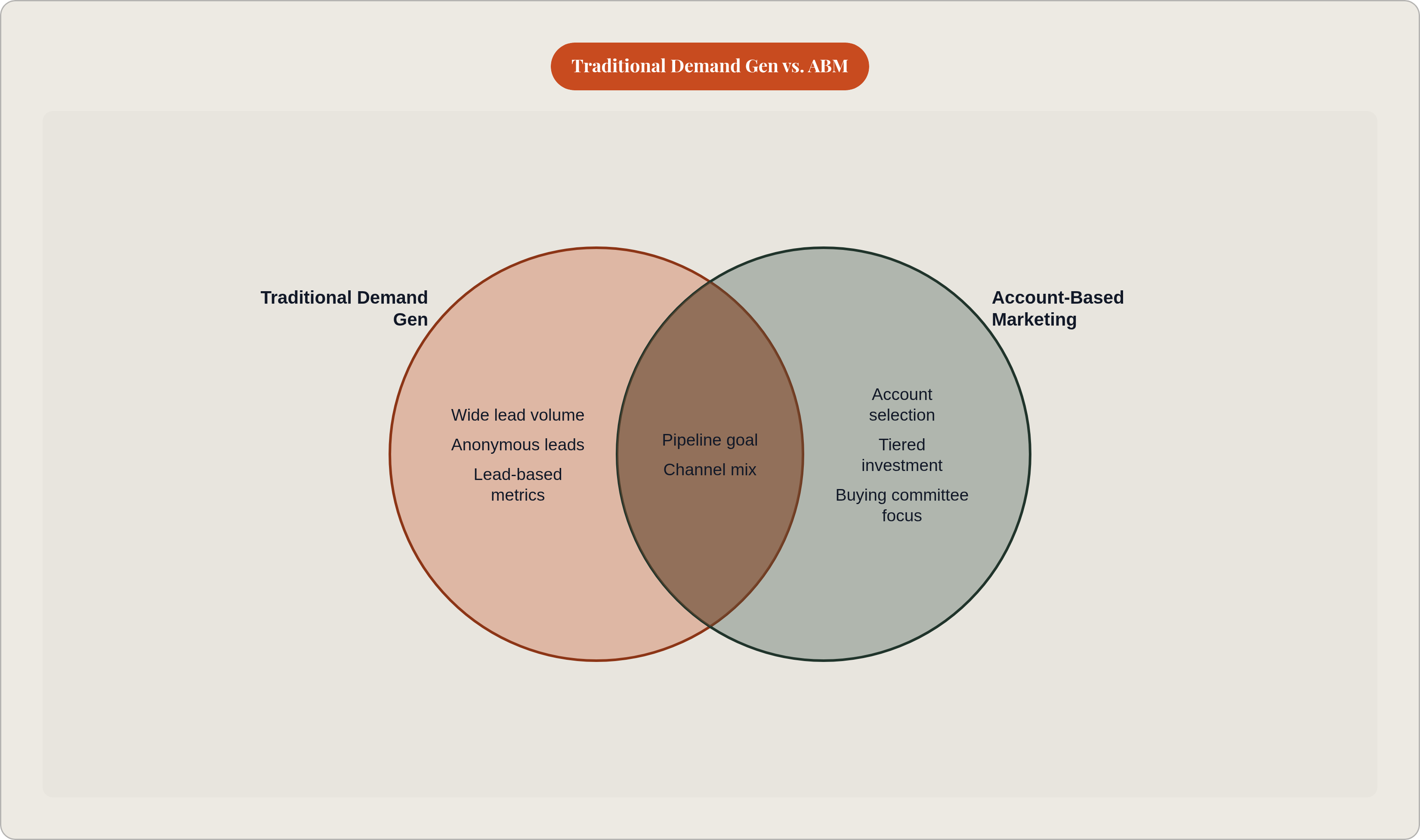
Traditional demand gen works like this: cast a wide net, generate volume, qualify down. The assumption is that somewhere in that pile of leads, real buyers are hiding. Forrester puts marketing-generated leads converting to closed revenue at under 5%. So most of what gets generated just evaporates. You pour water into the top, a trickle comes out the bottom, and everyone calls it a pipeline.
ABM doesn't fix that funnel. It replaces it entirely.
The inversion is structural, not philosophical:
- Traditional: Wide top, narrow bottom. Volume in, trickle out.
- ABM: Narrow before you start. Select accounts first, build engagement around them, and by the time outreach begins, the funnel is already tight.
Why does that matter operationally? Because the average B2B buying committee involves seven to eight people, each with different priorities, different concerns, and genuinely different definitions of success. A broad demand gen campaign cannot coordinate engagement across that many stakeholders at once. ABM can, because the entire account is the unit of focus — not individual leads scattered across your CRM.
What the inverted model actually demands is sales and marketing alignment before a single campaign launches. Not alignment as a cultural aspiration or a slide in the QBR deck. Structural alignment. If marketing is targeting one list and sales is working another, you don't have an ABM program. You have two separate campaigns running parallel, burning budget, and stepping on each other.
The hard question that follows from accepting this model: which accounts do you target, and how much do you invest in each one?
The ABM Tiers Exist for a Reason. Use Them.
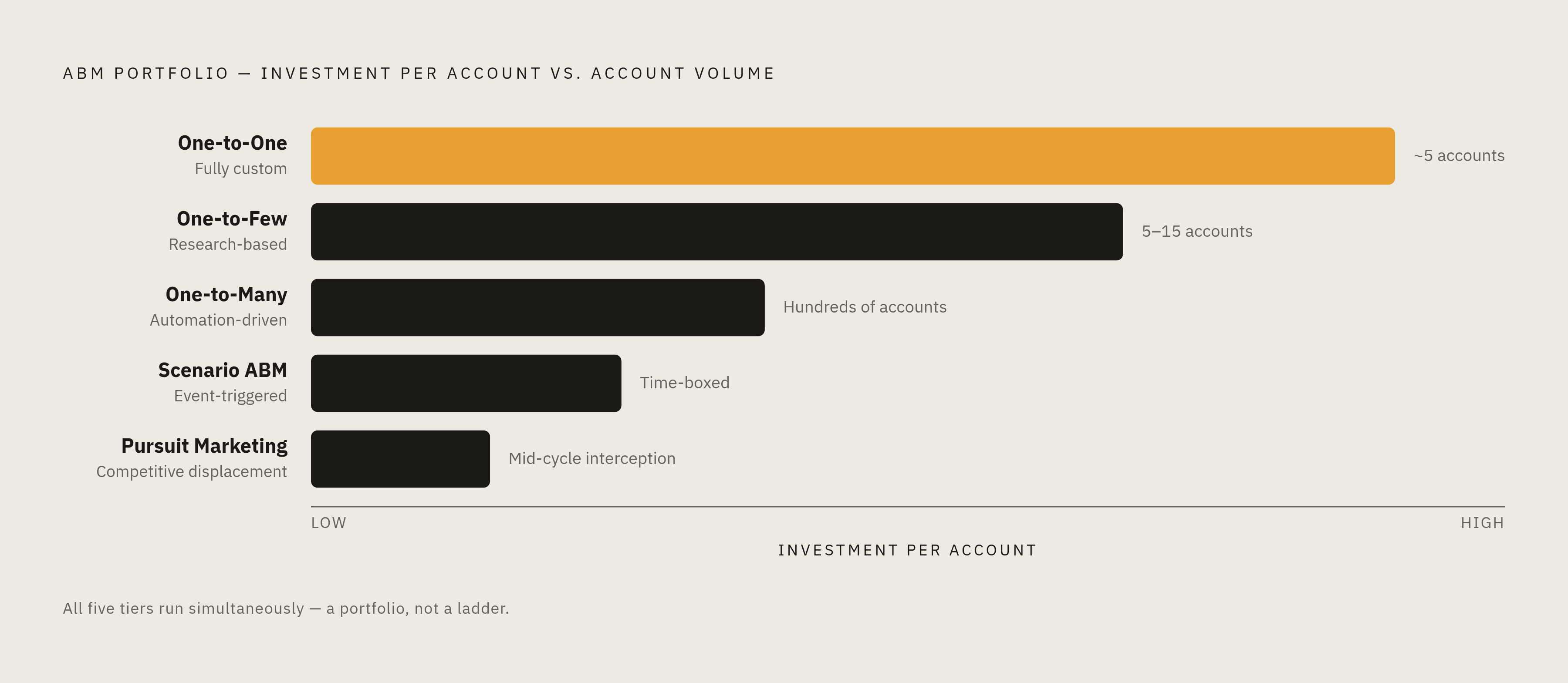
Bev Burgess introduced three tiers at ITSMA back in 2003, and they remain the clearest way to think about where your resources actually go.
One-to-one. A dedicated marketer partners with the account team on a fully customized program. Reserved for your most strategic accounts — the ones where winning or losing changes the quarter. The investment is high. The personalization is deep. You are not running this play for 200 accounts, and if someone is suggesting you do, they have not priced out what it actually takes.
One-to-few. Research-based principles applied to clusters of five to fifteen accounts that share similar business problems or industry context. Less custom than one-to-one, but still meaningfully differentiated from broad demand gen. The accounts have enough in common that a shared playbook makes sense without feeling generic.
One-to-many. Account-based principles applied at scale to hundreds of accounts, using automation and intent-driven advertising. Less personalized, but still more targeted than traditional campaigns. This is where ABM intersects with programmatic media buying.
Burgess's 2025 framework adds two more:
Scenario ABM. Time-boxed interventions built around specific events. A merger. A regulatory change. A leadership transition. The window is defined, the play is specific, and when the window closes, you move on.
Pursuit Marketing. Competitive displacement situations where you are actively working to unseat an incumbent. This gets its own tier because mid-cycle interception has a fundamentally different motion than net-new pipeline development.
High-performing organizations run multiple tiers simultaneously, as a portfolio. Not as a ladder you climb. The tier decision is a resource allocation question, full stop: account value and probability of winning determines investment level. There is no prestige hierarchy here. A well-run one-to-many program beats a sloppy one-to-one every time.
If you're just starting out, map your existing named accounts against these tiers before you buy any technology. The tech can wait. The targeting logic cannot.
Account Selection Is Where ABM Programs Quietly Succeed or Silently Die
You can run a flawless ABM program against the wrong accounts and produce absolutely nothing. Targeting the wrong companies with precision is just expensive failure delivered efficiently. Account selection is where most programs fall apart before the first campaign ever launches, and it happens quietly enough that nobody notices until the pipeline review six months later.
The inputs that belong in a real selection model:
- Fit signals. Industry, company size, region, tech stack. Does this account look like your best existing customers? If not, you need a good reason to be spending on it.
- Intent signals. Is this account actively researching your solution category, or a competitor's? Are they showing up on third-party review sites, content syndication networks, search terms relevant to your space?
- Trigger events. Funding rounds, leadership changes, hiring patterns, technology adoption signals. These indicate a buying window is opening even if the account hasn't reached out yet.
The 2025 best practice is signal stacking — a weighted score that blends fit signals and live triggers rather than relying on either alone. An account with strong firmographic fit but a flat intent score does not justify SDR time yet. An account whose intent score spikes sharply in a single week is telling you something worth acting on quickly.
Here is why intent data matters more than it used to: per 6sense's 2025 B2B Buyer Experience Report, buyers complete roughly 60% of their journey before ever engaging with a seller. Most of that early research is invisible to vendors. Intent data gives you a partial window into it.
Partial. That word matters, and I want to sit with it for a second. Intent data cannot tell you whether someone is doing casual market education or has budget approved and is building a shortlist. It is one input in a prioritization model, not a procurement readiness indicator. The teams that use intent data well are the ones validating their scoring weights continuously against actual closed deals — asking every quarter which signals actually predicted a win for their specific buyer profile. That question is worth asking more often than most teams do.
What Personalization Actually Means in ABM (It Is Not a Mail Merge)
Inserting a company name into an email subject line is not ABM personalization. That's the floor. Real personalization in ABM means your messaging maps to the specific business situation, pain points, and stakeholder priorities of a named account at this specific moment in time.
Getting there requires actual research:
- Which pain points are most acute for this account right now, based on intent topics, hiring patterns, and public announcements?
- Which stakeholders on the buying committee have different priorities and need different message tracks? The CFO's concerns and the VP of Engineering's concerns are not the same, and treating them like they are is a fast way to lose both.
- What competitive context is relevant? Are they currently using a rival solution?
Content built for ABM reflects this research specifically. Thought leadership that addresses the account's industry challenge. Case studies featuring companies in their vertical, not generic customer stories. Competitive comparison materials aligned to what a buyer who is actively considering a switch actually needs to see, not what your product marketing team decided to write six months ago.
Channel coordination matters just as much as message quality. Personalized content delivered through a single channel misses every stakeholder who lives somewhere else. A typical omnichannel ABM mix includes targeted display advertising to account IP ranges, direct outbound from SDRs, executive-to-executive outreach, and content syndication to specific titles and roles.
There is also a seller credibility dimension here that gets underestimated pretty consistently. A rep who shows up to a first call with insight that's genuinely relevant to what's happening inside the account lands differently than one running a generic discovery script. The research and content is what makes that possible — it's the mechanism that makes sellers look informed before the conversation even starts, which is no small thing when you have thirty minutes and seven stakeholders to convince.
Competitive Displacement Is Its Own Play. Run It Separately.
Pursuit Marketing earned its own tier in Burgess's 2025 framework because competitive displacement is structurally different from net-new pipeline work. The target already has budget allocated to the category. They already understand the solution type. The education phase is dramatically shortened. That efficiency advantage is real and it's worth building a dedicated motion around it.
Well-run displacement programs report competitive win rates improving by 35% and sales cycles running 20 to 30% shorter than net-new pursuits. Those numbers justify treating displacement as its own operating motion rather than folding it into standard ABM.
The trigger events that open a displacement window:
- Renewal timing. Outreach landing 90 days before contract expiration is not an accident. It's a deliberate timing decision, and the vendors who do it consistently win more than the ones who wait for the account to reach out.
- Leadership change. A new VP or department head re-evaluates the inherited tech stack. This pattern repeats reliably across industries.
- Product failure or competitive outage. Quiet dissatisfaction becomes active intent quickly when something breaks visibly.
- Funding or rapid growth. The current solution stops scaling. The pain surfaces.
- M&A. Mergers force platform consolidation decisions, and incumbents suddenly have to justify their position from scratch.
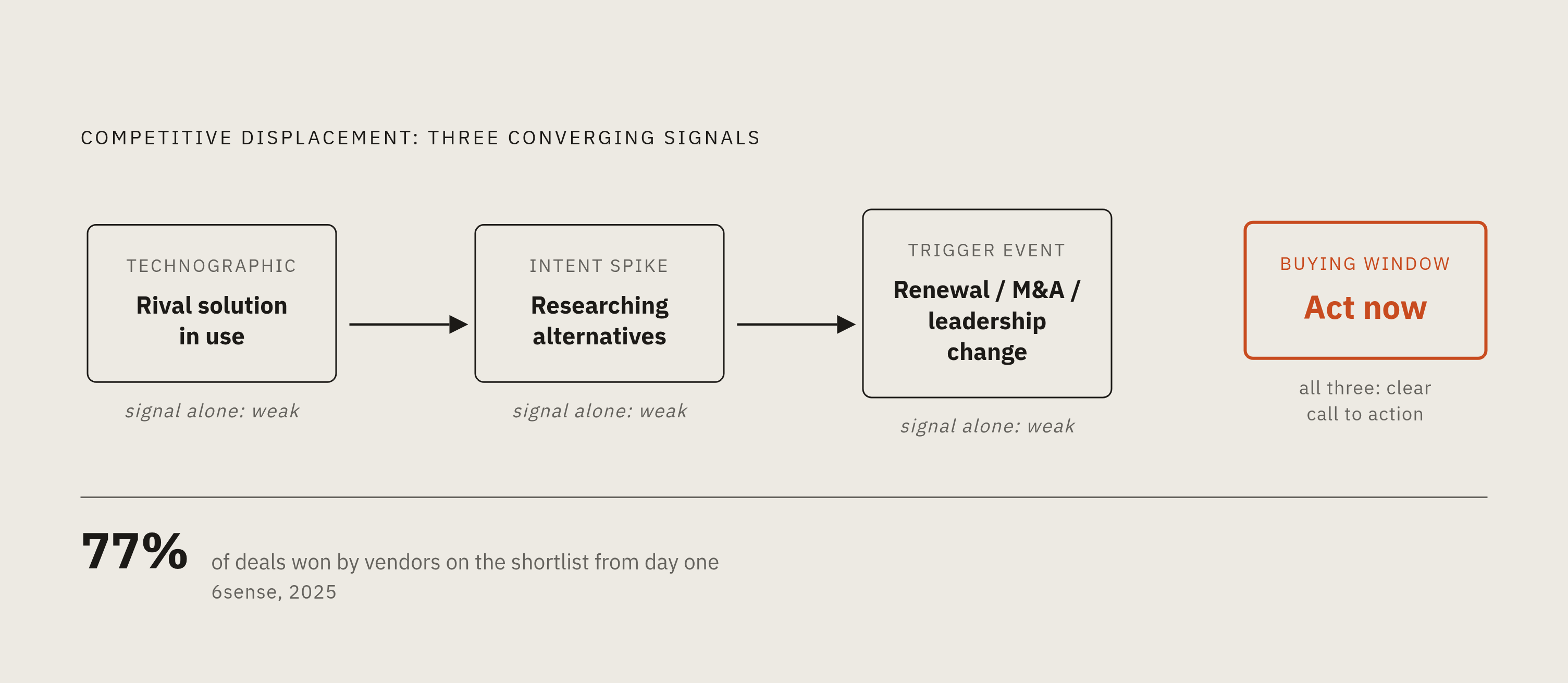
The signal combination that identifies the best displacement targets is specific: technographic data showing they use a rival's solution, combined with an intent spike showing they're researching alternatives, combined with a trigger event like a renewal window or leadership change. Any one of those signals alone is weak. Together, they're a clear call to action.
One tactic worth knowing about: mining competitor customer reviews for specific frustrations. One sales team reported a 54% increase in scheduled meetings after incorporating competitor review insights directly into their outreach messaging. The logic is straightforward. You're not guessing at their pain. You're reflecting it back with precision, which reads very differently to a buyer than another cold email about your feature set.
The timing argument matters here more than most people realize. Per 6sense's 2025 research, 95% of the time the winning vendor is already on the shortlist from day one of a formal evaluation, and those vendors win 77% of the time. Getting on the shortlist before the evaluation formally opens is the game. Displacement plays are how you get there first.
ABM Metrics Look Different Because the Goal Is Different
You cannot measure an ABM program with lead volume metrics. The unit of measurement is the account, not the individual form fill. A named account with five engaged stakeholders and a stalled opportunity tells you something completely different than a thousand anonymous leads who downloaded a PDF and never came back.
Account-centric metrics that replace or supplement traditional lead metrics:
- Engaged accounts. How many of your target accounts are showing measurable activity?
- Pipeline influenced. What percentage of open opportunities have ABM program touchpoints in the history?
- Deal velocity. Are ABM-touched accounts moving through the funnel faster than accounts outside the program?
- Revenue from named account segment. The number that matters most to anyone holding a quota.
Teams running ABM measure nearly 50% more metrics than those without, averaging just over 5.2 metrics compared to under 3.4 for teams without ABM, per 2024 industry benchmarks. That is not metric obsession. It is the natural result of running a more precise operating model that demands more precise measurement.
The ROI case for ABM is strong. 77% of B2B marketers believe ABM delivers higher ROI than any other marketing initiative, per ITSMA and the ABM Leadership Alliance. 91% of marketers using ABM report larger deal sizes, with a meaningful subset seeing deals grow by more than 50%, per SiriusDecisions.
Attribution is still genuinely hard, and ABM does not automatically solve it. Only 23% of B2B marketers can accurately attribute revenue to channels, per Salesforce's Q3 2024 research. But account-centric tracking makes the problem more tractable than tracing anonymous leads across campaigns. When you know which accounts are in the program, you can track their movement through pipeline specifically rather than guessing.
The practical starting point for any team building measurement from scratch: agree on which accounts are in program, track engagement and pipeline movement for those accounts, and compare deal velocity and win rates against accounts outside the program. That comparison is where the story lives, and it's usually convincing enough to get the next budget approved. Programs that skip this step end up defending their existence every quarter, which is its own kind of inefficiency.