Inbound vs Outbound Marketing for Pipeline Generation
Outbound moves faster but costs more; inbound compounds over time but needs runway to work.

Outbound's biggest structural advantage is that it doesn't wait. You go to them without needing a buyer to search for you, find your blog, read three posts, and decide to raise their hand. That means you can target named accounts, reach specific decision-makers, and book meetings within days, not months. Outbound is a spear. Precise, intentional, and only effective when you know exactly where to aim.
The "outbound is dying" narrative has been circulating for years. It's mostly wrong. Over half of B2B leads still originate from cold calls, and companies that abandoned cold calling saw significantly less growth than peers who kept it. That's not a rounding error. That's a structural hole in the pipeline you can watch form in real time.
Where outbound actually breaks down:
- Cost per lead is high, especially at scale, and it doesn't compound the way inbound does
- Untargeted outbound earns the spam label because it is spam. Blasting a bought list with a generic sequence isn't outbound marketing. It's noise.
- Rep quality and process matter enormously. Outbound scales with systems, not headcount alone.
- AI-assisted outreach is reshaping the math. Teams using AI-assisted outbound have seen conversion rates jump substantially compared to manual-only approaches. But AI amplifies both the upside of good targeting and the downside of bad targeting. A well-defined ICP plus AI is a fundamentally different machine than a weak ICP plus AI. I have watched teams learn that second lesson the expensive way.
The thing worth pushing back on is the idea that outbound equals spam. Personalized outreach to a decision-maker whose company fits your ICP tightly is a completely different activity than mass cold email blasting. One is a sales motion. The other is a PR problem. Conflating them is how good outbound programs get defunded by people who've only ever seen the bad version.
What inbound actually does well, and the cost it hides
Inbound works with buyer behavior instead of interrupting it. Buyers complete roughly 60% of their journey before they ever talk to a seller, according to 6sense's 2025 Buyer Experience Report. They're researching, comparing, and forming opinions before your rep ever gets on the phone. Inbound positions you to be found during that self-directed phase. If outbound is a spear, inbound is a garden. Slow to grow, but it feeds you long after the initial planting.
The economics back this up. Inbound leads cost significantly less than outbound and convert to sales-qualified leads at a higher rate. That's the kind of number that makes CFOs pay attention, right up until pipeline is down and someone needs a scapegoat.
Here's where inbound gets oversold: people call it "free." It isn't. Content creation, SEO tooling, marketing automation, and the people who run all of it are real costs. The investment is just front-loaded and less visible than a rep's salary. That invisibility is exactly what makes it so easy to underfund and so hard to defend in a pipeline review.
The bigger hidden cost is time:
- Inbound typically takes three to six months to gain traction
- Cost per lead can drop dramatically after that, but you have to survive those months first
- Early-stage companies with short runways face a genuine problem relying on inbound alone. Not because inbound fails to work. Because it doesn't work fast enough for some situations.
And the "inbound doesn't work for enterprise" argument? The opposite is actually true. Enterprise buyers research extensively before they engage any vendor. They review peer comparisons, read case studies, and vet thought leadership before a sales rep ever shows up. Inbound builds exactly the kind of authority they're looking for. It's one of inbound's strongest use cases, which surprises the people who've written it off for upmarket selling.
Most inbound programs underperform not because the channel is weak but because execution is mediocre. Top-quartile programs hit visitor-to-lead conversion rates roughly double the median. That gap is almost entirely execution, not channel.
How growth stage and deal size determine which motion to weight
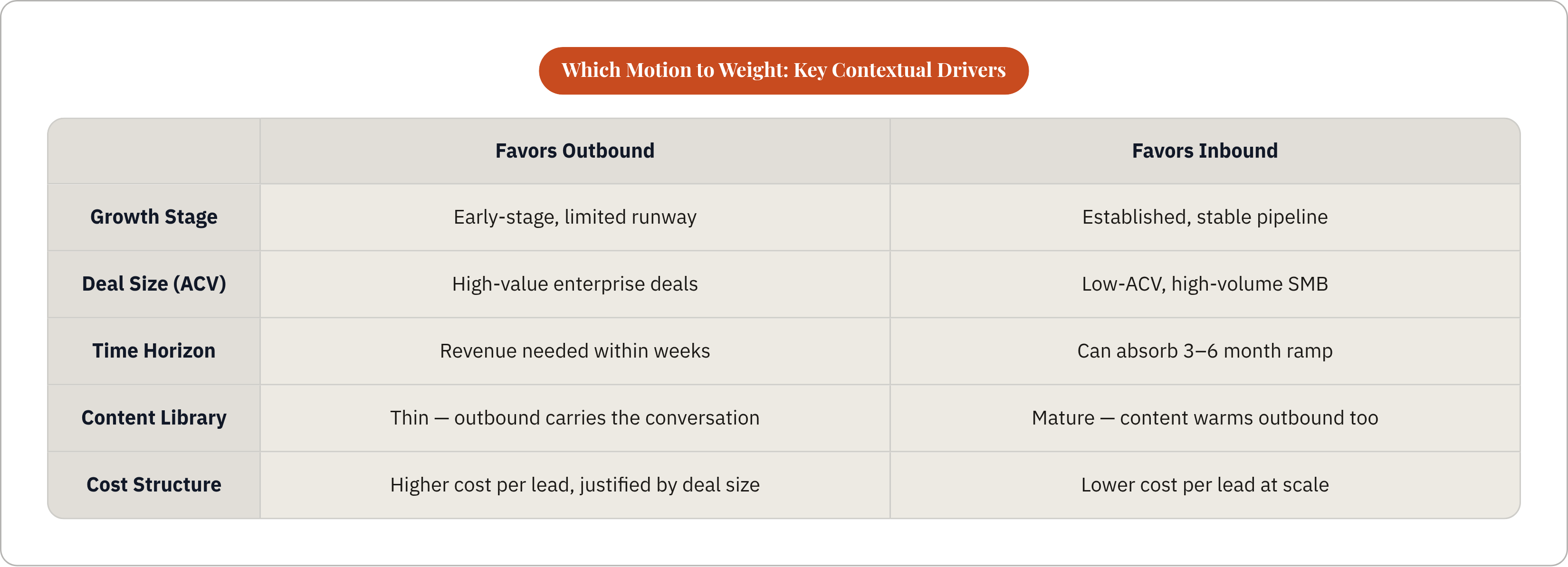
The allocation question isn't philosophical. It's contextual. Three things drive the right split: growth stage, average contract value, and how mature your content library is.
Growth stage. Early-stage companies need pipeline now. Inbound's three-to-six month ramp is a liability when runway is limited. Outbound is the faster path to revenue in that window.
ACV. High-value enterprise deals justify outbound's higher cost per touch. A single closed deal covering the cost of dozens of outbound sequences makes the math work. Low-ACV SMB deals often can't absorb that cost. At lower price points, inbound's lower cost per lead becomes a competitive necessity, not a preference.
Content library maturity. Outbound without content to point to is just a cold call. Outbound backed by a sharp comparison guide, a relevant case study, or a well-timed insight is a different conversation entirely. One of these gets a response. The other gets archived.
A useful concrete reference: a mid-market SaaS company with high growth pressure and moderate cost constraints might run roughly 65% outbound and 35% inbound, leaning on cold email sequences, paid ads, and content syndication, measuring success on pipeline velocity and payback period. That's not a universal rule. It's a contextual default that shifts as the business matures.
What changes the ratio over time is compounding. As content builds up, inbound's share of pipeline grows without proportional cost increases. Brand recognition also reduces outbound friction. Reps calling into accounts that have already encountered your content get warmer responses. The two motions don't just coexist. They reinforce each other in ways that single-channel thinking completely misses.
Where buyers actually are when pipeline conversations begin
By the time most buyers respond to your outreach, they've already formed opinions. Strong ones. According to 6sense's 2025 Buyer Experience Report, 94% of buying groups have already ranked their preferred vendors before making first contact with any of them. They review an average of 11 pieces of content before reaching out to a vendor. Gartner projected that 80% of B2B sales interactions would occur in digital channels by 2025.
What this means practically: outbound reaches buyers at one of two very different moments. Either they're in late evaluation and you're a latecomer, or they haven't started researching yet and you're early. Both can work. They just require completely different approaches. Treating them the same is one of the more expensive mistakes a revenue team can make, and it happens constantly.
There's a window between "not yet aware" and "already decided" that is the highest-leverage moment for outreach. The problem is that window is mostly invisible without intent signals. You can't see it in your CRM. Website analytics alone won't reveal it either. Which is exactly what the next section is about.
How intent signals reveal which pipeline motion a buyer situation calls for
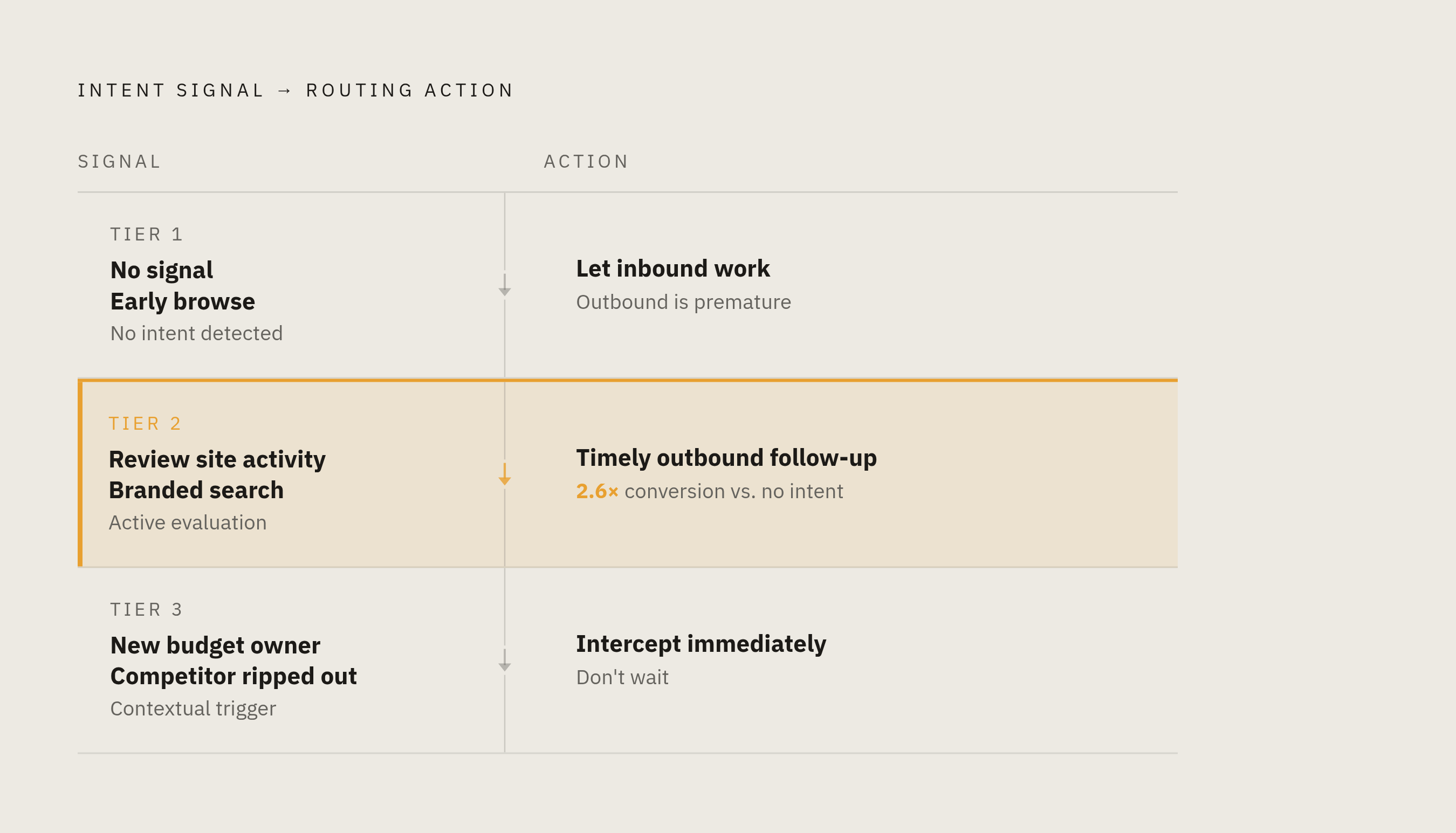
Think of intent signals less as targeting data and more as a routing mechanism. They tell you which motion to run, not just which accounts to add to a list.
There are three types worth distinguishing:
- First-party signals (website visits, content engagement, product usage): These tell you where a prospect is in their journey and whether your inbound content is actually doing its job.
- Third-party signals (review site activity, topic research across the web): These indicate active evaluation. G2 reports that accounts showing purchase intent on their platform convert at 2.6x the rate of accounts without that signal.
- Contextual signals (job postings, leadership changes, budget cycle language): These open buying windows before active research even starts. Very few teams track these systematically, which is why they remain one of the better sources of real competitive advantage.
The routing logic is fairly clean once you internalize it:
- No signal or early browsing behavior? Let inbound content do the work. Outbound at this stage will feel premature, because it is.
- Third-party review activity or branded search? The buyer is in active evaluation. Timely outbound follow-up is warranted.
- Contextual trigger like a new budget owner or a ripped-out competitor? That's an outbound interception moment. Don't wait for inbound to surface them.
Signal quality is where this gets messy, though. The majority of organizations report unreliable or inflated intent data, and only a fraction of signals actually convert to qualified opportunities. The edge doesn't come from buying more data. It comes from how you filter and act on what you already have.
Pattern recognition matters a lot here. Five pricing page visits over three months is curiosity. Five visits in one week suggests an active decision timeline. Three different people from the same company each showing moderate engagement is more predictive than one person showing very high solo interest. That last pattern usually means a buying committee is forming, which is a completely different conversation than a single champion doing research.
One more thing worth naming: a growing share of early research now happens inside ChatGPT, Perplexity, and AI Overviews. Those interactions are invisible to traditional intent platforms. Layering multiple signal sources isn't optional anymore. It's the baseline requirement for accurate pipeline routing.
Catching buyers mid-cycle while they are evaluating a competitor
Competitor evaluation is its own specific pipeline moment, not just another intent signal. When a target account is reading comparison guides, browsing competitor review profiles, or searching for alternatives, they are in active vendor selection. The shortlist is forming in real time.
Going back to that 6sense stat: 94% of buying groups rank vendors before first contact. Reaching a buyer during competitor evaluation is one of the last moments you can actually influence that ranking. After that window closes, you're either on the list or you're not. Miss it, and you're not late to the party. You're not on the guest list.
What the interception motion looks like in practice: an intent platform surfaces a Tier 1 ABM account showing purchase intent around "best alternatives to [competitor]." That signal triggers a comparison landing page, competitive retargeting ads, and a timely outbound sequence from sales. Demandbase has documented this pattern extensively. This outbound is not cold. It's context-aware, timed to a visible signal, and backed by content built specifically for this moment.
Reps need to be armed for this. That means counter-positioning content, competitive battlecards, and customer stories from companies that made the switch. Sending a generic nurture sequence to a buyer who is actively comparing you to a competitor is a missed opportunity and, honestly, a waste of their time.
Technographic signals are underused here. A company dropping a competitor's product or adopting a complementary tool is a direct buying signal. Timing outreach to that event, rather than waiting for inbound to surface the account, is the kind of asymmetric advantage most teams leave sitting on the table.
Bombora made its Company Surge intent audiences available on Reddit in 2025, extending intent-based competitive targeting into one of B2B's most active research communities. Buyers read peer comparisons on Reddit long before they visit vendor sites. That's now a channel teams can actually work with.
The content that lands at this stage is specific: comparison pages, switch-focused case studies, and objection handling built for late-stage evaluation. Not awareness content repurposed for a buyer who already knows what they need and is trying to make a final call.
How content functions differently across the pipeline rather than as a single top-of-funnel investment
The most common content mistake in B2B marketing is treating it as an awareness play and measuring it in traffic. Traffic is a fine leading indicator. It is a terrible end goal.
Revenue-first content sequencing inverts the typical build order. Start with bottom-of-funnel content: comparison pages, switch guides, ROI calculators. These deliver meaningfully higher conversion rates than awareness-first approaches because they meet buyers where the actual decision is happening. Then work backward. Mid-funnel content covers use case depth and implementation stories, reducing friction for buyers already engaged. Top-of-funnel content earns its place when it connects to the pipeline stages below it, not as a traffic-generating exercise that ends at a subscribe button.
Organizations with a documented content strategy report substantially higher content ROI than those without one. The gap between those groups isn't output volume. It's intentionality, and the willingness to build content around pipeline stages rather than editorial calendars.
The attribution problem undermines content's pipeline case more than almost anything else:
- Over half of B2B marketers cite difficulty attributing ROI to content as a top measurement challenge (Content Marketing Institute, 2025)
- Nearly 90% of marketers use single-touch or basic multi-touch attribution models, which systematically undercount content's role in multi-threaded enterprise buying (RevSure, 2025)
- Only about a quarter of B2B marketers can accurately attribute revenue to specific channels (Salesforce, Q3 2024)
So what should you actually measure? Look at metrics wired directly to pipeline behavior:
- Time-to-close for prospects who engaged content versus those who didn't
- Deal size for content-engaged versus non-engaged prospects
- Pipeline influenced by content, not just pipeline sourced from it
- Conversion rates broken out by whether content was part of the buyer's journey
Timeline reality: leading indicators typically appear within 90 days. Demo requests from organic search, increased visits to intent-rich pages, early conversion signals. Full pipeline attribution usually materializes in three to six months. Teams that pull the plug before 90 days are making decisions before the data exists to support them.
Why pipeline attribution breaks down and what to measure instead
Attribution is where the inbound versus outbound debate often gets distorted beyond recovery.
When attribution is poor (and it usually is), outbound gets credit because it's trackable. A call was logged. An email was sent. A meeting was booked. The CRM has a timestamp. Inbound, by contrast, works quietly. A buyer reads a case study, Googles an alternative, sees a retargeting ad, then responds to a rep's email three weeks later. The CRM records the email response. The case study, the search, the ad. Those get nothing.
This is how the misread happens. Outbound looks like it's generating more pipeline than it actually is because it gets logged. Inbound looks like it's generating less because most of its work happens before the trackable event. The result is predictable misallocation. Teams double down on outbound sequences, defund content programs, and then wonder why pipeline quality declines and sales cycles stretch out. I have sat in that meeting. It is not a fun meeting.
What to measure instead:
- Pipeline influenced, not just pipeline sourced. A deal that touched content before closing is not the same as a deal that didn't, even if content didn't "source" it in a first-touch model.
- Time-to-close by cohort. Buyers who engaged content before responding to outbound close faster than those who didn't. Track that gap.
- Deal size by engagement type. Content-engaged buyers often come in at higher ACVs. That's pipeline quality data worth having.
- Multi-touch contribution windows. If a buyer visited your pricing page, downloaded a comparison guide, and then responded to a rep's LinkedIn message, all three events belong in the story.
- Conversion rate by intent tier. Are you closing intent-prioritized accounts at a meaningfully higher rate than unprioritized ones? If you have the data and aren't tracking this, you're flying blind on your most important routing decision.
The inbound versus outbound debate often isn't really about strategy. It's about measurement. Teams argue over which motion is working because they can't actually see the full picture of how buyers moved through the pipeline. The teams generating the most pipeline aren't the ones who picked the right motion once and stuck with it. They're the ones who built enough visibility into buyer behavior to know which motion to run, when to switch, and what actually moved a deal forward. That's a measurement problem before it's a strategy problem.