Inbound vs Outbound Sales Motion Tradeoffs
Inbound attracts ready buyers cheaply; outbound builds pipeline fast but costs more.

Think of it like fishing. Inbound is casting a line and waiting for the fish to bite. Outbound is jumping in the water and catching the fish yourself.
Inbound: the buyer comes to you. They found a blog post, ran a search, heard a referral, started a free trial. Some level of interest existed before a rep ever got involved. You didn't go looking for them. They came looking for a solution, and you happened to be in the way.
Outbound: you go to the buyer. An SDR or AE reaches out to accounts that fit your ideal customer profile but haven't raised their hand. Cold email, phone, LinkedIn, direct mail, personalized video, event outreach. You are interrupting someone's day and hoping the timing is decent. That's the honest version of what outbound is.
The structural difference is who controls the timing of first contact. That one thing cascades into everything downstream.
Inbound pipeline is self-selected. Buyers move at their own pace, do their own research, and show up when they are ready. Outbound pipeline is constructed. You pick the account, you pick the channel, you pick the moment. Neither is inherently better. They are just solving different problems.
Most mature revenue teams by 2025 are not running one or the other in isolation. They're running both together in what people now call an "allbound" model. But you can't combine them intelligently until you understand what each one actually does on its own. So let's start there.
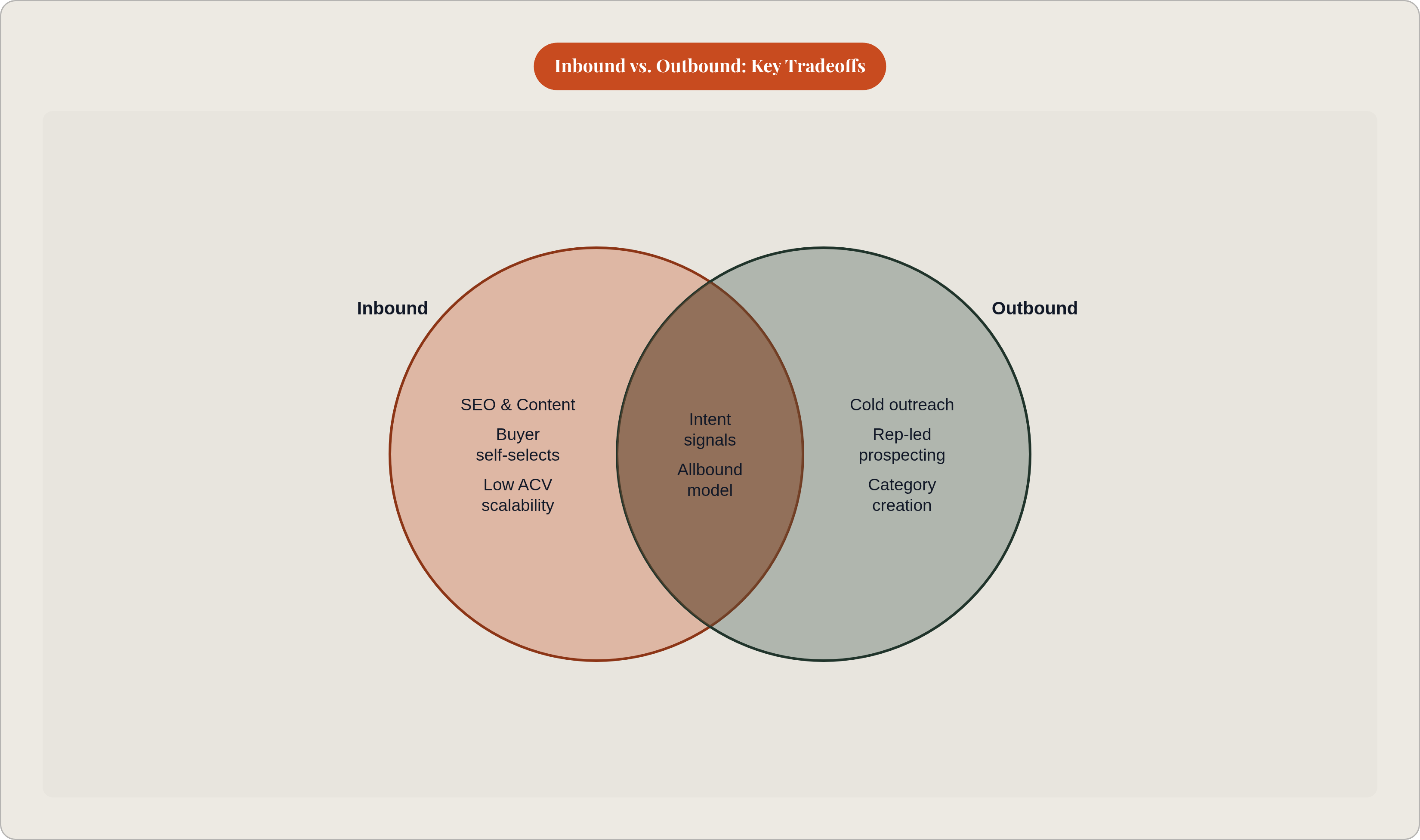
The four tradeoff dimensions: cost, control, speed, and conversion
Strip away the ideology. Four dimensions are where the real tradeoffs live.
Cost
Inbound has high upfront costs. You are investing in content, SEO, and audience-building before you see any return. The unit cost per lead falls over time as those assets compound. That math only works if you survive long enough to let it play out. Many early-stage teams don't.
Outbound costs scale linearly. More pipeline requires more headcount and more tooling. The cost per meeting doesn't improve much with volume unless your targeting gets meaningfully sharper. Which it can. But only if you're deliberate about it.
Control
This is where outbound wins, and it's not close. You choose who hears the pitch, when, and through which channel. That matters enormously when you're selling something new, something buyers don't yet know to search for. Inbound attracts buyers who are already searching, but you can't control which accounts find you or when they show up.
Speed
Outbound wins here too. A sharp campaign can generate meetings and real pipeline in weeks. Content and search rankings take months to build before they pay back. That payback is durable when it arrives, but it is not fast.
Conversion
Inbound wins over time. When a buyer self-selects, they've already done some version of qualification before a rep gets involved. HubSpot's February 2025 State of Marketing Report puts the median SQL-to-closed-won rate for B2B SaaS at 21%, with a 102-day median sales cycle. Outbound starts colder. Top-of-funnel conversion rates are lower, but they can be improved dramatically with better targeting.
Inbound wins on cost and conversion over time. Outbound wins on control and speed to first pipeline. Those are just facts. They are not a recommendation.
When time horizon makes outbound the rational choice
There are three conditions that make outbound the rational call.
You need pipeline this quarter and have no established inbound audience yet. Content takes months to mature. If the quarter closes in six weeks, inbound is not going to save you. That's not a knock on inbound. It's just physics.
Your deal sizes justify the cost of direct human effort per account. Outbound economics improve as average contract value rises. A rep spending two weeks working a $200K opportunity is a completely different math problem than the same rep chasing a $2K deal. Run the actual numbers before you decide.
You are selling a new category where buyers don't yet know to search for your solution. If nobody is typing your problem into Google, you can't wait for them to find you. You have to go find them first.
Outbound is still a major driver of B2B revenue. Close to 28% of B2B revenue comes from outbound efforts, and more than 60% of B2B appointment setting is still driven by cold outreach. The obituaries for cold outreach get written and ignored on a pretty regular cycle.
There's also a category-creation argument that people routinely miss. If you wait for inbound to develop in a market that doesn't yet know your solution exists, you're waiting for something that isn't going to happen. Outbound isn't just a short-term revenue tool. It's how you build a category from scratch.
When time horizon makes inbound the rational choice
Two conditions that make inbound the rational call.
Buyers already search for a solution to the problem you solve. If organic demand exists, it can be captured. Spending money interrupting people who would have found you anyway is waste. Simple as that.
Your unit economics can't support a rep working every account by hand. Lower ACV, higher volume products need inbound's scalability. A rep-heavy outbound motion on a $500/year product doesn't close. The math kills it before the rep ever picks up the phone.
The compounding argument for inbound is real, but it requires patience most early-stage teams don't have. Content and rankings mature slowly, and then they pay back for years at declining cost per lead. Marketing-sourced pipeline contribution sits at around 42% of total pipeline per Forrester's Q2 2024 data. That number took time and real investment to build. Teams with a short runway can't make that trade, and there's no shame in acknowledging that.
Buyer behavior is also moving in inbound's favor in ways that matter for pipeline velocity, not just lead volume. A strong majority of B2B buyers now prefer a rep-free buying experience. They want to self-educate and self-qualify before they ever talk to a human. Gartner's Q1 2024 research found that deals where buyers engage with marketing content during the sales cycle close 23% faster. That's a pipeline velocity argument for investing in inbound content even when outbound is your primary motion. The two aren't as separate as teams often treat them.
How intent signals change outbound's cost and conversion math
Here's the core problem with traditional outbound. Research from 6sense's 2024 Buyer Experience Report, based on responses from more than 2,500 B2B buyers, found that 70% of the B2B buying journey is complete before buyers contact any vendor. Most cold outreach hits accounts at the wrong moment, not because the message is bad, but because the timing is random. You're reaching out to accounts that might be the right fit on paper but are nowhere near ready to buy. That's where the efficiency bleeds out.
Intent signals solve the timing problem.
An intent signal is an observable behavior that suggests an account is moving toward a buying decision. Website visits, review site activity, topic research, pricing page visits, comparison queries. These behaviors leave a trail. The question is whether anyone is reading it.
Here's what the timing difference actually looks like in the numbers: the same message sent to a cold list earns about a 3% reply rate. That same message sent to an account actively researching a solution earns a 15 to 25% reply rate. Same message. Completely different moment.
Demandbase breaks intent signals into three stages:
- Awareness: the account is researching broad topics related to your category
- Consideration: they're comparing solutions, checking competitor pages, downloading industry guides
- Decision: pricing page visits, RFP downloads, demo requests
Stacking signals from multiple sources produces measurable lift. Teams using combined first-party data, third-party intent feeds, and contextual signals see conversion rates 25 to 35% higher and sales cycles 30 to 40% shorter compared to teams relying on a single intent source.
Contextual signals are worth calling out specifically because they're the least saturated channel. Most competitors buy the same third-party intent feeds. Few teams systematically track leadership changes, funding rounds, earnings call language, or job postings. A new CRO in their first 90 days is one of the strongest buying windows in B2B. New leaders bring new strategies and new budgets. Reaching out during that window isn't luck. It's a system.
The shift that's already underway: outbound has moved from list-led to signal-led prospecting. The list gets you to the right company. The signal gets you to the right company at the right time.
Competitor signals as the highest-leverage moment in an active evaluation
If intent signals are useful, competitor signals are where that logic goes into overdrive.
When a buyer is already comparing vendors, the evaluation is live and the deal is real. This isn't awareness-stage curiosity. This is someone who has a problem, a budget, and a shortlist. A cold account that kind of fits your ICP is a different situation entirely.
What competitor signals look like in practice: spikes in "best alternatives to [competitor]" research, visits to G2 comparison pages, review site engagement paired with technographic data. These are explicit mid-funnel indicators that a buying cycle is already underway. G2 alone draws over 90 million annual users. Companies using G2 Buyer Intent can identify which businesses are actively researching their solutions or a competitor's pages. When that signal appears, you're not interrupting someone. You're showing up exactly when they want someone to show up.
The response playbook is fairly straightforward:
- Serve a comparison landing page that addresses the likely objections head-on
- Retarget with competitive positioning content
- Equip reps with a timely follow-up sequence built around the comparison context
One signal gives you who to reach, what frame to use, and roughly when. Three problems, one data point.
Competitor signals also work for retention, which most teams underutilize. If a current customer starts visiting a competitor's review page, the account manager can step in before churn becomes a decision rather than just a risk. For deals that have gone quiet, intent data can surface re-engagement signals too. Renewed research activity, topic shifts, comparison queries from an account that ghosted three weeks ago. That's a re-entry window most teams miss entirely because they stopped watching after the deal went cold.
This isn't a separate strategy from the inbound versus outbound question. It's the sharpest form of signal-led outbound applied at the moment when a buyer is most reachable and most ready to move.
What the "allbound" model requires to work in practice
Allbound is not just running both motions at the same time. That's just having a marketing team and a sales team, which most companies already have. Having both teams exist in the same building does not automatically produce anything coordinated.
Allbound is integrative. Outbound creates awareness that eventually returns as inbound demand. Inbound signals tell reps which accounts deserve a direct touch right now. Each motion feeds the other. But only if the plumbing is set up to allow it, and most organizations' plumbing is held together with spreadsheets and good intentions.
The attribution problem is a real obstacle. Blended-source pipeline is harder to forecast and harder to attribute than single-motion pipeline. Nearly 90% of B2B marketers still rely on single-touch or basic multi-touch attribution models, according to a 2025 RevSure study of more than 60 senior B2B SaaS marketers. Those models systematically undervalue inbound's influence on deals that eventually get closed through outbound. Salesforce's Q3 2024 data found that only 23% of B2B marketers can accurately attribute revenue to specific channels. Which means most allbound programs are running partially blind on what is actually working.
What disciplined allbound actually requires:
- Shared ICP and account prioritization between marketing and sales. Not two separate target lists that occasionally overlap. One list. This sounds obvious. It is shockingly rare.
- Content that serves both motions. It builds inbound pull and gives reps something useful to send in outbound conversations. Content that only works for one motion is leaving half the value on the table.
- Intent signals routed to reps in near-real-time. The window on a competitor comparison signal closes fast. A signal sitting in a dashboard nobody checks is expensive noise.
- Attribution infrastructure that can read multi-touch journeys. Not last click. Not first touch. The full picture.
ABM teams are already closer to this model than most. Teams with active ABM practices measure nearly 50% more metrics than those without. More rigorous measurement is both a cause and an effect of tighter sales and marketing integration.
The structural requirement here is not a soft cultural goal. It's a systems requirement. Blended motions only work when both teams are operating from the same account list, reading the same signals, and sharing attribution data. Without that foundation, allbound is just a word on a strategy deck.
Making the motion choice deliberately rather than by default
Most teams don't choose a motion. They inherit one. Based on what the last leader preferred, what the tool stack supports, or what the sales culture rewards. The result is drift, not strategy. You could say they're not running a go-to-market plan — they're running a go-to-habit plan.
Four questions that cut through it.
What is your time horizon? If this quarter's number must be hit, inbound alone is not going to deliver it. That's not an opinion. That's just how long content takes to produce pipeline.
Does your category have existing search demand? If buyers don't yet search for your solution, outbound is the only way to reach them. Waiting for inbound to develop in a market that doesn't know your category exists is waiting for something that won't happen.
Do your unit economics support direct human effort per account? High ACV justifies outbound. Low ACV with high volume requires inbound's scalability. The math is not complicated, but it has to actually be run.
What signals are you already capturing, and are reps acting on them? Intent data without a response workflow is just noise with a nicer interface.
The motion also evolves over time, and that evolution is predictable. An early-stage company with no audience builds outbound first to survive, and uses that period to fund the time it takes to build inbound. A mature company with an established inbound base uses outbound to intercept competitor evaluations and accelerate deal cycles. Both are correct for their moment.
The goal is not to find the right motion once and be done. It's to stay honest about whether the motion you're running still fits the circumstances you're actually in. Most companies don't fail because they picked the wrong motion. They fail because they picked the right motion for a moment that passed and never noticed.