SaaS Sales Cycle Management When a Champion Leaves Mid-Deal
Built to survive a champion's exit, not just to exist until they leave.

A champion vanishing mid-deal feels like bad luck. It's actually the predictable output of how SaaS buying works now. Buying committees have grown large enough that Martal's SaaS sales process guide points to committee size, security and procurement review, and a missing business case as the real reasons deals go quiet, well before anyone blames the buyer for losing interest. Longer sales cycles compound the exposure: the more time a deal sits open, the more chances any single contact has to get reassigned, promoted, reorganized, or simply reprioritized before a contract gets signed. The usual exit triggers, a shift in company priorities, an internal objection the champion can't answer, a role change, or a buying committee that suddenly grows, follow recognizable patterns. Given more stakeholders and slower cycles, the real question for a rep is whether the deal was built to survive disruption to the champion relationship.
Why single-threading is the actual cause of the loss
A deal built around one champion is a deal that was already broken before anyone noticed. The champion's exit doesn't cause the collapse, it just shows everyone where the cracks were. A single-threaded deal concentrates every risk in the account (personnel changes, political turf wars, budget reshuffling) onto one person's shoulders. When that person gets promoted, transfers, quits, or hits a wall with procurement, the rep is left holding a relationship that no longer exists. One of the most common ways deals actually die is champion confidence failure: the champion can't explain why the product beats the alternative, or can't justify the price to finance, and folds under questioning nobody prepared them for. Most reps only start reaching out to other stakeholders after the champion has already gone quiet, and by then every new conversation feels like sneaking around someone's back. A strong bond with one champion can feel like enough. It's precisely that confidence that hides how fragile the deal was the whole time.
Reading the warning signs before a champion goes dark
Champions rarely disappear without warning. Reps just tend to miss the warning because it doesn't look like an announcement, it looks like a slowdown. Priority displacement is one tell: the champion gets harder to schedule, meetings slip, replies take longer, all signs that some internal initiative from leadership has pushed the deal down the list. Watch for hedging: a champion who stops proposing next steps and starts qualifying every answer has probably hit a procurement, security, or finance objection they can't resolve, and embarrassment is keeping them quiet when they should be asking for help. Watch for the line "a new executive just got looped in and we're waiting to hear back," because that sentence means the buying committee just expanded and the champion no longer controls the outcome. Watch the simple structural tells too: job-search activity picking up, an out-of-office reply nobody expected, emails getting forwarded, a new name suddenly added to the thread. And watch the account, not just the contact: when several people at the same company start quietly researching the category or comparing vendors without ever filling out a form, that's committee-level movement signaling the deal has outgrown the champion's control, and it's often the moment competitors start circling again.
Multi-threading before the champion exits, not after
Multi-threading only saves a deal if it starts before anyone needs saving. Waiting until the champion goes dark turns the same move from prevention into damage control. Map the real buying committee in week one: champion, economic buyer, technical evaluator, end users, procurement, legal, by name, not by job title guesswork. Talking to those stakeholders directly takes pressure off the champion to sell internally alone, and legal, security, and procurement objections appear in week two instead of week twenty, when there's still time to fix them. The sequencing matters: have the champion introduce the rep to the economic buyer during the business case stage, and show up to that meeting with a CFO brief or ROI one-pager already built, so the ask has a reason attached. Frame it to the champion directly: "To protect your internal timeline, I want to make sure procurement and finance aren't surprised later." That one sentence turns multi-threading from a threat into a favor. The objection every rep imagines, that reaching out to colleagues will make the champion feel undermined, only holds if it's done quietly. Done with the champion's knowledge and blessing, it protects their internal standing.
What a Mutual Action Plan does
A follow-up email dies with the inbox it was sent to. A Mutual Action Plan doesn't, because it isn't addressed to a person, it's addressed to the deal. A MAP is a shared, dated timeline of what both sides need to finish before a decision gets made, and because it's co-authored with the champion, it carries weight as an agreement the company made, not just a pitch the vendor is still making. When the champion leaves, the MAP stays behind: the successor inherits a documented process their predecessor already signed off on, complete with owners, dates, and milestones already checked off. Martal's B2B SaaS sales strategy guide groups MAPs with multi-threading and security readiness as the structural habits that actually shorten enterprise sales cycles, not extras bolted on for polish. A well-built MAP also hands the rep natural reasons to re-engage: an overdue step isn't an awkward nudge, it's a documented trigger to reach out to someone new. To survive a champion transition, the MAP needs named owners instead of vague references to "the buyer," explicit next steps for both sides, a decision deadline with the business reason behind it, and an ROI case both parties already agreed to. What it can't do is replace multi-threading: a successor who's never heard of the vendor gets context from the MAP but not trust, so documentation and stakeholder breadth have to work together.
Equipping champions to sell internally before they disappear
The materials a rep builds for a champion aren't a courtesy; they're the deal's memory, and when the champion leaves, those materials go with whoever replaces them. The most common mistake is an AE building a slick ROI deck full of generic metrics and emailing it over, only to watch it sit unused because it never answers the specific question the CFO is actually asking. Build it the other way around: co-create a CFO brief that puts a number on the cost of doing nothing, a security questionnaire finished ahead of time, a one-pager that ties the product directly to the business case the champion has already been pitching internally. Co-creation makes this work. A champion who helped shape the material is more likely to actually use it, and more likely to leave it behind on the way out, because it reflects how they already framed the problem to their own team. When the champion exits, the CFO brief, the ROI calculator, and the security questionnaire all outlive them, and the rep can hand those to the successor as "materials your colleague and I built together," which buys trust without a cold pitch. Thought leadership written in the economic buyer's own language, finance, risk, operational efficiency, gives the successor something to read before the first call even happens, cutting down the time it takes to rebuild trust from scratch.
The recovery motion when a champion has already left
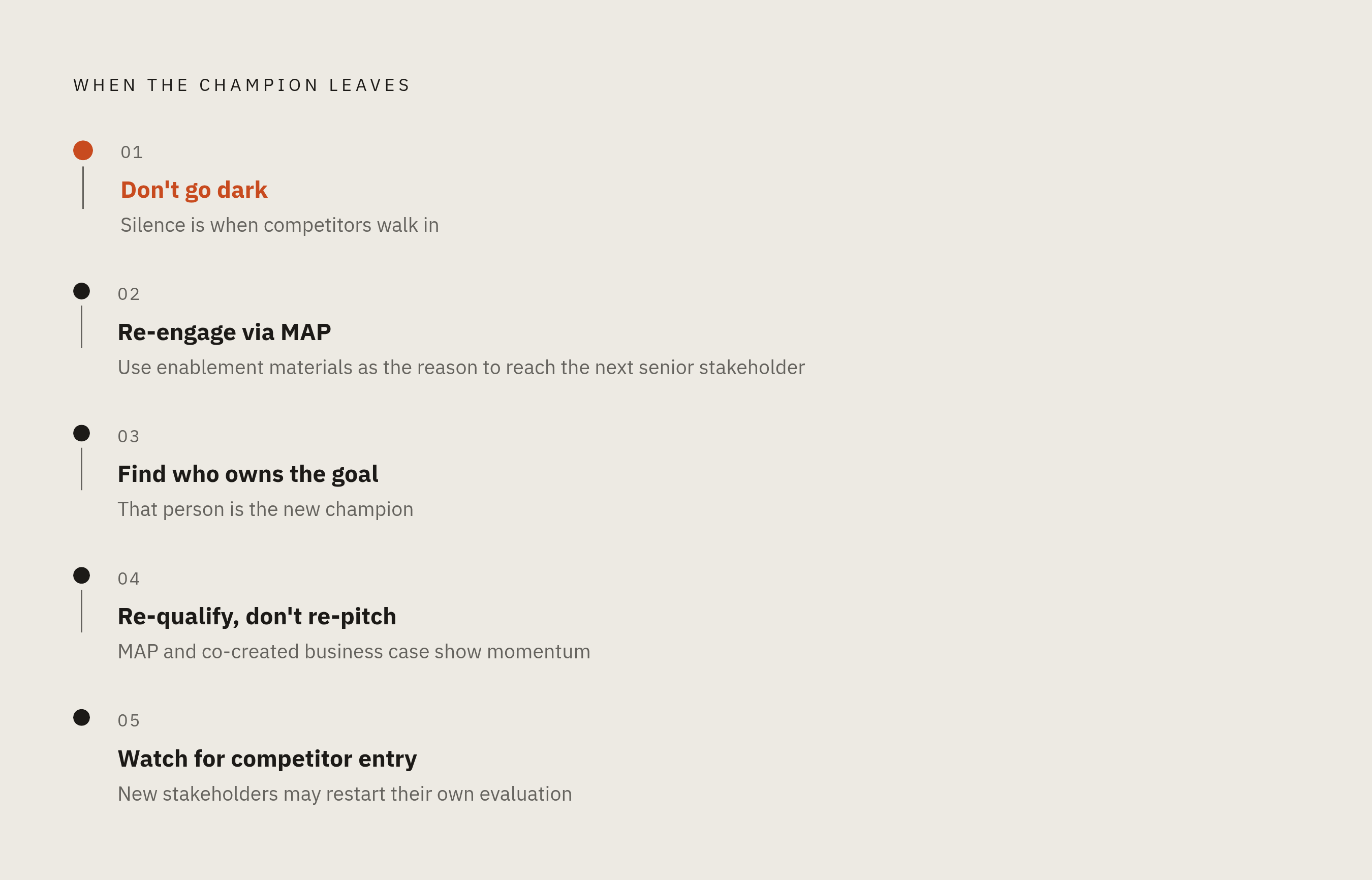
Once a champion is gone without warning, the rep has a short window to re-establish footing in the account before the deal either dies quietly or a competitor claims the opening. The first move is simple: don't go dark waiting for a new contact to surface on their own, because that silence is exactly when competitors walk in. The second move is to use the MAP and the enablement materials already built as the reason for reaching back out, approaching the next most senior stakeholder already involved in the deal with something concrete to say, something like, "I wanted to make sure the timeline we built with [name] doesn't lose momentum during the transition." The third move is figuring out, fast, who now owns getting the departed champion's business goal solved, because that person is the new champion, and they're often not the official replacement hire. The fourth move is re-qualifying the opportunity without re-pitching it from zero: the new stakeholder needs to understand the deal, but running a full demo again signals the vendor has no momentum and is starting over, so the MAP and the co-created business case should do the work of showing what's already been accomplished. The fifth move is watching for signs a competitor is entering the picture: Martal's B2B SaaS sales strategy guide notes buyers now self-educate and often arrive with a shortlist already formed, so a new stakeholder may quietly start their own evaluation from scratch unless account research activity is being tracked closely. None of this works if it moves slowly, because a buying signal that looked active three weeks ago can already be stale, and in mid-market deals the gap between "actively researching" and "picked a vendor" can close fast, so speed matters just as much as how well the re-entry is handled.
Using champion job changes as a proactive pipeline source, not just a loss event
A champion leaving mid-deal isn't only a loss to manage, it's a lead walking out the door to somewhere new. Reps who track that movement turn the same event that threatens one deal into the start of another. A former champion, someone who already evaluated the product, used it, or bought into it, carries the relationship, the product knowledge, and the internal credibility to move fast at their next company. None of that has to be rebuilt: the rep isn't starting from a cold open, and the champion isn't starting their evaluation over either, since they already have a formed opinion of the product. That only works if job changes are tracked as a matter of process, not stumbled on through a stray LinkedIn notification, because the window between a champion landing somewhere new and settling into their own vendor preferences closes quickly. When the new company fits the target customer profile, the outreach lands warm, discovery moves faster, and the deal can close quicker than something sourced cold. The same pattern runs in reverse inside existing accounts: a new executive arriving without any loyalty to the incumbent vendor is exactly the opening competitors look for, and it's just as much a chance for the current vendor to re-establish the relationship before it quietly fades. Layer in intent signals, category research or competitor comparisons happening at the champion's new company, and that combination of warm relationship plus active research is about as strong a reason to reach out as a rep is going to get.