Wiring Champion Job Change Alerts Directly Into Your Revenue Pipeline Reviews
Track champion moves into your CRM to convert warm relationships into booked meetings.

Champion job change tracking is a high-value pipeline signal because a proven buyer brings earned trust into a new account. To bring those alerts into revenue pipeline reviews, each move needs CRM enrichment, a named rep, outreach that fits, and conversion the team can measure. The opportunity is warm, but without that operational chain, it is still just a notification.
Why champion job changes are the highest-value signal in B2B sales
A former champion takes a VP role at an ICP-fit company, while the sales team discovers the move only after the new colleagues have introduced other vendors. The relationship was already there. The team lost the timing advantage while its product’s case remained intact. Manual LinkedIn checks across hundreds of past contacts make this gap predictable, and a spreadsheet cannot notice what nobody has entered.
Cold outbound has to establish credibility before a buyer will consider a proposal, while a former champion has evidence from a successful implementation. Their new role also creates a reason to act. New leaders need early wins, and recommending a tool they have used successfully offers a familiar route to results.
Launch Leads calls this “signal clarity,” a predictable moment of need involving a known buyer. That makes a champion arrival more specific than a form fill, although it does not guarantee a purchase. The new account still needs to fit, and the buyer’s authority still needs checking. Preserve the signal’s advantage while those checks happen, rather than leaving the opportunity in a spreadsheet until it qualifies for archaeology.
What qualifies a contact as a champion worth tracking, and how most CRMs misclassify this
A tracking program gets noisy when the CRM treats every satisfied user as a champion. Product enthusiasm is useful, but it is not buying influence. When the team tracks the wrong contacts, the alerts rarely lead anywhere, so reps learn to ignore the next notification.
SalesMotion distinguishes two requirements for a real champion, namely personal motivation and institutional credibility. The product must help the person do well, and colleagues must trust their judgment enough to listen when deciding what to buy. Both conditions have to be present. The decisive test is whether the contact will put their reputation on the line, rather than praise the product privately and disappear when the committee meets.
Boomerang identifies useful evidence in internal advocacy during renewals, proactive product feedback, proximity to expansion decisions, and public references to the vendor. These behaviors give CSMs something concrete to feed into the champion record. They also make the classification more useful than a rep’s recollection that someone was “very positive” on a call. Friendly is not a purchasing role.
Qualified closed-lost contacts should also be on the watchlist. Someone who supported the product but could not secure budget may gain purchasing authority in a new role. The old opportunity’s outcome does not settle the contact’s future value. Separating the person’s influence from the previous account’s constraints keeps potentially warm pipeline out of the CRM graveyard.
The five operational jobs a job change must complete before it becomes a booked meeting
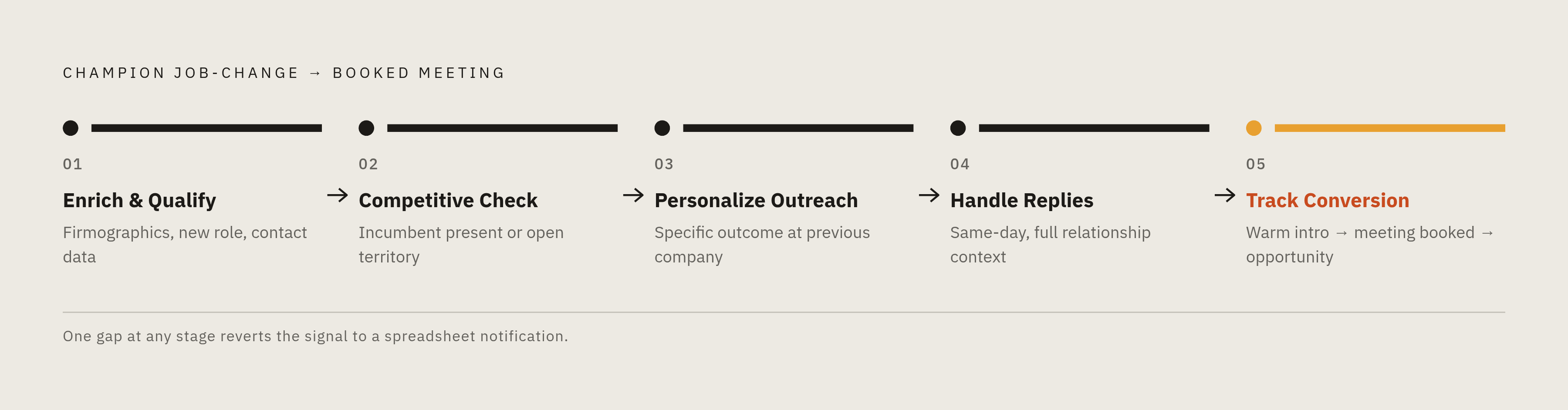
The practical workflow has five jobs, with enrichment and qualification combined at the start and conversion tracking closing the loop. Each needs a defined system or workflow. The test is straightforward. Can a move lead to a meeting without someone keeping a spreadsheet up to date?
The first job is to enrich and qualify the new account. That means getting firmographics, details of what the champion now does, and up-to-date contact data before outreach starts. The second job is to check competitive context, because an account with an incumbent competitor needs a different approach from open territory. Together, these jobs establish whether the opportunity fits and what conversation the rep should start.
The third job is to personalize outreach around a specific outcome delivered at the champion’s previous company. Shared history is the shortcut here. The fourth job is to handle replies quickly, with enough context about the relationship to answer intelligently. A fast alert followed by a multi-day reply queue simply moves the bottleneck.
The fifth job is to keep track of conversion. Boomerang specifies the chain from warm intro to meeting booked to opportunity created, giving the team a way to locate losses between stages. Timing also needs calibration, rather than a race to send the first congratulatory message. Launch Leads places the optimal initial contact window at two to four weeks after a move, when the champion has had time to settle in but may still be looking for early wins.
How to route job change alerts in the CRM so they get acted on, not ignored
A shared inbox is not an owner. Neither is a feed of alerts that reps remember to check when their calendars miraculously clear. Both leave reps to act when they have time to spare. To remove that dependency, route the alert to a specific rep with the same discipline used for an inbound demo request.
The CRM configuration should assign the AE responsible for the new account immediately and trigger an auto-drafted warm intro request. Enrichment should run automatically on every alert, qualifying the account within minutes. The rep should receive an actionable opportunity. When a tracked contact replies, use a same-day response SLA.
Automatic CRM write-back is a must because a separate feed gives work another place to hide. Coverage must match the system the team actually uses, whether that is Salesforce, HubSpot, Pipedrive, or Zoho. A Salesforce-only integration cannot solve routing for a team working elsewhere.
This configuration also separates initial outreach timing from operational speed. Assignment and enrichment should happen immediately, even when the first message is scheduled for the appropriate contact window. A reply, by contrast, should not wait for that schedule. Treating these as distinct clocks prevents “give them time to settle in” from becoming an excuse for leaving an alert untouched.
Layering competitive context onto champion alerts to catch buyers mid-evaluation
A champion arriving at an account with an incumbent competitor creates a different opening from a champion entering open territory. The rep may be joining an evaluation already underway. That changes the message. A generic invitation to discover the product ignores both the existing relationship and the new company’s current choice.
Competitive context becomes more precise when the job change coincides with the account reading competitor reviews or consuming “alternatives to [Competitor]” content. What people do on review platforms gives the team second-party intent that can show they are weighing their options now. The champion’s arrival supplies the relationship, while the content activity supplies a clue about the account’s immediate question. Neither signal has to dress up as a signed purchase order.
For a competitive intercept, the outreach should acknowledge the incumbent and offer a specific reason to evaluate. Where an upcoming renewal is known, it provides a natural decision point. The objective is a relevant comparison. A warm contact should not have to explain why the current contract exists before the seller becomes useful.
Content can also trigger a micro-ABM play, with ads highlighting differentiated advantages and a rep offering a structured comparison. Dissatisfaction can be visible in private community discussions and AI-driven conversational research before a public review or form fill appears. These less visible signals add context where available. Their purpose is to sharpen the evaluation frame while keeping the champion alert in focus.
What the outreach message itself must do differently for a champion versus a cold prospect
Sending a champion the standard cold sequence throws away the trust that the tracking system was built to keep. The buyer already knows the category and features. What they need to recognize is that the seller remembers the outcome they achieved together.
The contrast is simple without inventing a testimonial. A cold-template message explains what the product does and asks whether the prospect has the problem it solves. A champion-specific message refers to the actual result at the previous company, connects it to the new responsibilities, and asks whether a similar result would be useful there. The details must come from the relationship record.
In open territory, the message can explore replicating a known success. At a competitive account, it should acknowledge the incumbent and offer a specific evaluation path. This is where the earlier research earns its keep, because the rep no longer has to choose between a warm message and an informed one.
Relevant content can make that invitation more useful. A benchmark, a case study from the champion’s new industry, or a migration assessment gives the buyer something suited to the decision ahead. Familiarity opens the door, but relevance gives the champion a reason to keep it open.
What job change tracking tool will wire alerts into your existing stack?
Choose a tool with automatic CRM write-back so alerts enter the CRM workflow. The other criteria are CRM coverage, buying committee enrichment for ABM, churn early-warning when champions depart, and setup effort. Departures help protect existing revenue, while arrivals open expansion into new accounts. A tool that requires another daily feed check rebuilds the manual problem with a subscription attached.
The descriptions of vendors here are as of August 2026 and should be checked in a live demo before buying. UserGems is an enterprise signal platform that combines champion job changes with other buying signals, primarily for Salesforce and HubSpot teams. Its pricing and rollout are geared toward larger organizations. Champify is Salesforce-native and focuses on past champions and users moving into target accounts, making it a more focused fit for Salesforce-centric outbound teams than for teams on other CRMs.
LinkedIn Sales Navigator displays moves for leads that reps have manually saved, but it cannot scan the full CRM or write back to it. Reps must check the feed themselves. Common Room takes the broader route, combining job changes with product usage, community activity, and social signals, which suits teams seeking a full signal stack but can be heavier than a champion-only program requires.
Live Data Technologies has raw job change feeds and APIs for teams that build their own workflows. That offers flexibility but requires engineering resources, CRM plumbing, and playbook development. The choice is therefore partly about who will build the connection. The work needed to set it up affects how soon reps can use the alerts and whether they use the workflow at all.
Running the program: ownership model, SLAs, and the quarterly review that keeps it converting
Continuous monitoring needs continuous ownership. Boomerang assigns program ownership at Series C+ to customer marketing, with CSMs supplying champion data and sales acting on alerts. The handoffs are explicit. Each function has a job, so “joint ownership” does not become a polite term for nobody checking.
The operating review should test the standards already built into routing, including immediate assignment, enrichment within minutes, and same-day responses to replies. Quarterly pipeline reviews should then compare champion-sourced win rates with the standard outbound baseline. Boomerang takes the conversion chain through closed revenue, so the team can measure each stage in the CRM. This makes it possible to distinguish weak qualification from poor outreach or slow follow-up, rather than treating every missed meeting as the same failure.
The network also needs care between moves. Champions stay engaged through customer awards that recognize them publicly on LinkedIn, exclusive product access that lets them shape the roadmap and try early features, and CXO networking with their peers. As successful implementations accumulate, the watchlist can grow from those relationships while maintaining the champion criteria, creating the compounding effect Launch Leads describes.
Unify’s 2026 Pylon customer story reports four-point-two times ROI and three times more meetings from an orchestrated automated outbound motion. That provides evidence for orchestration in the automated outbound motion described. A program must show what it adds through its own conversion chain.