Champion Departure and Churn Risk Response Playbook
When a key contact leaves, you have 48 hours to prevent up to half the account from churning.

A champion leaves. Somewhere between 51% and 65% of those accounts churn within a year, depending on how senior that champion was, according to Sturdy's data via ChurnZero. That's the whole story in one sentence: departure isn't the risk, it's the flashlight that shows you the risk was already there. This piece breaks down what actually happens in those accounts and the five moves that decide whether you keep them.
What the churn benchmarks reveal about where champion risk is most concentrated
Start with the math, because the math is unflattering. B2B SaaS churned around 12.5% annually in 2025. Run that through a $30M ARR business and you're bleeding $3.75 million a year before anyone even talks about contraction. Flip it around: shave one point off churn and you've just kept $300K in ARR that nobody has to go sell for. That's not a customer success talking point. That's a CRO's whole quarter.
GrowthSpree's 2026 benchmarks put median gross revenue churn at 12%, with the top quartile under 6% and the bottom quartile over 20%. That spread is enormous, and it's not random. It tracks segment and vertical almost perfectly.
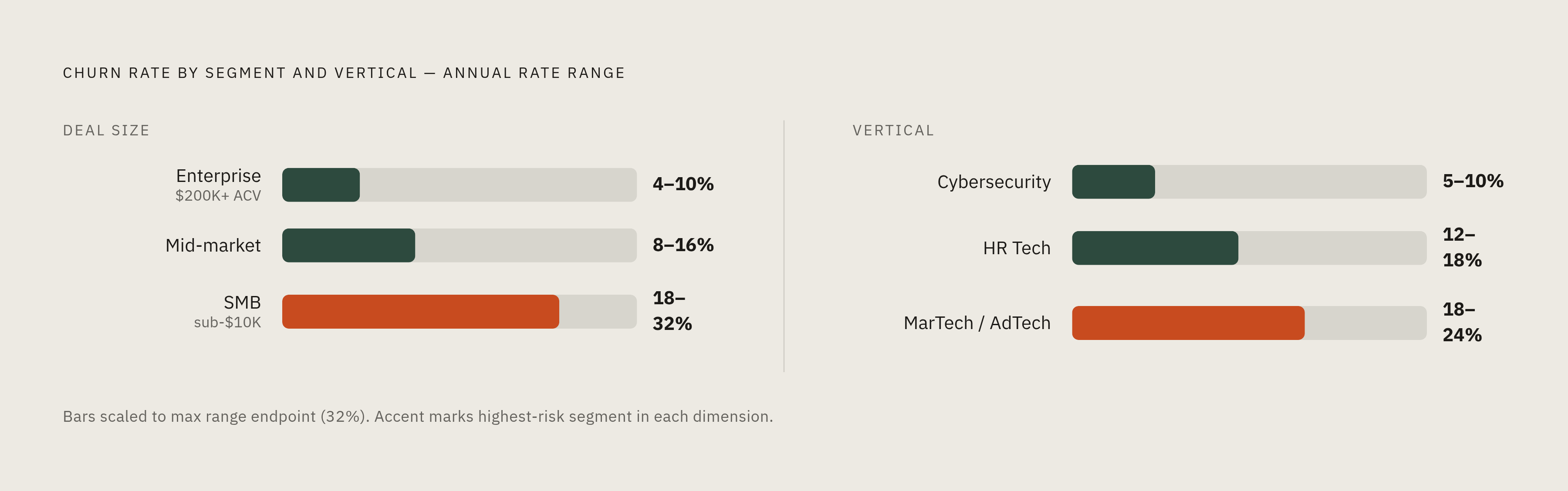
Enterprise accounts ($200K+ ACV) churn at 4 to 10% a year, which sounds great until you remember each one of those losses is a gut punch to ARR. Mid-market sits at 8 to 16%. SMB, the sub-$10K crowd, churns at 18 to 32%, but losing one of those barely dents the model. Small deals die often and it doesn't matter much. Big deals die rarely and it matters enormously.
Layer vertical on top and the picture sharpens further. MarTech and AdTech run 18 to 24% gross churn, partly because marketing spend tends to face recurring scrutiny, and a champion exit ahead of a budget review is about as bad timing as it gets. HR Tech sits at 12 to 18%. Cybersecurity, by contrast, holds at 5 to 10%, because ripping out a compliance-tied security tool is its own special kind of headache, and that headache buys vendors a cushion even when the champion who bought the tool is long gone.
Put enterprise ACV and a high-churn vertical in the same account, and the exposure compounds. That's exactly where a structured departure-response playbook earns its keep. And here's the detail that should sting a little: 53% of enterprise SaaS churn traces back to weak onboarding, poor relationship management, and reactive service, according to getmaxiq.com. All three of those are exactly what a brand-new champion goes looking for when they inherit a tool they never asked for.
The 48-hour detection window and why most teams miss it
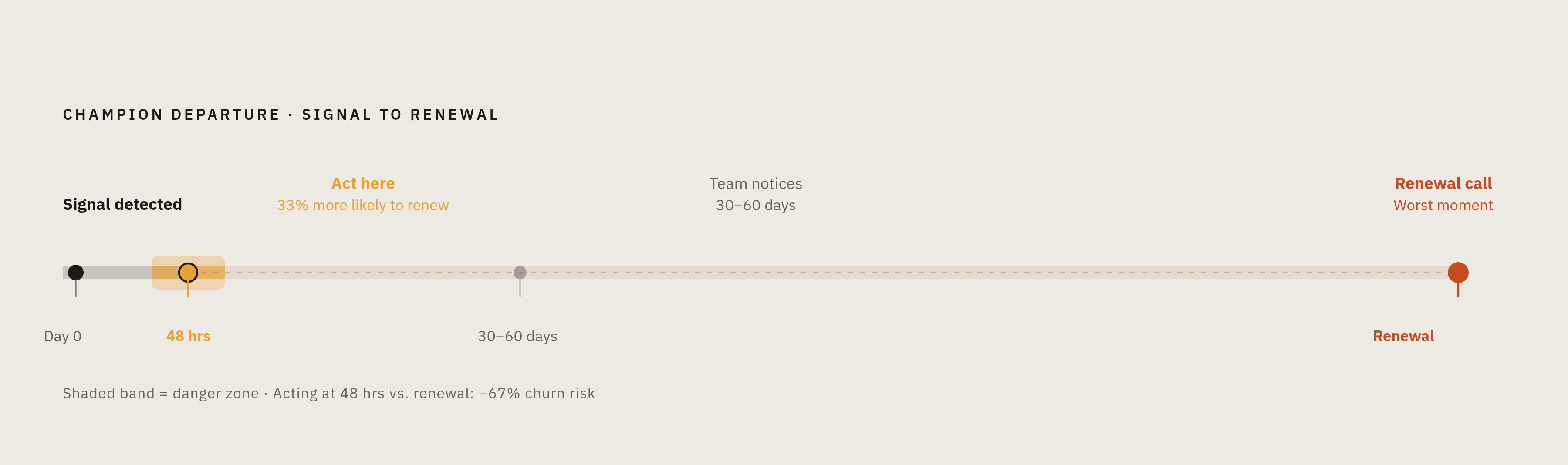
Here's the number worth tattooing on the inside of your CRM: accounts where CS acts on an executive change signal within 48 hours are 33% more likely to renew, per Sturdy's research via ChurnZero. Not 48 days. Forty-eight hours.
Most teams don't come close. Stakeholder change typically shows up 30 to 60 days before churn does, but the average team finds out about it at the renewal call, which is roughly the worst possible moment to learn anything. By then the new contact has already formed opinions, maybe already had a competitor's rep buy them a coffee.
Why does passive monitoring fail so consistently? A few reasons, and none of them are exotic.
CRMs don't update themselves. Contact records go stale the second someone changes jobs, and nobody circles back to fix it until the deal's already wobbling. Usage data tells you something's wrong weeks after it's already wrong, since it reflects the consequences of a departure, not the departure itself. And most teams simply aren't watching the right channels. AI-driven sentiment analysis of emails, calls, and support tickets can flag relationship decay earlier than product usage data alone, according to getmaxiq.com's 2026 guide. That's a lot of runway to waste.
A functional detection stack isn't complicated. It just has to actually run:
- LinkedIn job-change alerts on every named contact in the account
- Company news alerts for executive shuffles and reorgs
- Email open-rate drop-off and community engagement dips
- NPS, CSAT trend shifts, and support ticket spikes, which can flag risk well ahead of renewal
MaxIQ's 2026 numbers show CS intervention at the signal stage cuts churn 25 to 45%. Tools like LinkedIn Sales Navigator, Champify, UserGems, Boomerang, LoneScale, The Swarm, and Common Room exist specifically to catch these signals systematically. But detection alone doesn't save an account. It just tells you the fire started. Somebody still has to grab the hose, automatically, the moment the alert fires, not three business days later after it's been triaged into a queue.
There's a sharper signal too: buyer intent data that shows a newly inherited account actively researching competitors. That's not "someone left." That's "someone left, and their replacement is already shopping." Treat those two signals very differently.
Step 1: Reaching the new contact before the window closes
The first message to a new contact is not a pitch. Every vendor touching that account is about to slide into their inbox with some version of "excited to continue the partnership," and every one of those messages reads as self-interested, because it is. The move that stands out is the one that leads with something useful instead of something sales-shaped.
A short note works better than a deck. Congratulate them on the role. Offer time on their schedule, not yours. Frame the meeting around helping them understand what their team already gets out of the product, not around the contract sitting on your desk with a renewal date circled in red.
Run a parallel track while the old champion is still reachable. Ask who's stepping into the role and whether they'd make an introduction. A warm introduction from a departing champion who had a good experience beats a cold LinkedIn message every time.
Before that first call happens, the CSM needs three things done, not winged:
- A full account history: usage depth, feature adoption, every support case and how well it was actually resolved
- A read on the new contact's background: past companies, past roles, the priorities and blind spots that come with that resume
- A list of open questions about what changed internally and what this person is now being measured on
Ali Cudby of Alignmint Growth Strategies, in commentary shared through ChurnZero, describes a "you, we, me" structure for that first meeting, and it holds up well. Start with "you": let the new contact talk about their context and concerns without any product mentioned. Move to "we": walk through the shared history and the outcomes achieved, including what the old champion actually cared about. Only then, "me": what you can offer, mapped to their goals, not the previous person's.
The trap to avoid is treating the new contact like a replacement part for the old one. Different person, different priorities, probably a different way of measuring success entirely. Pitching them the old champion's win is like handing someone their predecessor's business card and expecting it to mean something.
Step 2: Multi-threading the account before and after a departure
Single-champion accounts carry 2 to 3 times the churn risk on departure. That's not a soft correlation, that's a structural weak point, the account equivalent of wiring your whole house through one extension cord.
The fix is multi-threading, and the data backs it hard: Forecastio's 2024 research found deals with three or more stakeholders close at 68%, versus 23% for single-threaded deals. Renewals run on the same logic. One relationship is one point of failure.
The target is 3 to 5 named relationships spanning different functions, not just whoever signs the check:
- The economic buyer who approves the contract
- The end-user champion using the product day to day
- A technical stakeholder handling integration or security
- An executive sponsor focused on strategic fit
That last one deserves its own program. An executive sponsor cadence, run on a regular basis, C-level to C-level, focused on strategic value rather than product metrics or renewal logistics, keeps a relationship alive at a level a champion departure can't touch.
Oddly enough, a departure is actually a decent excuse to widen the net. A new contact joining the account gives you a natural reason to introduce them to more people on your side, and that introduction tends to surface more people on theirs. Use the transition instead of just surviving it. And internally, map the new stakeholder landscape in the CRM right away: who holds budget authority, who influences the decision, who's a likely skeptic versus a likely ally.
One more lever worth building into the cadence: sending the right piece of thought leadership to the right stakeholder at the right time does relationship work between the actual calls. That matters most with a skeptical new contact who doesn't yet trust anything coming from a vendor's inbox.
Step 3: Rebuilding perceived value for a contact who didn't buy
Here's the blunt version of the problem: the new contact never chose this product. They have zero emotional investment in it, and the working assumption in their head is that it's probably not necessary. Not "prove it's good." "Prove it needs to exist at all."
That means ROI has to get rebuilt from scratch, in language the new contact actually uses.
Pull whatever outcomes data the old champion cared about and translate it into terms the new person is measured on. Usage data by itself won't do the job. Nobody gets promoted for high feature adoption. Reframe it as time saved, pipeline touched, risk reduced, whatever maps to what this person's boss is asking them about.
A short, structured outcome retrospective helps here, whether AI-moderated or just a well-run interview: what did the account hope to achieve, what actually happened, what's still missing. That retrospective becomes the renewal narrative, and it beats improvising a pitch from memory every single time.
Speaking of improvising: don't. Build the toolkit once, templates for intro emails, onboarding-the-new-contact meeting agendas, updated success plans, and reuse it. Rebuilding this from scratch for every at-risk account doesn't scale, and at scale is exactly when it needs to work.
The stakes are concrete. 22% of B2B SaaS churn comes down to a value gap, customers who never got the ROI they expected. A new contact is going to form their own judgment about that value quickly, typically well before the renewal conversation begins. Whoever shapes that judgment first tends to win it. A well-timed case study from a comparable company, or a sharp piece of market analysis, sent before the first renewal conversation, does real work here precisely because it isn't asking for anything.
Step 4: Redesigning the renewal motion around continuous validation rather than a single call
A renewal call that's the first time anyone asks "are you getting value out of this" is a renewal call that's already too late. The call should be a summary of a 90-day window of evidence, not the opening question.
A cadence that actually catches problems early looks something like this:
At T-120 days, check champion stability. Are they still in the role, still holding budget, still funded internally? Sponsor turnover at this stage is, by a wide margin, the single biggest predictor of churn nobody saw coming. At T-90 days, run the outcome retrospective from Step 3, structured or AI-moderated, and use it to build the renewal narrative. At T-60 days, widen the lens: interview multiple stakeholders, not just the primary contact, to check whether value is understood across the account or just by one person who might be on their way out the door too.
Watch behavior, not just words. A renewal conversation that keeps getting pushed, legal getting pulled in unusually early, a QBR declined two quarters running: these are operational tells of disengagement, and a real cadence catches them 30 to 60 days before they'd otherwise surface.
Expansion is the cleanest leading indicator available. Accounts actively expanding churn at meaningfully lower rates than accounts sitting flat on usage. So the renewal motion should include an actual expansion conversation, not just a "please don't leave" conversation.
There's a parallel worth drawing to onboarding. Forrester's research, cited in Arcade's 2026 guide, found that activation depth in the first 60 days predicts retention better than any single later intervention from a CSM. Redesigning the renewal motion is the same insight, just applied to the other end of the lifecycle. And per ChurnZero's internal research, only about half of CS organizations have a formal key-contact-change play in place at all. Which means doing this properly isn't table stakes yet. It's still a genuine edge.
Step 5: Intercepting competitive evaluation before the new contact has ranked vendors
The first 30 to 60 days after a new contact takes over is prime hunting season for a competitive evaluation. They've got the political cover to question decisions they didn't make, and the budget authority to act on what they find.
By the time a buyer engages a seller, a large chunk of the buying journey is usually already finished, and most buying groups have already ranked their preferred options before that first conversation even happens, according to industry buyer-behavior research. A new contact quietly re-ranking your product against alternatives is running the exact same process. You just don't get invited to watch.
Competitive intent inside an existing account tends to show up in a few specific places: someone at the account viewing competitor profiles or pricing pages, competitor names surfacing in support tickets or recorded calls, or a new contact's LinkedIn history and prior employer's tech stack hinting at which alternatives they already know well.
G2's Buyer Intent product added Competitive Intent Signals in August 2025, giving visibility into when contacts at existing accounts engage with competitor content — a signal that a new contact may already be evaluating alternatives.t product added Competitive Intent Signals in August 2025, giving visibility into exactly this kind of behavior, existing customers browsing competitor pricing pages, which is the sort of re-evaluation an account team would otherwise only discover at the worst possible moment: the renewal call.
When that signal fires, the response needs teeth. Escalate straight to executive engagement, not a routine CSM check-in. Bring out a competitive battlecard built around the new contact's stated priorities, not the old champion's. And compress the Step 3 value-rebuild timeline, because the real window here is shorter than the standard renewal calendar assumes.
The catch with intent data generally: the market's flooded with it, and a meaningful share of organizations report that the signals they get are unreliable or inflated. Volume of data isn't the edge. Routing a real signal to a defined action with a real deadline, that's the edge, and most teams still don't have it wired up.
The offensive flip: turning a departed champion into net-new pipeline
A champion who leaves doesn't disappear from the relationship. They walk into a new company, and that new company is a fresh account with a built-in advocate who already knows the product, already trusts the team, and doesn't need a demo explaining what the thing does.
Champify built an entire category around exactly this movement, tracking champions as they change jobs so sales teams can follow them into net-new accounts instead of treating a departure as a pure loss column entry. The logic is straightforward once someone points it out: a happy champion leaving is a warm lead wearing a new company badge, not a dead deal.
That reframes the whole playbook. Every step above, fast outreach, multi-threading, rebuilt ROI narratives, a real renewal cadence, competitive intercepts, is about defending the account left behind. This last move says the account isn't the only asset in play. The person is too, and the person just took your product to a company that's never heard your pitch. Treat the departure like a closed door and you lose twice. Treat it like a door that opened somewhere else, and the same event that torched your renewal forecast just handed sales a lead that already trusts you.