Inbound vs Outbound Leads Quality and Conversion Rate Comparison
Inbound leads convert faster early; outbound deals close bigger later.

Inbound and outbound leads don't just close at different rates. They earn their conversion at completely different points in the funnel, and if your revenue team doesn't know which channel does its heavy lifting where, you're going to pour budget into the wrong stage and wonder why pipeline still feels thin six months later.
The real split isn't inbound versus outbound as channels. It's intent-initiated contact versus interruption-initiated contact. An inbound buyer already spotted a problem, went looking for answers, and showed up on your site of their own accord. That intent is baked in before your team says a word. An outbound buyer gets pulled out of whatever they were doing, and their readiness is a mystery box the rep has to crack open on a call nobody asked for.
That behavioral gap is why conversion rates split the way they do, and it's why close rate alone tells you almost nothing useful. Close rate flattens deal size, sales cycle length, and how much rep effort a lead soaks up before it turns into money. A fair read has to track conversion at each funnel stage, deal size, and cost to convert side by side. So take this as a stage-by-stage breakdown, not a final verdict.
There's also a reason this comparison matters more now than it did five years ago. Buyers do most of their homework before they ever pick up the phone with a vendor. By the time outreach starts, a lot of the decision already happened quietly, off to the side, where sales can't see it. That shift shrinks the window where outbound can change a buyer's mind and puts more weight on whatever impression inbound content made earlier.
Where inbound earns its conversion advantage: the top-of-funnel gap
Inbound wins at the top of the funnel, and it's not close. SEO and organic content pull in people already digging into a problem on their own; the channel does the qualifying before a rep lifts a finger. First Page Sage's 2024 numbers show inbound beating outbound-sourced leads on lead-to-MQL conversion by a wide margin, mostly because those inbound contacts already fit the problem profile before anyone runs a lead score.
Inside inbound, the sub-channels don't pull equal weight either. SEO-generated leads sit at the top of the MQL stack. Paid search, despite eating more budget and hogging more attention on dashboards, trails well behind it.
The cost math makes the gap worse for outbound, not better. HubSpot's 2024 State of Marketing Report puts inbound leads at roughly three-fifths cheaper per lead than outbound, on average. Inside inbound, SEO cost-per-lead runs a fraction of what paid search costs, and that gap widens over time because content keeps earning traffic long after you've stopped paying for it. Cheaper leads that convert better isn't a coincidence, it's compounding interest. Inbound also just produces more raw volume than paid advertising overall.
None of that tells you whether those leads actually close, though. Volume and MQL rate are a top-of-funnel story. What happens after the form fill is a different question, and it's the one that actually pays the bills.
How the close-rate gap opens — and where outbound narrows it
Here's the stat everyone quotes: SEO-sourced leads close at roughly 8.5 times the rate of cold-call or cold-email leads. It's the single most-cited number in this whole comparison, and it's real. But it measures the average cold outbound list, not a well-run targeted campaign, and that difference changes how you should read it.
Point outbound at a tightly defined ICP instead of a spray-and-pray list, and the close rate recovers fast, sometimes past inbound. Some analyses show targeted outbound beating inbound outright when the fit is genuinely strong. Outbound's close-rate problem isn't a ceiling built into the channel. It's a targeting problem, and targeting problems get fixed with better lists and sharper research, not with hope.
Close rate also hides outbound's best card: deal size. Outbound campaigns generate meaningfully larger average deal sizes than inbound, roughly half again as large, according to available benchmarks. Run the math and a rep closing fewer, bigger outbound deals can out-earn a rep closing more, smaller inbound deals. Revenue per opportunity settles an argument close rate alone can't.
The Ebsta and Pavilion 2025 GTM Benchmarks tried to settle it a different way, blending win rate, deal value, and sales cycle length into one composite score. Outbound landed within striking distance of organic inbound on that measure. Paid lead generation, meanwhile, scored dramatically worse, the weakest performer in the whole study. So the real story isn't inbound beating outbound. It's inbound and outbound running neck and neck, with paid lagging far behind both.
The funnel-stage breakdown: where each channel's leverage actually sits
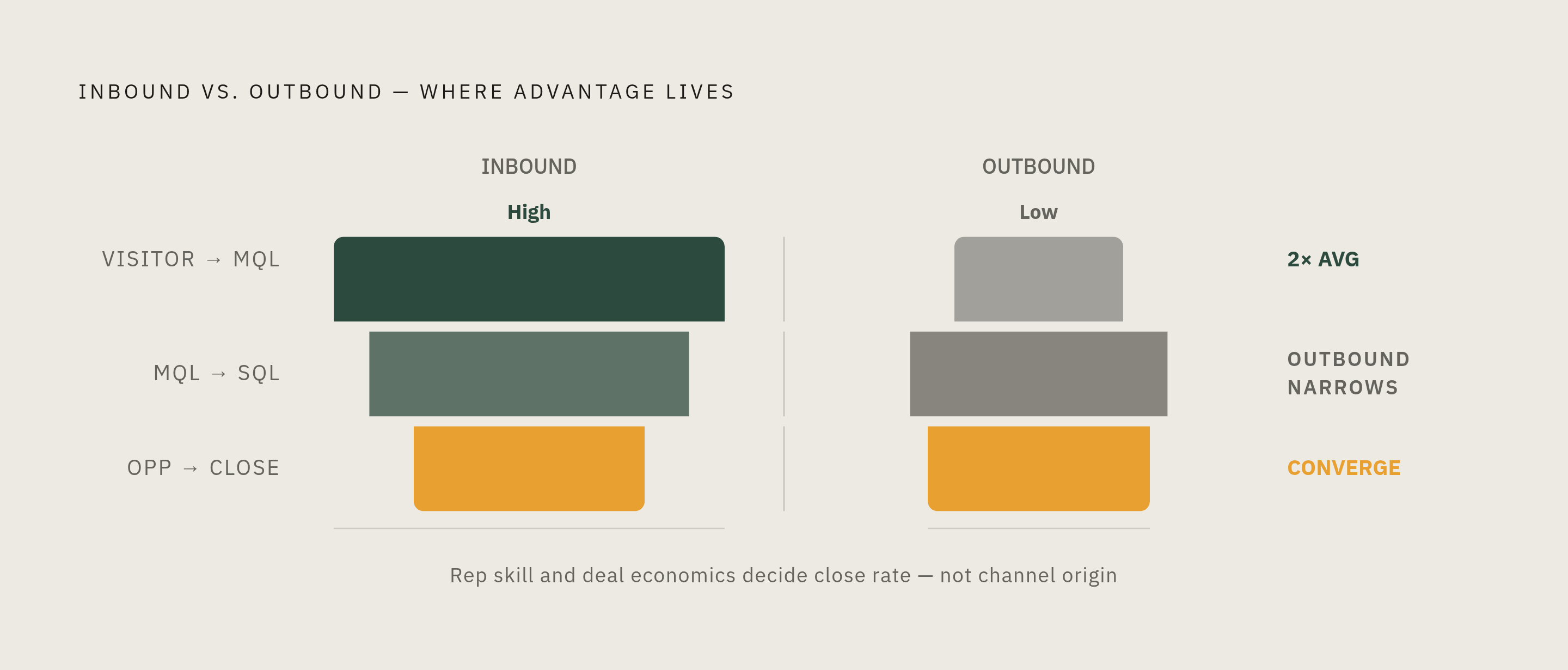
Visitor-to-lead and lead-to-MQL belong to inbound. That's where the self-selection effect is loudest: organic search surfaces people already researching, while paid search pulls in a much weaker intent signal by comparison. MQL-to-SQL conversion for SEO-sourced leads sits well above the funnel average, while cold list leads convert at a fraction of that rate at the exact same stage. Website-generated leads, form fills and chat, convert at MQL-to-SQL rates more than double the overall average.
Mid-funnel is where outbound's discipline starts paying off. An outbound lead that makes it to SQL already survived a manual filter the rep applied by hand. The pool is smaller, sure, but it's pre-screened in a way raw inbound traffic isn't. That's why outbound's funnel looks thin at the top and comparatively strong in the middle once targeting is tight. Compare that to inbound's mid-funnel: Data from over a million B2B SaaS form submissions shows median qualified-to-booked rates sitting well above the typical outbound contact-to-meeting rate.
By the time you're at opportunity-to-close, channel origin stops mattering much. Rep skill, deal economics, and how you stack up against competitors decide the outcome more than whether the lead started as a cold email or an organic search. Close rates converge here in a way the earlier stages don't prepare you for.
One more wrinkle worth naming: sourcing pipeline and closing pipeline are different jobs, and the data treats them that way. The Ebsta and Pavilion 2025 GTM Benchmarks found BDR-sourced pipeline outpacing AE-sourced pipeline, meaning the prospecting role generates more raw pipeline than the closing role does on its own. That reframes the whole outbound ROI debate: you're not just buying meetings, you're buying volume closers can't generate by themselves. A 2025 industry analyst survey of B2B technology marketing leaders on marketing-sourced pipeline shows a wide spread between median performers and the top quartile, and that gap is execution, not some innate advantage baked into the channel.
What outbound economics actually look like when you price them honestly
Most teams underprice outbound, badly. The Bridge Group's 2025 SDR report, covering a large sample of B2B companies, puts median SDR on-target earnings and monthly meeting quotas in a range that implies a cost per held meeting well above what inbound benchmarks show for a qualified form fill. And that's before tooling, data subscriptions, and management overhead get added in, all of which push the fully-loaded cost per meeting higher still. SDR attrition runs high, ramp takes months, and both facts quietly inflate the true cost of the channel past what a simple headcount-times-salary spreadsheet would suggest.
Cold email isn't helping the case, either. Open rates and reply rates have fallen off hard over the past several years, according to LeadHaste's 2026 data, to the point where it now takes a large volume of sends just to book one meeting. LinkedIn direct message beats cold email on response rate by a meaningful margin, which means the channel mix inside outbound matters as much as the outbound-versus-inbound question itself. Multi-channel sequences beat single-channel outbound by a factor of two to three across available benchmarks, so teams running email-only outbound are underperforming even by outbound's own low bar.
Cold calling, oddly enough, is having a comeback. A large-scale cold calling study covering tens of thousands of dials recorded a dial-to-meeting rate that roughly doubled year over year, and found most B2B buyers will actually take a cold call. C-level and VP buyers have been found to prefer phone contact over email, which builds a real case for call-heavy outbound on senior-target campaigns, even in an era everyone assumes has gone all-digital.
Then there's the downstream problem nobody likes to talk about: AE quota attainment is sliding. Recent AE benchmark data found fewer than half of reps hitting quota, with ramp time at a multi-year high. Translation: outbound pipeline alone can't carry a revenue target if the closing side of the house is stretched this thin. Inbound pipeline stops being a nice-to-have at that point. It becomes load-bearing.
How intent signals change the conversion equation for both channels
Most of the buying activity happening around your product is invisible to you. Buying groups finish most of their vendor ranking before any sales contact, and they do it anonymously; your inbound content only converts for the fraction of buyers who happen to fill out a form. Intent data exists to make that anonymous majority visible.
Think of intent signals in three tiers. First-party signals, the ones off your own site, carry the highest confidence and the smallest population: pricing page visits, case study downloads, a return visit from someone who was here two weeks ago. Second-party signals come from review sites like G2 or TrustRadius and tend to show up mid-to-late funnel; someone reading a competitor comparison page there is actively sizing up vendors. Third-party signals come from data co-ops that aggregate research activity across thousands of B2B publisher sites, and they show up earlier, flagging topic surges before a buyer has settled on any vendor at all. Matching the right signal to the right funnel stage is the execution gap most teams never close.
Adoption of intent data runs high across B2B marketing, but only a small slice of teams report real ROI from it. The gap between buying the data and the data actually making money comes down to execution almost every time: catching the signal is the easy part, pairing it with fast, relevant outreach and stage-appropriate content is the part most teams skip.
If there's one signal worth treating as a fire alarm, it's a buyer landing on competitor comparison pages or "X vs. Y" content. That's not category research anymore, that's decision mode. The account is actively weighing alternatives right now, and that's exactly the moment for outbound prioritization, sharp competitive positioning, and, frankly, getting an executive on the phone. It's the highest-leverage moment in the whole sales process, for marketing and sales alike.
None of it matters if you're slow. Multiple independent studies show qualification odds drop sharply once the response to a signal or form fill lags by more than a few minutes; the buyer's attention window is short and it closes fast. Intent data is only as good as the speed of the outreach it triggers.
The hybrid model that outperforms either channel alone
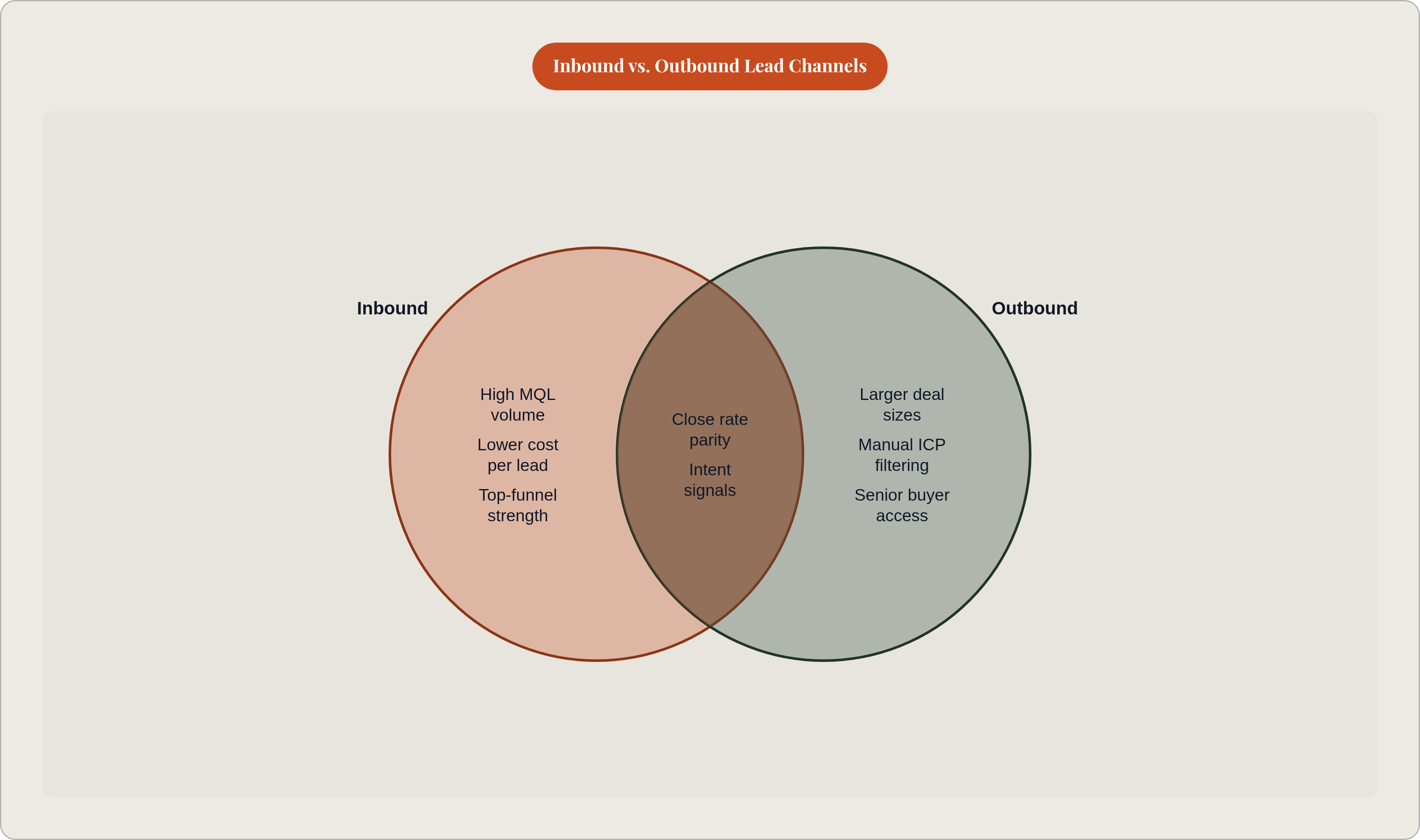
Teams running both channels together outgrow single-channel bettors on revenue by a wide margin, according to available benchmark data. The combination doesn't just add up, it multiplies, because each channel patches the other one's blind spot.
Here's the loop: inbound content builds the research presence that gets a brand onto a buyer's shortlist before outbound ever makes contact, covering the consideration phase outbound can't reach on its own. Intent signals thrown off by that same inbound activity, content downloads, pricing page visits, comparison page views, become the targeting list for outbound that's actually precise instead of a cold blast. And the objections reps hear on calls point straight back to the content gaps and competitive worries the inbound program should tackle next. Outbound turns into a feedback loop for content, not just a separate lane running in parallel.
Account-based marketing is the structured version of that hybrid. Organizations that align sales and marketing around ABM programs report substantially higher win rates, and the programs that stay narrow, targeting a focused account set instead of going broad, show the strongest returns. Spread ABM too thin and you lose the precision that made it work in the first place.
There's a third channel worth naming here: referral. The Ebsta and Pavilion 2025 GTM Benchmarks scored partner referral as the single highest-efficiency channel on their composite index, ahead of both inbound and outbound. Content that earns partner and customer referrals ends up compounding the efficiency of the other two channels instead of competing with them for credit.
One last note on timing, because it trips up more teams than it should: inbound needs six to twelve months to build real pipeline from a standing start. Teams that treat it as a side project, something to dabble in between outbound pushes, never stick around long enough to find out what it can actually do.