Outbound Sales Meaning for Modern Revenue Teams
Winning teams now target buyers actively researching, not just companies that fit the profile.

Outbound sales sounds simple on paper: a seller starts the conversation instead of waiting around for inbound to show up. In practice, right now, in 2025, the teams winning at this game have quietly rebuilt outbound around precision instead of volume. Everyone else is still grinding cold call lists and fighting over scraps.
That distinction matters more than the tired "is outbound dead" debate that keeps making the rounds on LinkedIn. Nearly 28% of B2B revenue still traces directly back to outbound. About 37% of revenue teams run a dedicated outbound function, and another 43% run some hybrid of inbound and outbound working together. Add it up and four out of five revenue teams still build part of their org chart around outbound. You don't do that for a corpse.
Outbound used to be cruder: cold call lists, mass email blasts, cadences built to hit anyone who technically fit the buyer profile. Spray and pray, basically, and it earned the category its bad reputation fair and square. The version that works now looks for buyers who are showing real evidence of being in-market, rather than buyers who just happen to check the right boxes on a firmographic filter. Same word, same starting definition, a fundamentally different job. Here's why that shift happened, and what it actually looks like in practice.
How the buying journey has moved out of reach of traditional outbound
About 70% of the B2B buying journey happens anonymously, according to research on the so-called Dark Funnel. Buyers research, compare vendors, build shortlists, and argue with their own procurement team, all before a rep ever gets a call connected.
By the time a rep's sequence fires, the buyer has usually already made up their mind. Research finds 94% of B2B buying groups have already ranked their preferred vendors before talking to a single salesperson. Separate research lands close to the same spot from a different angle: 41% of buyers pick a preferred vendor before formal evaluation even starts. Formal evaluation hasn't started, and the decision is basically made.
So a rep calls in cold with a generic pitch, three weeks after the buyer's shortlist already hardened. What happens? Nothing good. The rep isn't in a fair fight. They're competing against a decision that got made in someone else's head, weeks earlier, without them in the room.
The target moved, and outbound has to move with it, earlier, into the window where buyers are still forming opinions instead of defending ones they've already locked in. Buyers consume a lot of content in that window, almost entirely anonymously, which means the only real read on their intent is behavioral: what they're reading, comparing, and clicking on before they ever raise a hand.
And that's the gap. Most outbound teams are still prospecting the old way: company size, industry, job title. That stuff tells you someone could buy. It doesn't tell you they're about to. That gap is the whole subject here.
Why raw activity volume is no longer a reliable outbound metric
The average SDR logs 94.4 activities a day now. That breaks down to 35.9 calls, 32.6 emails, 15.3 voicemails, and 7 social touches. That's an exhausting number of actions to rack up before lunch even hits.
And what does all that motion produce? Quality conversations per day have fallen to 3.6, down 55% since 2014. Reps are doing more, dialing more, logging more, and getting fewer real conversations out of it than they did a decade ago. That's not a motivation problem or a discipline problem. It's structural. The volume lever has a ceiling, and most teams are already pressed right up against it.
Single-channel strategies make it worse. Sopro's State of Prospecting 2025 report found email-only campaigns generating meaningfully fewer leads year over year. Meanwhile, sequences mixing email, phone, and LinkedIn touches see engagement jump 287% compared to single-channel approaches. The lift doesn't come from more touches. It comes from sequencing those touches with some actual thought behind them.
So if volume's the wrong lever, what's left? Precision: who you target, when you show up, what you actually say. And precision needs something volume-based outreach never needed. It needs signal intelligence.

Intent signals: the mechanism that makes precision outbound possible
Intent signals are behavioral data points showing an account is actively researching a problem, a category, or a specific vendor. Firmographic fit tells you someone's a plausible buyer. Intent signals tell you someone's an active one, right now.
There are three tiers worth knowing:
- First-party signals: your own website visits, content downloads, product usage data. Highest accuracy, since it's your data about your own prospects, but limited reach, since it only covers people who've already touched your stuff.
- Second-party signals: behavior captured on review and comparison sites like G2 or TrustRadius, where buyers evaluate vendors in public, or at least semi-public, view.
- Third-party signals: aggregated research behavior pulled from data co-ops across thousands of publisher sites. Broadest reach by far, but it goes stale fast, and stale intent data is basically useless.
The payoff for using this well is real. Teams that build intent signals into prospecting consistently see a 30% lift in lead conversion rate. But here's the catch: 91% of marketers already use intent data, and only 24% report exceptional ROI from it. Almost everyone has the tool. Almost nobody's cashing the check.
Why the gap? Mostly execution, not access. Stale data sits in a dashboard nobody opens. Signals never make it out of marketing's platform and into a rep's actual queue, because the intent data and the outreach motion live in two systems that don't talk to each other. The teams getting real ROI obsess over freshness and accuracy, then wire the signal directly into rep workflows so it shows up as a task on someone's list, not a slide in a report nobody reads.
The direction of travel is clear either way. 68% of B2B marketers are increasing their investment in intent data, and the vendor landscape is consolidating, fewer standalone point tools, more bundled platforms, as the category matures from nice-to-have add-on into core infrastructure. The tools keep getting better. Execution is the piece still lagging behind.
Competitor intent as the highest-leverage outbound signal
Intent signals aren't all equal, and competitor intent sits at the top of the pile. This is the signal that shows a buyer actively sizing up a competitor: visiting a G2 comparison page, reading an "X vs. Y" post, checking out rival reviews, poking around a competitor's pricing page.
Why does this beat generic research activity? Because it confirms the buyer isn't browsing anymore. They're deciding. The shortlist already exists, and someone on that buying team is narrowing it down this week, maybe this afternoon. That's why competitor intent tends to trigger outbound's highest-priority plays: pricing escalation, exec-to-exec outreach, the moves that can't wait for next Monday's cadence. The window compresses fast here, and waiting even a few days can mean the deal walks somewhere else.
The plumbing behind this signal has gotten genuinely good. Review platforms like G2 route competitor-comparison behavior, alternatives-tab visits, category comparisons, profile views, straight into CRM and sales tools with daily buying-stage scores attached. TrustRadius captures similar late-stage comparison behavior, useful both for competitive takeout plays and for catching your own accounts quietly shopping around before they churn.
None of this works if the messaging doesn't shift to match it. A buyer deep in competitor comparison mode already knows the category cold. Another feature list won't move them. What works instead: sequences that lead with differentiation instead of a product tour, benchmarks and risk framing instead of a pitch deck, and speed, because the window between signal and rep contact closes fast.
Conversation intelligence adds a layer on top of all this. GTM teams using AI conversation intelligence to catch competitive mentions and pricing objections in real time on calls see 35% higher win rates, according to Gong Labs' "Best Sales Insights of 2024." The buyer's side of this is straightforward: decision-makers respond when a supplier hands them information that actually moves their own thinking forward. Competitor-intercept moments are exactly where that kind of help lands hardest, because that's the exact moment the buyer is deciding who to trust.
What reps say when they reach an in-market buyer: content as the credibility layer
Knowing a buyer is in-market gets you through the door. It doesn't tell you what to say once you're standing in the room, and a poorly timed pitch with generic messaging wastes a signal that took real work to surface.
The receptivity is there, at least, as a starting point. 82% of buyers say they'll take meetings at least occasionally with sellers who reach out first. That's the floor. Clearing it means the outreach has to feel like it comes from someone who actually did the homework, not someone reading a script written for a different account entirely.
In-market buyers respond to sellers who clearly get their context, their problem, and their alternatives, rather than sellers reciting a features list they could've pulled off the website. This is where content stops being a marketing department output and starts being a rep's toolkit. Thought leadership and benchmark content give reps something worth sharing, something that pushes the buyer's thinking forward instead of just selling at them. Case studies work as proof exactly when a buyer is mid-evaluation, hunting for a reason to trust one vendor over another. And enablement content pre-loads reps with the same language and framing buyers are already using in their own research, so the conversation feels like a continuation instead of an interruption.
The structural case for thought leadership in outbound is straightforward: content that moves a buyer's thinking forward earns credibility with decision-makers before any formal engagement even starts.
Here's the structural point underneath it all. Content built for inbound (SEO pages, thought leadership, comparison guides) doubles as exactly the toolkit reps need to earn credibility in outbound conversations. It's the same content, doing two jobs at once. Outbound deals now average around 62 days to close, and buyers keep pulling more stakeholders into the decision before committing. Content that speaks to several people on that buying committee, not just the one person the rep happens to have on the phone, is what actually shortens that timeline.
Aligning marketing and sales around the same signals and the same buyer moment
The old model has a blind spot built right into it: marketing makes content and hands off leads, sales runs its own sequences on its own clock, and neither side can see what the buyer already read, watched, or compared before the rep ever picked up the phone.
Alignment looks different in practice, and none of it is complicated. It's just underused. Marketing surfaces which accounts are showing intent and feeds that straight into rep prioritization, instead of relying on a generic lead score from a form fill. Content gets built to match the buyer's actual stage: awareness content for early signals, differentiation content once competitor-intent starts firing. And sales reports back what objections and competitor names are coming up on calls, which tells marketing exactly what to build next.
The payoff for getting the buying committee part right shows up in the numbers. Teams that engage three or more stakeholders in a deal see 30% faster close rates. Reaching a whole committee instead of one champion takes coordinated content and outreach; it isn't something one rep can improvise alone on a Tuesday afternoon.
There's a ceiling worth naming honestly here: content creation capacity remains a real bottleneck for most teams, and that's the ceiling worth naming honestly. Signals can fire all day long, but if marketing can't produce stage-matched content fast enough to keep pace, the signal just sits in a rep's inbox with nothing useful attached to it.
Bridging that gap means connecting intent signals to content creation and distribution, so reps have something relevant ready the moment a signal fires, and marketing can see which pieces are actually moving pipeline instead of just racking up page views. Modern outbound needs marketing producing content on the buyer's timeline, and it needs sales closing the loop back to marketing on what's actually landing.
How to evaluate whether your outbound motion is built for precision or still optimizing for volume
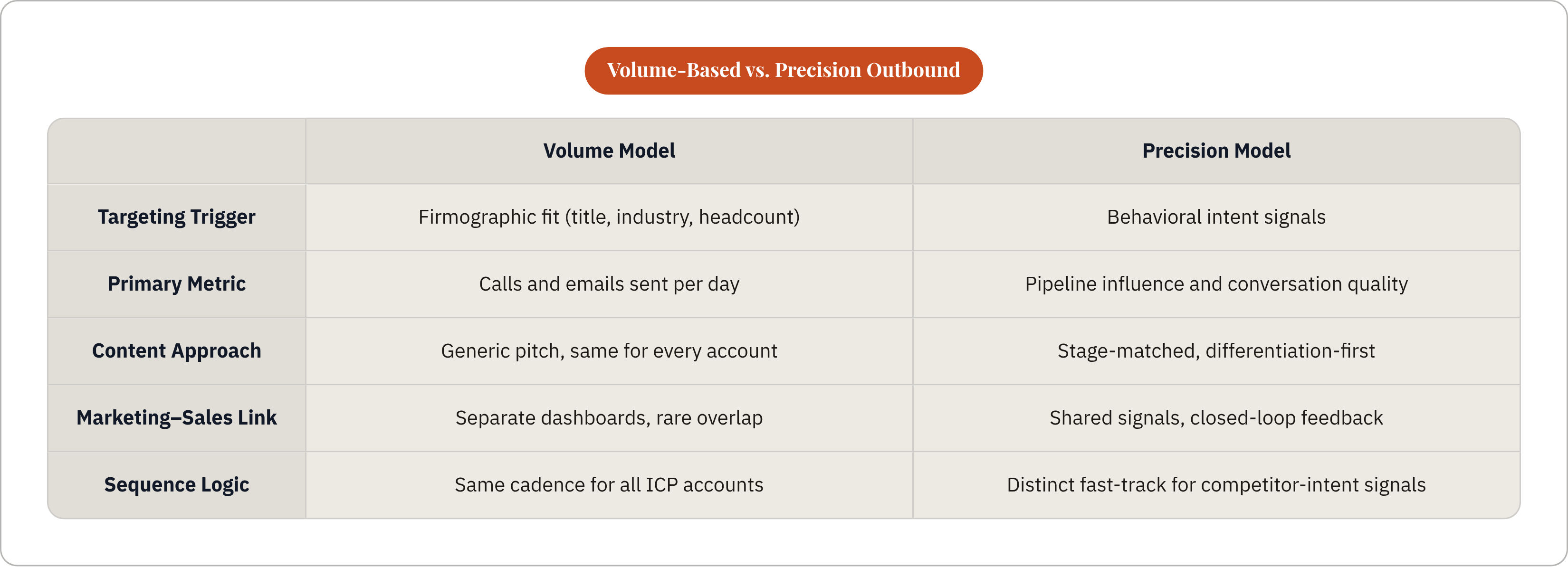
Most teams think they've already made this shift. The real tell is in what gets measured and what triggers a sequence, not what gets said in a planning meeting.
Signs you're still running the old volume model: calls-per-day and emails-sent are still the primary SDR scorecard, sequences trigger off firmographic fit (title, industry, headcount) rather than behavior, the content reps share is generic and doesn't match where the buyer actually is, and marketing and sales stare at separate dashboards and rarely compare notes.
Signs you've actually made the shift to precision: prioritization runs off intent signals, first, second, or third-party, not just ICP fit. Competitor-evaluation signals kick off a distinct, faster sequence with differentiation-first messaging built in already. Reps know exactly which content to send at which stage, and it's sitting there ready to go. Pipeline influence and conversation quality get measured right alongside activity volume, not swapped in for it.
Most teams sit somewhere in the middle of that list, and that's fine. What matters is the direction of investment, not the exact spot you're standing in today. Outbound has narrowed rather than disappeared. The teams pulling ahead accepted that fewer touches, better timed and better equipped, beat a bigger pile of touches every single time.
So the real question for your team is about knowing which accounts are actually ready to hear from you right now, and knowing what to say once you get there.