Sales Enablement Content Types That Accelerate Deals
Match buyer journey stages to content types, not just your sales pipeline.

Your CRM stages and your buyer's journey are not the same thing, and confusing them is one of the most common mistakes in B2B content strategy.
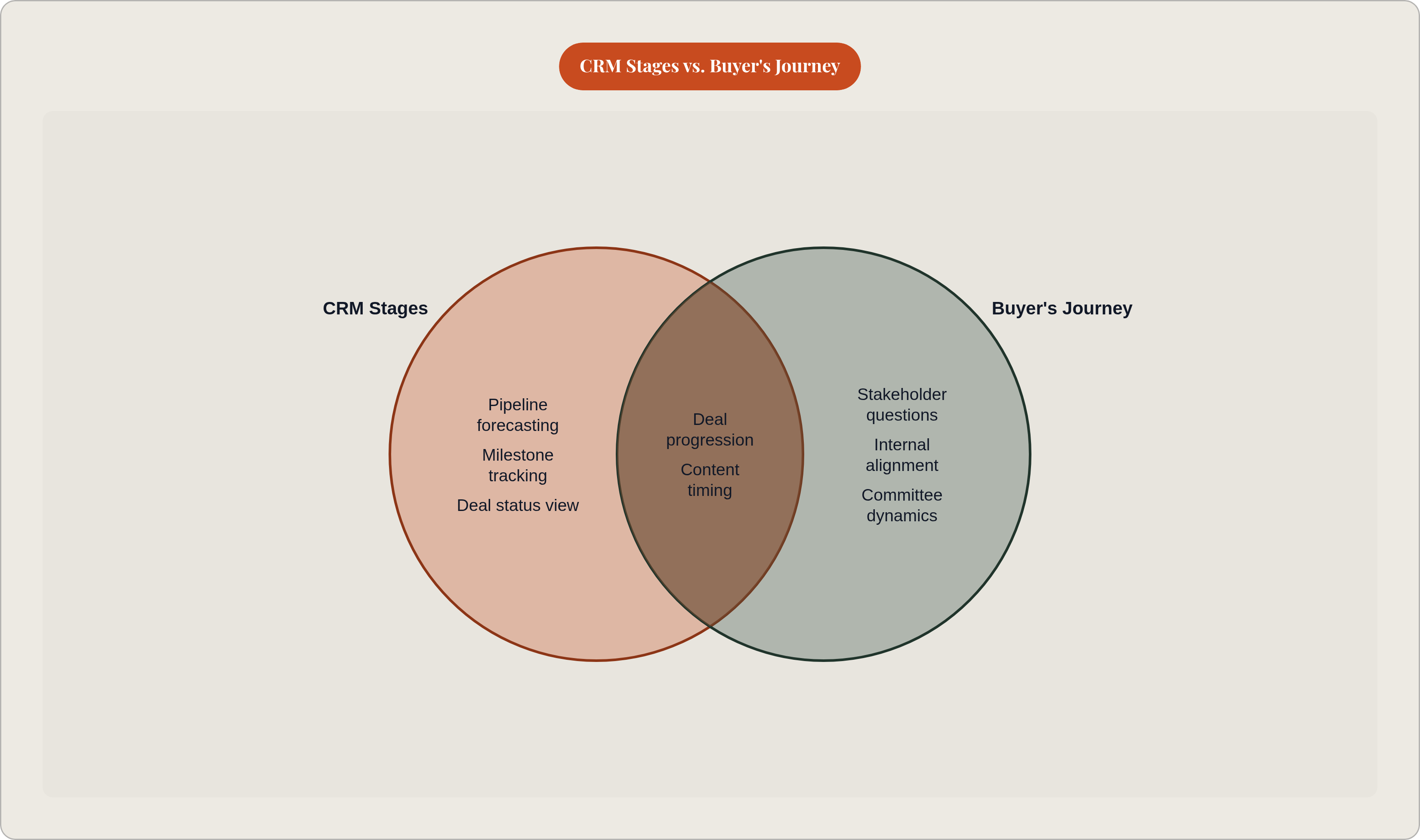
Your CRM stages tell you where you are. "Discovery," "proposal sent," "negotiation" — those are your milestones. Useful for forecasting. Useless for choosing what to send.
Your buyer's journey tells you where they are. What question are they trying to answer right now? Who else in their organization is asking a completely different question? That's what should drive your content decisions. Your pipeline view cannot do that.
Three buyer orientations cover most of what you'll encounter:
- Problem recognition: They're defining the problem, and shopping for vendors comes later. They want to understand something, and a pitch will lose them.
- Active evaluation: They're comparing options, pulling in more stakeholders, and stress-testing every claim you make.
- Decision and internal justification: They've picked you. Now they have to convince four other people inside their own company.
That third stage is where most content libraries fall apart completely. Gartner's research on B2B buying keeps returning to the same finding: the hardest part of a complex purchase isn't understanding the product. It's getting internal alignment. Yet late-stage content is almost always the thinnest section of any content audit. It's like a restaurant that nails the appetizers and then hands you a frozen entrée — all that careful work at the start, abandoned right when it matters most.
There's also a buying committee problem nobody talks about enough. A case study written for "enterprise buyers" doesn't help anyone if it never addresses the CFO's payback concern, the CTO's integration risk, or the end user's workflow disruption. That's three people. Three different objections. One useless asset.
The practical move: run a content audit where the question for every single asset is "which stage does this serve, and for whom?" Asking "what format is this?" tells you almost nothing. That one shift immediately shows you what's missing.
Content that earns attention before a buyer knows they want to talk to you
At this stage, your buyer is researching the problem. They are not researching you. Content that tries to sell loses. Content that teaches wins — and if you're not teaching, you're just adding noise.
What belongs here:
- Whitepapers and original research: Data and insight buyers can't easily find elsewhere. This positions you as a category thinker, not just another vendor in their inbox.
- Thought leadership articles and POV content: The goal is to become associated with expertise before any sales conversation starts.
- Educational video: Short explainers that address the problem. The product comes later. The problem comes first.
Here's what makes this stage more important than most people realize. The 2025 Edelman-LinkedIn B2B Thought Leadership Impact Report surveyed 1,934 management-level professionals across seven markets and found that 95% of "hidden buyers" — the stakeholders who influence vendor selection but never talk to sales — become more receptive to outreach from brands publishing strong thought leadership.
Read that again. These are people who will never appear in your CRM. They never fill out a form. They influence the deal anyway. Content is the only reliable channel you have to reach them, and most companies aren't using it well.
The quality bar is also easier to clear than you'd think. Nearly every company produces some form of thought leadership. Very few buyers rate what they read as genuinely good. Doing the basics well — actual insight, a real point of view, a willingness to say something specific — is enough to stand out. You don't have to be brilliant. You just have to avoid being boring.
One distribution note that matters: early-stage content needs to live where buyers actually research. Ungated content reaches the hidden buyer. Gated content misses them entirely.
Content that moves a buyer from "interested" to "evaluating you seriously"
This is where format specificity matters most. The buyer's question has changed. It's no longer "why should we fix this?" It's "why you, over everyone else?"
What belongs here:
- Case studies and customer stories: But not generic ones. A CFO story should focus on payback period. A CTO story should focus on integration. An end-user story should focus on workflow change. Same product, three completely different narratives. Persona-specific case studies convert better, and Forrester has connected customer story usage to shorter sales cycles at SaaS companies.
- Competitor battlecards: Internal documents that give reps what they need to handle objections in real time. One rule: a battlecard refreshed on a regular cadence beats a polished one updated once a year. Competitive positioning decays fast. Cadence matters more than polish.
- Product one-pagers and comparison sheets: Buyer-facing assets that evaluators can share internally without editing them first. If your champion has to rewrite it, you've already lost some of the deal.
- Demo scripts and guided demos: A structured narrative connecting what the product does to the specific problem this buyer has, rather than a generic product tour.
- Objection-handling guides: So reps respond consistently and credibly under pressure, not with whatever comes to mind in the moment.
Reps spend a surprisingly small fraction of their week actually selling. Mid-funnel is where having the right content at the right moment recovers the most selling time. Top-performing sales teams are using AI-driven enablement tools specifically at this stage to surface the right asset without reps having to dig for it.
Content that helps a buyer close the deal internally after they've chosen you
The deal is mostly won. And then it stalls.
A significant share of B2B deals stall not because the champion lost interest, but because of internal misalignment within the buying group. The champion needs to sell the deal upward and sideways. Late-stage content should be designed to help them do exactly that.
What belongs here:
- ROI calculators and business case frameworks: Give the economic buyer the numbers they need. Customizable inputs tied to their specific context, not marketing claims pulled from a press release.
- Data sheets and technical specs: Answer the CTO or IT stakeholder's integration and security questions without requiring another vendor call. Another call at this stage is a speed bump.
- Mutual success plans and implementation roadmaps: Show what the first 90 days look like. Turn an abstract commitment into a concrete path. This reduces perceived risk more than almost anything else at this stage.
- Executive briefing documents: One-page summaries for the C-suite stakeholder who joined the process late and won't read everything that came before.
- Proposal templates and pricing summaries: Assets the champion can forward as-is. No rewriting required.
The 2025 Edelman-LinkedIn report found that a majority of hidden decision-influencers use thought leadership specifically to convince C-suite executives to back their preferred vendor. A well-placed original research asset can do more late-stage deal work than another sales call. Genuinely worth considering.
Most content audits show a sharp drop-off in assets built for this stage. If your deals are stalling in the final stretch, that's probably why.
How competitor intent signals reveal which stage a buyer is actually in
A buyer researching your competitor is telling you exactly where they are in their journey. They're in mid-to-late evaluation. They just didn't bother to tell you directly.
Signal types break down roughly like this:
- First-party signals (pricing page visits, repeated case study views, chatbot conversations): High confidence. These buyers have already found you. They're late-stage and should be treated accordingly.
- Second-party signals (review site activity on platforms like G2): Mid-stage evaluation. The buyer is actively comparing options. Accounts showing this behavior convert at multiples of the rate of accounts without it.
- Third-party signals (topic consumption spikes via intent data platforms): Earliest-stage signal, broadest reach. Catches buyers before they've engaged with any vendor directly.
One underrated signal worth watching: multiple people from the same company each showing moderate intent is more predictive than one person showing strong solo intent. That pattern means the deal has moved from individual research to group evaluation. The buying committee is forming. That's a meaningful shift.
The operationalization gap is real. Most teams that collect intent signals route the lead and then send the same generic sequence regardless of what the signal actually implies. That's leaving most of the value on the table.
Intent data also expires fast. If routing and enrichment take too long, the signal is already degraded by the time anyone acts on it. Compressing response time from days to hours is where the actual competitive advantage lives.
One special case worth calling out: a former champion at one company who moves to a new role already knows your product. They need a displacement case study and a renewal comparison, with education largely off the table. This is one of the highest-converting signal types in existence, and almost no one has content built specifically for it. Revenue is sitting on the floor.
How to build a content library organized by deal stage rather than format
Start with an audit. Not a production sprint.
Map every existing asset to a deal stage and a persona. Most teams discover they're heavily weighted toward early-stage awareness content and thin on mid-to-late-stage justification assets. It's a predictable pattern. And it's a problem.
The audit question for every asset: "At what point in the buyer's journey would this be the most useful thing a rep could send, and to whom?"
Gap-filling priority order:
- One case study per major customer segment, written to the primary economic buyer persona
- One battlecard per top competitor, refreshed on a regular cadence. Cadence beats polish. Every time.
- An ROI calculator or business case framework for the late-stage justification conversation
- Then: email sequences, objection guides, and demo scripts calibrated to stage
Tagging matters more than people think. A content library tagged by stage and persona is usable in the moment. A library tagged by topic alone is a search problem. Reps won't dig through it. They'll send whatever they already know about, which is usually the thing they used three deals ago.
Close the feedback loop. The content shared most often in deals is the most valuable signal you have about what's actually working. Quarterly surveys asking reps which assets they actually reach for bring field reality back into content production. Organizations with formal content strategies consistently outperform those without them. Structure creates the advantage, not volume.
What sellers become when their content is matched to the moment
When reps have the right content at the right stage, something real shifts in how buyers experience them.
They stop looking like salespeople managing a process. They start looking like advisors who understand the situation. That's a concrete outcome — a rep with the right content is like a doctor who walks in already knowing your chart, versus one who asks you to repeat your symptoms for the third time. It changes the quality of every conversation, and it changes what the buyer is willing to share with you.
The trust problem in B2B sales is genuinely difficult. Buyers complete most of their decision-making before talking to a vendor. A rep who shows up late with generic content confirms every skepticism the buyer already had. A rep who shows up with exactly the right asset at exactly the right moment earns a completely different kind of conversation.
The Edelman-LinkedIn finding that 95% of hidden buyers become more receptive to outreach from brands publishing strong thought leadership isn't just an awareness story. It's a relationship story. The content precedes the relationship and shapes its quality before the rep ever enters the picture. That's a fundamentally different way to think about what content is actually for.
Stage-matched content is a sales capability. Treating it as a marketing deliverable undersells what it can do. The teams that figure this out build an advantage that grows over time. Every deal teaches them something. Every refined asset makes the next conversation faster. The gap between those teams and teams still organized by format just keeps widening, quietly, deal by deal.