Sales Pipeline vs Sales Funnel Distinctions for Outbound Teams
Pipeline tracks seller activity, while funnel reveals whether buyers are actually moving.

Sales pipeline and sales funnel get used like synonyms at most companies. That's the mistake, right there, and it's how deals go quiet for six weeks before anyone notices.
Quick version: the pipeline tracks what your reps did, while the funnel tracks whether the buyer is still moving at all. Confuse the two and you'll either manage activity with no clue if it converts, or spot a drop-off with no idea what caused it. I've watched both mistakes eat a quarter, so let's take them one at a time.
What the pipeline actually tracks and why it is seller-centric by design
The pipeline runs inside-out, and it's your rep's to-do list wearing a nicer shirt. Nothing wrong with that, as long as you know that's what you're looking at.
Pipeline stages describe what a seller did: outreach sent, discovery booked, proposal delivered, legal review kicked off. A deal parked in "proposal sent" just means someone on your team hit send on a PDF. It says little about whether the buyer opened it, forwarded it to finance, or set a coffee mug on top of it and forgot it existed.
A pipeline does three things well. It shows where every live deal sits today, tells the assigned rep what to do next, and rolls up dollar value for forecasting. What it struggles to show is whether the account marked "consideration" is actually engaged, gone cold, or three signatures deep with your competitor. The pipeline has limited visibility outside your own CRM.
Outbound teams get sloppy here in predictable ways. Deals sit in a stage for weeks because nobody built a trigger to move them along. Stages get defined by calendar events ("we had a call") instead of buyer actions ("they asked for security documentation"). There's rarely a built-in freshness check, warm versus cold, so a pipeline without one drifts into a wish list sorted by dollar amount.
I inherited a pipeline once where a six-figure deal had sat in "proposal sent" for eleven weeks. Asked the rep for an update, and he said, "that one's basically closed, I just haven't heard back." The buyer had gone quiet the exact way a phone goes quiet when someone's declined your call three times running. Pipeline said green, while reality said stop emailing me.
What the funnel actually tracks and why it is buyer-centric by design
The funnel runs the opposite direction: outside-in. It tracks how a whole population of prospects moves through their own decision process, whether your team lifts a finger or not.
Funnel stages describe buyer states, not seller actions: aware, interested, evaluating, deciding. This framework has little use for what your rep did last Tuesday, and neither, frankly, does the buyer.
The funnel shows where the biggest chunk of prospects quits before converting, and whether the problem is volume up top or friction at the bottom. It reveals whether outbound is reaching people at the right moment at all. It won't tell a rep which account to call this afternoon, because the funnel works as a diagnostic more than a task list. It answers one question: where is momentum breaking down.
Skip funnel visibility and you can run an extremely busy outbound team that loses deals at the same stage, for the same reason, quarter after quarter. Nobody catches the pattern, because nobody's looking at the shape of the thing, just the deals inside it.
How the two instruments connect in a functioning outbound operation
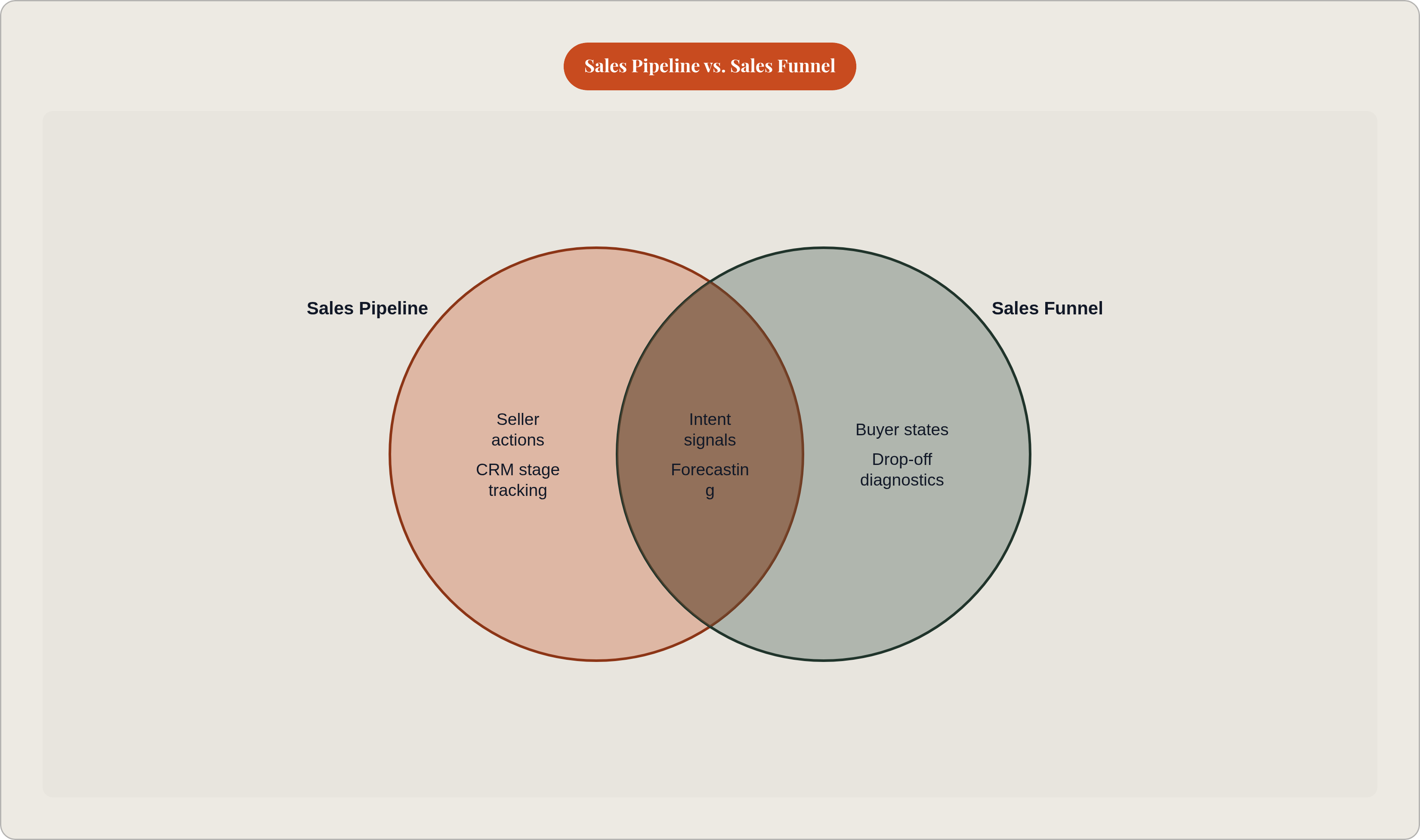
Speed and fuel is the closest comparison: one tells you how fast you're moving right now, the other tells you if you'll actually reach the destination. Watch only one and you still break down, just with better posture on the way.
The funnel feeds the pipeline. Awareness and interest are where prospects get made, and the pipeline is just where they show up once qualified enough to work. The pipeline stress-tests the funnel right back: if qualified deals keep entering but close rates stay flat, something between evaluation and decision needs a hard look.
Neglect either side and the failure is predictable, if not identical. Pipeline without funnel visibility means reps grind on deals already dead at the buyer level, and nothing in the CRM told them so. Funnel without pipeline discipline gets you gorgeous conversion charts and zero structured follow-up, with leads sitting there, rotting quietly on the vine.
Buyers finish most of their evaluating before they ever talk to a vendor, which is the part that makes this expensive instead of just untidy. They're deep into their own funnel long before they become a line item in your pipeline. The gap that costs you money isn't stage-to-stage movement inside the CRM; it's the distance between where the buyer already stands and where the seller still thinks they are.
Why outbound timing failures trace back to using only the pipeline lens
A stage labeled "consideration" is a seller's guess wearing a status update. It reflects what your rep did more than what the buyer's doing right now, who might be reading a competitor's G2 reviews on their lunch break with a sandwich in one hand.
That research happens off the grid entirely. Buyers dig through publisher sites, review platforms, comparison pages, all anonymously, none of it touching your CRM because there's no rep name attached to the activity. You have no record and no lever to pull.
Most buying groups rank their preferred vendors before a single sales call happens. By the time your rep books a meeting, the shortlist may already be locked, and teams running on pipeline data alone are blind to that ranking process while it's underway, which is a strange thing to be blind to, given it's the whole ballgame.
The result looks like an effort problem, but it's often a timing problem instead. Reps reach out too early, before budget lines up internally, or too late, after a competitor already has the inside track. Gartner's research puts the share of a B2B purchase journey buyers spend actually meeting with vendors at a genuinely small slice, so the window to influence the outcome is narrower than most outbound playbooks assume. Pipeline data alone will rarely show you where that window sits.
The funnel lens, fed by behavioral signals, is what tells you a buyer crossed into active evaluation. That moment, not the calendar, is when outreach earns its paycheck.
How intent signals give outbound teams a funnel view they cannot build from CRM data alone
Intent data is the closest thing outbound teams have to a window into the funnel's black box. It captures research behavior: topic surges across publisher networks, competitor comparisons on review sites, pricing page visits, whole afternoons lost to content binges nobody on your team witnessed.
Split it into two buckets. First-party signals come from your own channels: website visits, content downloads, email opens. Third-party signals come from research happening elsewhere, out in the wild, where anonymous evaluation actually happens at scale.
Signals from review platforms carry unusual weight. An account reading competitor reviews on G2 is actively sizing up who to buy from, and that's about as close to a raised hand as anonymous research gets.
What this buys an outbound team is real. You get to prioritize accounts that are behaviorally active instead of ones that just fit a demographic checklist, and you get visibility into a population that's largely invisible otherwise, accounts deep in their own buying journey who haven't touched your pipeline yet. You also get to time outreach off the buyer's actual momentum instead of a cadence some sales ops person built in a spreadsheet three years ago and nobody's touched since.
Intent data moved from niche add-on to standard practice fast, and treating it as optional isn't really a preference anymore. It's a disadvantage you're choosing.
Plenty of teams collect these signals and route them straight to sales unchanged, though, running the same script and same email with zero acknowledgment that the account is mid-evaluation. The signal gets captured and wasted in the same motion. Collecting intent data and then ignoring it is a bit like installing a smoke detector and pulling the batteries because the beeping got annoying.
The highest-leverage moment intent data surfaces: mid-cycle competitor evaluation
One moment is worth building your whole outbound motion around: a buyer researching a named competitor. By the time that happens, they've cleared the hardest parts already. Budget's aligned internally, the problem is recognized, and somebody with actual authority is sponsoring the search.
The job for outbound changes completely here. Educating the buyer and framing the problem is a ship that sailed weeks ago. The work now is positioning against the specific alternatives already sitting on the table in front of them.
In practice this shows up as accounts surging on a competitor's brand keywords across third-party networks, reading head-to-head comparison pages, hitting competitor pricing pages (sometimes visible through your own referral data if you know where to look).
These accounts don't belong in "prospecting" on the pipeline side. Their real stage is "mid-evaluation by someone else," and filing them anywhere else wastes the signal you just paid to collect. On the funnel side, this is the sharpest version of the buyer-seller gap there is: the account self-progressed to late-stage evaluation entirely without you, and the distance between where they stand and where your pipeline thinks they stand has never been wider.
Bynder is a good example of what happens when a company actually acts on this. They used AI-powered intent data to find in-market accounts and saw outbound pipeline multiply, with the investment paying for itself fast. That's the payoff of intercepting a buyer mid-comparison, instead of showing up six weeks early or six weeks late.
Don't blow it with a generic template once you get there, though. Hitting a buyer mid-comparison with "just checking in, got 15 minutes?" is showing up to a chess match with a bag of checkers, the wrong game entirely. The message has to know exactly where the buyer is standing.
What buying committee dynamics do to both the pipeline and the funnel
Enterprise buying committees run close to ten stakeholders, per Gartner, and every one of them is off consulting their own sources independently. Nobody's sitting around waiting for your rep to brief them.
This wrecks the pipeline in a specific way. A deal can look perfectly healthy on paper, champion engaged, discovery done, proposal out, while quietly losing ground with finance, legal, or procurement, none of whom your rep has ever spoken to. CRM says green, while reality says something else entirely.
It wrecks the funnel too, just differently. Late-stage conversion tanks not because the buyer lost interest, but because the account can't get aligned internally. Edelman and LinkedIn's 2025 B2B Thought Leadership Impact Report found a meaningful share of deals stall for exactly this reason: hidden stakeholders in finance, legal, compliance, and ops who never once show up on a discovery call.
Those hidden buyers consume category content at nearly the same rate as the primary buyer does, and per that same report, they're more likely to back a vendor whose thought leadership they've actually read. Your content reaches rooms your rep will never sit in.
Thought leadership published well before a deal enters the pipeline does quiet work on your behalf, building credibility with people your rep will never meet face to face. It's about the cleanest case there is of a funnel-level action (someone in legal reading your blog on a Tuesday afternoon) determining a pipeline-level outcome (the deal actually clearing legal review three weeks later).
So how many stakeholders does it actually take to approve an enterprise deal? Nobody really knows, and your rep's only met two of them, which is a bit like a play where the star has met two of the twelve people who'll vote on whether the show gets renewed.
How to decide which instrument to reach for at each stage of an outbound motion
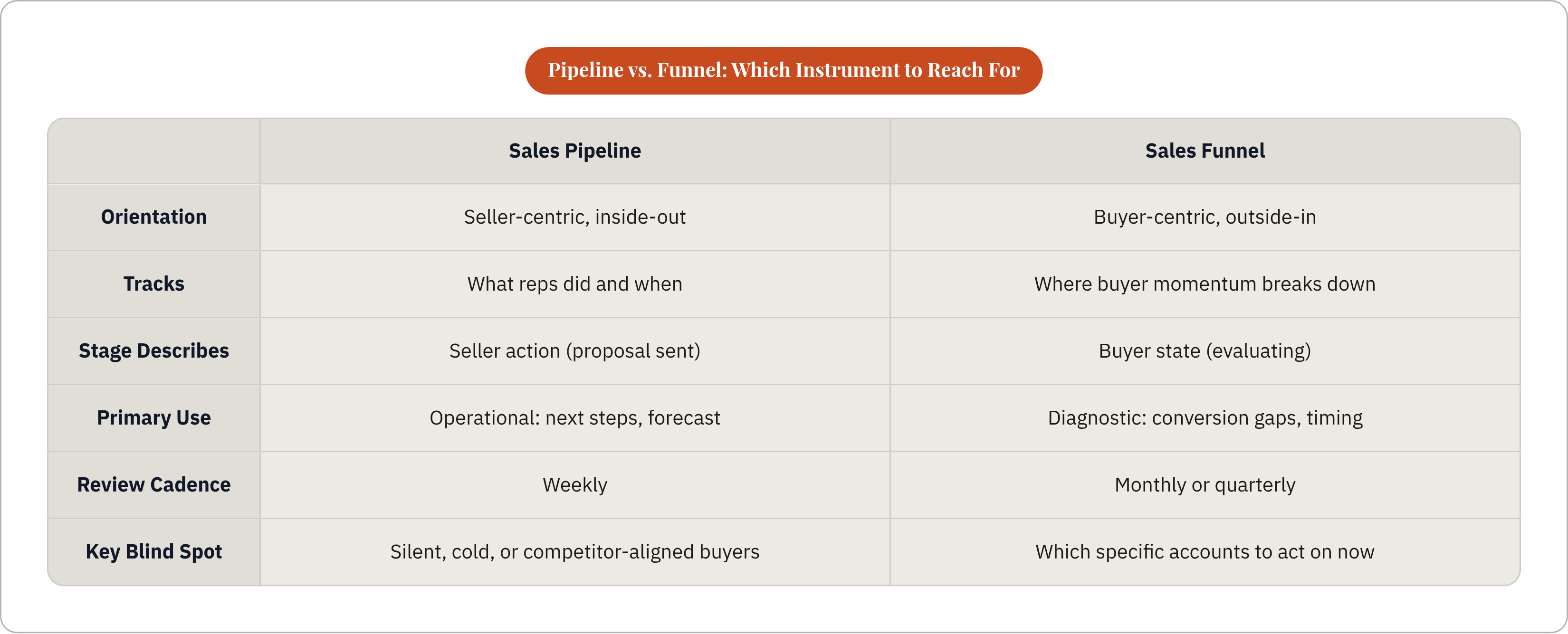
Reach for the pipeline when the question is operational. Which deals are about to go dark this week? Pipeline review, sorted by stage and last-touch date, answers that. What should the rep do next? Pipeline stage answers that directly. What's the forecast this quarter? Pipeline value, weighted by stage, is the answer there too.
Reach for the funnel when the question is diagnostic instead. Why are you booking meetings but stalling at discovery? That's a funnel conversion problem. Is outbound reaching buyers too early or too late? Compare funnel entry timing against intent signal timing. Where's the biggest chunk of your addressable market bailing before they even engage? That's a top-of-funnel visibility gap, and no amount of pipeline hygiene fixes that one.
Here's the calibration that separates the sharp teams from the busy ones: pipeline reviews happen weekly, funnel audits happen monthly or quarterly, because they're different instruments running on different clocks. Checking your fuel gauge every five seconds doesn't get you there any faster, and it just makes you anxious. Anxious people miss turns.
Intent signals are the connective tissue between the two. They update the funnel view in real time and should trigger specific pipeline moves automatically. An account surging on a competitor's keywords ought to bump a stage and generate a tailored task on its own, not sit in a dashboard waiting for someone to notice on a Friday afternoon.
When a deal stalls, ask which lens actually explains it. Is the rep's next move unclear? That's a pipeline problem. Did the buyer lose steam internally, or align with someone else entirely? That's a funnel problem. The diagnosis decides the fix, and rarely the reverse.
Building an outbound system where pipeline actions and funnel signals reinforce each other
The goal is a motion where funnel signals shape pipeline priorities automatically, without a human remembering to cross-reference two dashboards at 5pm on a Friday because they finally found five free minutes.
Here's what that looks like in practice. Intent signals flag accounts in active evaluation, and those accounts enter the funnel view as behaviorally qualified, not just demographically plausible on paper. They get elevated in the pipeline with stage assignments that reflect where the buyer actually stands, not "we sent an email once and hoped." Thought leadership and competitive content get pushed toward committee members who'll never take a sales call. Pipeline tasks fire off funnel events instead of a generic Tuesday-and-Thursday cadence someone set up years ago and never revisited.
This means tracking pipeline advancement and funnel conversion side by side, stage by stage, so you can tell an execution problem (reps aren't doing the work) from a messaging problem (the work isn't landing). Those two look identical on paper during a bad quarter, and they need completely different fixes.
Good enablement content extends your reach into funnel stages you can't personally access: building trust with a finance person you'll never meet, getting ahead of competitor objections before they quietly kill the deal, staying relevant during the long stretches when the buyer isn't in a room with you at all.
The teams pulling ahead stopped treating pipeline and funnel like a choice between two tools years ago. They just ask, at any given moment, which instrument is talking, and what it's actually telling them to do next.