signal-based prospecting tools that combine intent data with automated multi-channel outreach
These tools hunt for buying signals early, but data quality determines whether leads convert.

B2B buyers do their homework before a salesperson ever hears from them now. Research, comparison shopping, vendor shortlisting: all of that happens quietly, on the buyer's own clock, long before anyone fills out a form. By the time your sales team makes contact, the buying journey is usually past the halfway mark, and tracking it is only getting harder. That's the gap signal-based prospecting tools try to close. This piece walks through how they actually work, where the quality problems hide, and what to check before you buy one.
The buying journey has stretched out, and it's got more stops along the way than it used to. Standard attribution tools, built to catch web visits and form fills, only see a slice of that journey now. Layer on the fact that a huge share of B2B buyers research vendors inside AI chat tools instead of typing keywords into a search bar, and the old trail of breadcrumbs (searches, clicks, downloads) is thinning out fast. A lot of purchase influencers are doing this research inside private AI tools that no vendor can see into at all. Net effect: teams leaning on inbound forms and ad clicks alone are watching a shrinking slice of a much bigger market.
What signal-based prospecting tools actually do, mechanically
At the core, these tools scrape and sort digital behavior from across the web: site visits, content downloads, keyword searches, competitor page views, review site activity. The goal is simple to say, harder to pull off: figure out which accounts are actively shopping a category right now, before they raise their hand.
Two separate jobs happen here, and it helps to keep them apart in your head.
One layer reads the signals and figures out who's in-market and roughly where they sit in the process. The other layer takes that read and fires the actual outreach, sequencing sales and marketing touches based on what got flagged. A tool that only does the first part hands you a report you still have to act on by hand. A tool that only does the second part is automated spray-and-pray wearing a nicer interface. The whole point of these platforms is stitching the two together so the read triggers the response on its own.
Where the signals come from matters a lot, and providers split into different camps here. Some pull from cooperative networks, basically a group of publisher and media sites pooling behavioral data across a lot of properties at once. Others get data second-party style, straight from one platform, like a review site watching its own visitors compare products side by side. Then there's first-party data: a vendor's own web traffic, CRM records, engagement history. That carries the most weight simply because you know exactly where it came from and nobody touched it in between. Most platforms blend all three now instead of picking one lane.
On top of the pure intent signals, most tools also pull in context: job postings, funding rounds, earnings calls, headcount swings. That context doesn't confirm someone's shopping. It suggests the timing might be right, which is its own useful thing.
What lands in front of a rep isn't a spreadsheet of raw hits. It's a scored account list, a guess at what stage the account sits in, and a next move, often already queued up to go out the door.
How signal quality is determined — and why it is the variable that most determines outcomes
Here's the part nobody puts in the sales deck: a lot of intent data is junk. Plenty of teams running these tools find the signals inflated or unreliable, and only a small slice of what comes through turns into a real opportunity. Data quality is the top complaint among users. Making sense of the data itself comes in a close second.
Three things decide whether a signal is worth anything.
First, coverage. How many sites and interactions actually feed the network, and is the data deduplicated so you're not double-counting the same visitor bouncing between three properties owned by one parent company? Second, decay. Intent signals go stale fast, often within a couple weeks of being captured, so a provider that only refreshes monthly is selling you old news dressed up as a hot lead. Third, noise filtering. Volume alone means nothing; a firehose of raw signals still needs a filter smart enough to tell a real buying pattern from someone who clicked a blog post because it showed up in their feed.
Decay isn't just a vendor problem either. It's an operational one on your side too. You need fresh signals, sure, but you also need internal rules for how fast your team moves once one fires. A perfectly fresh signal sitting in a queue for three days is functionally a stale one.
Two different models are worth telling apart. A "surge" model flags a spike in research activity against a baseline, which helps you prioritize a list but throws false positives when a competitor publishes something popular and everyone's traffic jumps at once. A "stage" model tries to estimate where an account sits in its buying cycle based on accumulated patterns. That takes more work to build, but pays off more when the model's trained well.
If you're shopping vendors, ask for hit rate: signals generated versus opportunities that actually got qualified from them. Asking about total signal volume just gets you a bigger number that tells you nothing about whether any of it converts.
The buying-stage taxonomy that determines which signal triggers which outreach
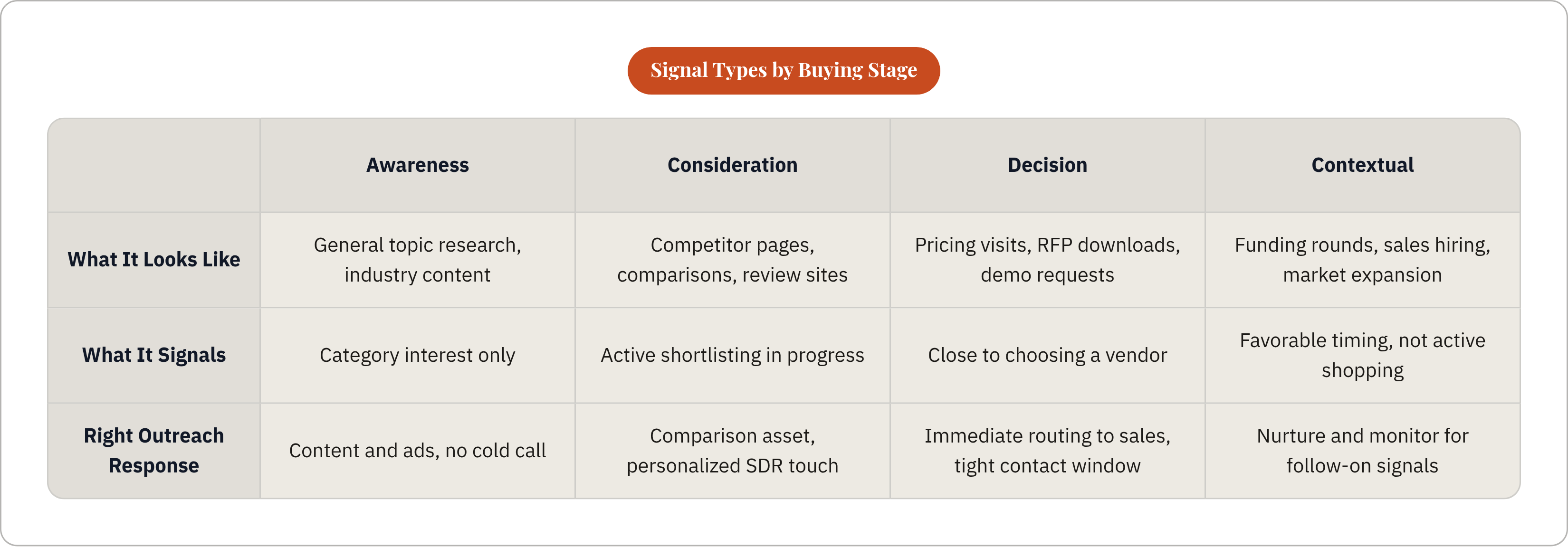
Every signal deserves its own response, calibrated to what it actually indicates. Treating them all the same is where a lot of these programs go sideways.
Broad topic research, someone reading about "customer onboarding best practices" or general industry frameworks, tells you a company has category interest. It doesn't mean they're ready to book a demo, and pitching one at this stage usually just annoys people.
Consideration-stage signals look different: competitor page visits, side-by-side comparison content, analyst reports, review platform browsing. This is a company actively building a shortlist, and it's the stage where competitive positioning actually lands.
Decision-stage signals are the closest thing to a green light: pricing page visits, RFP downloads, demo requests, security review page views. The account is close to picking someone.
Then there's a separate bucket of contextual signals that don't show active research at all, but set up the right conditions for it. A funding round means budget probably just opened up. A jump in sales hiring means a company's scaling and about to need new tools to support it. A market expansion announcement means new use cases just walked in the door.
Here's the part that should reshape how teams prioritize: most buyers already have a vendor in mind before their buying process even formally starts. So the awareness stage is largely a lost cause for changing minds, and the real fight for knocking out an incumbent happens at consideration, not later.
Good tools map the outreach motion to the stage instead of just reacting to whatever fires. Awareness gets content and ads, no cold call. Consideration gets a comparison asset and a personalized SDR touch. Decision gets immediate routing to sales, sometimes straight to a senior rep, with a tight window to make contact. Speed matters more than most teams assume: a high-intent signal that sits unworked in a queue quickly loses its value as the window for timely contact closes. That's a routing and staffing problem your platform either solves for you or doesn't.
Why competitor-focused signals are the highest-value subset of intent data
Competitor research signals sit right at the consideration stage, and they carry more weight than almost anything else in the intent stack for one plain reason: the account has already decided to buy something. The only open question is from whom.
Since most buyers walk in with a vendor already in mind, catching a competitor-research signal early means you're trying to get onto a shortlist that's already being drawn up, rather than trying to talk someone into wanting the category in the first place. That's a much easier fight to win.
In practice, this shows up as a target account's team searching competing product names, browsing comparison pages on a review site, downloading an "alternative to" guide, or poking around a rival's pricing page.
The response, done right, is a coordinated push: a comparison guide sent directly, retargeting ads built around your differentiated points, and an SDR touch that names the specific competitor being researched instead of firing off a generic template. Strategy gets set once; the system handles execution and handoffs across channels from there.
None of that works without decent content behind it. A generic cold email that happens to fire because a competitor signal tripped is a wasted signal. The comparison asset and the use-case story have to actually hold up, or the whole exercise backfires. Some teams also pair competitor signals with conversation intelligence pulled from sales calls, so they can see which competitor-researching accounts show patterns that actually track toward a win, and go hardest after those first.
How the outreach automation layer works and what omnichannel execution actually requires
There's a distinction here that a lot of vendor marketing blurs on purpose, because building the fix is harder than the buzzword makes it sound.
Multichannel means outreach runs across email, LinkedIn, ads, and phone, but each channel operates on its own, no shared memory between them. Omnichannel means every channel feeds one account profile, so a LinkedIn ad click actually changes what happens next in email, maybe suppressing a scheduled send or triggering a call instead.
This isn't a nitpick. A large share of B2B buyers actively avoid vendors who send them irrelevant outreach, and disconnected multichannel sequences are basically a machine built to produce exactly that. Running several channels at once does lift engagement over a single channel, but only when the channels actually coordinate around what's known about the account, rather than repeating the same pitch in three formats.
When signals trigger a genuinely coordinated play across email, paid, and SDR outreach, pipeline moves noticeably faster than single-channel response. Deals sourced from intent-prioritized accounts also tend to close at better conversion rates than ones that weren't. AI-written personalization is creeping into this layer fast too, changing how outbound messages get composed and sent at scale. Worth saying plainly: personalization generated the same way, at scale, for every account starts to read as generic as the mass blasts it replaced. Personalization built off a real signal carries far more weight than personalization that just drops a first name into a template.
The piece most teams underbuild is the response window. High-intent signals call for contact within minutes, and an immediate pause on every other message queued to that account. Most sales teams don't have the routing logic to pull that off without the platform doing it for them.
The major platforms and what each is actually differentiated on
The intent data market has grown into a real, sizable category by now, not some experimental corner of martech. Spending reflects that: mid-market B2B tech companies often land in the tens of thousands of dollars a year on this, while larger enterprise deployments run well into six figures.
A handful of names get cited over and over as category leaders, and each has carved out a different angle worth knowing before you shop.
Some platforms differentiate almost entirely on contact data scale, matching buying signals to verified emails and phone numbers so a rep can act the moment a signal fires, no separate step to figure out who to call. Others take an aggregation-first approach, pulling from multiple intent providers at once and layering AI on top to sharpen the combined read. That suits teams wary of locking into a single data source. Review-site platforms offer a different flavor entirely: second-party, high-confidence, late-stage signals from buyers actively comparing software, though usually at the account level only, without naming the individual doing the comparing.
Technographic-focused providers filter intent against a company's existing tech stack, so outreach only targets accounts running compatible or competing infrastructure. That cuts a lot of wasted noise for vendors selling into a specific technical environment. And platforms built around account-based marketing infrastructure tend to wire intent signals directly into ad targeting, site personalization, and sales routing inside one system, which suits teams running coordinated marketing-and-sales motions rather than sales-led outreach alone.
There's also a distinct category of platforms built around content and enablement rather than pure data: tools that connect the signal layer to the actual messaging that makes outreach credible in the first place. That's the one to look at if the content behind your outreach matters as much as the timing of it.
How to evaluate whether a tool's signals will produce pipeline or noise for your specific use case
Most companies shopping this category right now are doing it for the first time, with no years of scar tissue to draw on. That's fine, but it means the evaluation has to be more deliberate than "which demo looked slickest."
A few questions cut through the noise fast.
Ask what the signal-to-opportunity ratio actually looks like in practice, not in aggregate marketing copy. Ask how fast signals decay and how often the underlying data actually refreshes, not just how often the dashboard repaints. Ask whether the tool tells surge spikes apart from real stage progression, because those two things get marketed identically and behave very differently. Ask whether the outreach layer is actually omnichannel, meaning channels talk to each other, or just several disconnected channels running in parallel under one login.
And ask, bluntly, what happens on your end when a decision-stage signal fires at 4:45 on a Friday. If the answer involves someone checking a dashboard manually on Monday, the process needs work regardless of which tool sits underneath it. The best signal in the world is worth nothing if nobody's fast enough to act on it.