What an Intent Provider Actually Delivers

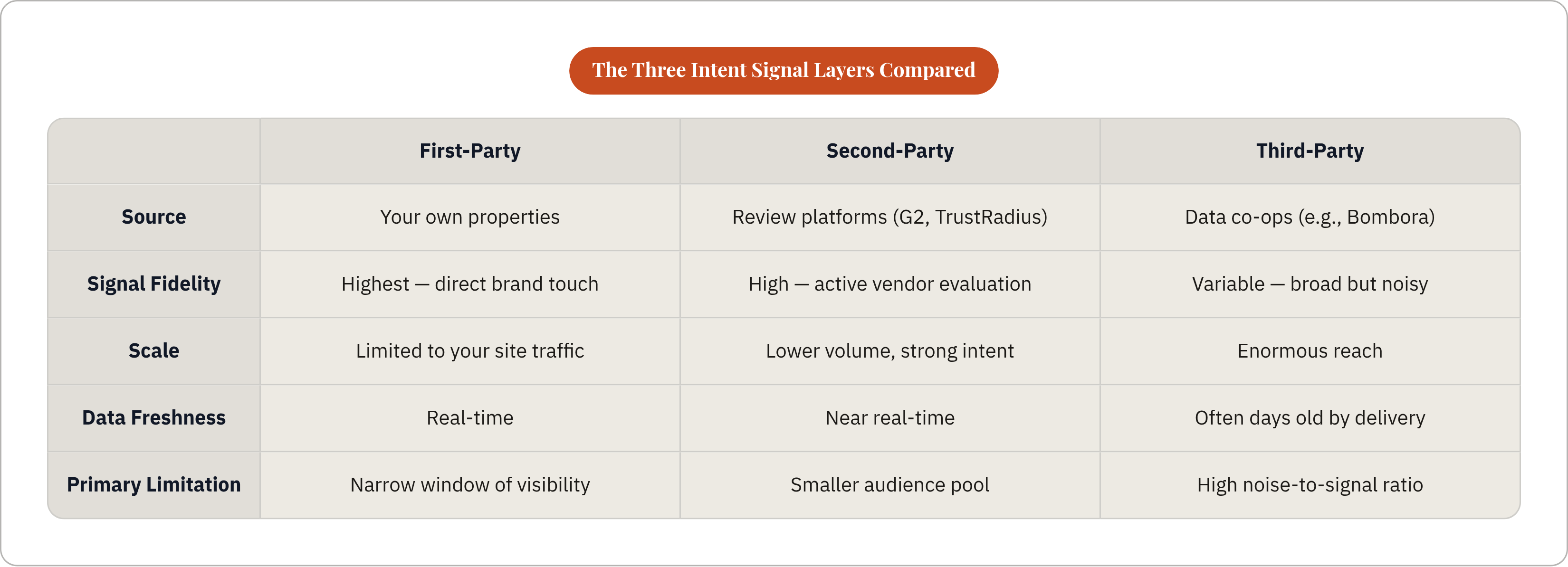
Every intent provider pulls from some combination of three data sources. Which one anchors their product tells you almost everything about what you are actually buying.
First-party signals are your own data. Page visits, pricing page engagement, content downloads. This is the highest-fidelity signal you will ever get because it is direct evidence of someone touching your brand. The problem is scale. You only see what happens on your own properties. That is a pretty small window.
Second-party signals come from review platforms like G2 and TrustRadius. Buyers on these platforms are usually in active vendor evaluation mode. Comparing products, reading reviews, building shortlists. Someone on a review platform is not passively browsing. They are shopping. The signal volume is lower, but the intent is hard to argue with.
Third-party signals are where most of the market lives. Data co-ops, with Bombora being the most widely known, aggregate research behavior across thousands of B2B publisher sites. When someone reads three articles about data warehousing tools on different trade publications in the same week, that pattern gets captured. The scale is enormous. The noise is also enormous.
Here is what the category does not emphasize enough: these three layers are not interchangeable. They have different noise-to-signal ratios. Different latency. A third-party co-op signal is often days old by the time it reaches your CRM. A first-party signal from your own site is real-time. That gap matters more than most buyers realize when they are sitting through a demo.
Most providers specialize in one or two layers and license the rest to round out their pitch. That bundling is not inherently bad. But you want to know which layer is actually theirs, because that is where the data quality lives. Everything else is a resale arrangement dressed up as a platform feature.
This is also where the "dark funnel" concept becomes relevant. A large share of B2B buying happens on third-party properties. Competitor comparisons, category research, vendor shortlisting. None of it visible to you by default. Intent providers exist specifically to surface that hidden activity. But how much of it they can actually surface depends entirely on which networks they have access to and how deep that access goes. Two providers can both claim dark funnel coverage and be describing completely different things.
Account-level vs. contact-level delivery (and why the difference matters operationally)
Most third-party intent providers deliver account-level output by default. They tell you a company is researching a topic. They do not tell you who at that company is doing the research.
That is a real operational constraint if your sales team's job is to call someone specific and say something relevant. An account-level ping tells you where to look. It does not tell you who to call.
Contact-level output identifies the actual person. It is dramatically more actionable. It is also harder to generate at scale without running into privacy compliance issues, which is why most providers offer it only within specific networks or verticals.
TechTarget's Priority Engine is the clearest real-world example of this tradeoff. It is built on a large opt-in network of technology-focused editorial properties, and it delivers contact-level intent for IT and technology buyers specifically. Vertical depth over horizontal breadth. If your buyers are IT decision-makers, that depth is valuable. If they are not, you are paying for data that does not match your market.
There is also a newer layer worth knowing about: buying group intent. When multiple stakeholders at a single account are all researching independently, a single lead score or contact ping can look like traction when it is really just one person doing preliminary research on a slow Tuesday. Intentsify introduced buying group and persona-level intent as a way to show whether the broader decision-making unit is engaged, not just one curious employee. For deals with many stakeholders, that distinction changes how you prioritize your week.
The operational math here is simple. If a provider only delivers account-level signals, your sales team does the investigative work to figure out who to actually contact. That work has a cost. Factor it in before you sign.
How signal quality degrades (and the data reliability problem the category doesn't advertise)
Intent signals expire. The predictive value of a signal drops fast after the behavior occurs, and teams that act within a tight window see materially better results than teams that batch-process signals once a week. That is not a minor implementation detail. It changes the whole infrastructure question.
The false positive problem is also real, and it is not a fringe complaint. The majority of organizations using intent data have reported experiencing unreliable or inflated signals. Only a fraction of raw signals convert to qualified opportunities. This is a near-majority experience, not an edge case.
Why does this happen? Co-op data aggregated across broad publisher networks picks up all kinds of activity. Competitive research by someone who is already your customer. Academic interest from a grad student writing a thesis. A job seeker exploring a new category. Content consumption with zero purchase intent behind it. A spike in topic consumption does not equal budget, authority, a real need, or a timeline. It just means someone read something.
The most effective deployments address this by layering. Combining behavioral intent signals with business-event signals (funding rounds, hiring surges, technology stack changes) and first-party engagement data reduces the false positives that any single layer generates on its own. No one layer is reliable enough to act on without validation. Anyone who tells you otherwise is selling you something.
There is also a structural shift happening that most providers are not talking about openly. Generative AI is changing how buyers research. When a buyer uses an AI tool to compare vendors, they are not visiting the publisher sites that third-party co-ops depend on. They are not leaving the same digital trail. The research behaviors that intent tools were calibrated to track are starting to shift, and the category's response to that is still developing. Which is a polite way of saying: nobody has fully figured it out yet.
One practical evaluative criterion that is easy to overlook: does the provider actually document how their signals are generated and how fresh the underlying data is? Not every provider discloses that clearly. The ones who do not are telling you something.
Competitor intent signals and what a mid-cycle interception actually requires
Competitor intent is the highest-leverage signal type in the category. The logic is straightforward. A company already paying for a competing product has already confirmed budget, problem awareness, and category fit. Those are the three hardest things to establish from scratch. You are not trying to convince them the problem exists. You are trying to convince them you solve it better. That is a much shorter conversation.
What these signals look like in practice:
- Branded competitor search spikes
- Engagement with comparison guides
- Activity on review platforms within the category
- Visits to competitor pricing or feature pages
The renewal timing layer makes this even more actionable. Knowing a competitor is installed is useful. Knowing when their contract expires gives you a natural opening. The teams that do this well combine install data with contract timing so they are reaching out during the actual re-evaluation window, not just whenever someone remembered to pull a report.
Intent data can also surface mid-cycle recovery opportunities. A previously dormant account or a closed-lost deal that starts showing topic shifts, renewed review site activity, or comparison queries. That account is back in research mode before they have told anyone. Including you. That window is short and it closes without warning.
But here is what an interception play actually requires to work. The signal alone does nothing.
- You need content already built. Competitive battlecards. Comparison pages. Customer stories from people who switched from that specific competitor. The signal is only as valuable as the response it can trigger.
- You need a coordinated sales-marketing handoff. The signal needs to route to the right rep with the right context fast enough that the window is still open.
- You need messaging calibrated to the specific competitor being researched. Not a generic "here is why we are great" pitch. That gets deleted.
Forrester has noted that a large share of B2B buyers already have a preferred vendor in mind before formal evaluation even starts. Intercepting a competitor evaluation is as much about being a vendor the buyer already recognizes as it is about showing up at the right moment.
What intent providers actually deliver here is the signal. In some cases, recommended next actions. The content assets and the sales execution are yours to build. That part does not come in the contract.
The output formats providers actually hand over (and what connects them to pipeline)
When you sign a contract with an intent provider, here is what you are likely to receive:
- Account priority scores
- Intent topic lists per account
- Contact records with behavioral context (where available)
- CRM alerts and integrations
- Weekly or daily surge reports
Where those outputs land matters as much as what they contain. A surge report sitting in a separate platform that your reps never open is not a deliverable in any meaningful sense. It is a file somewhere, slowly going stale.
CRM and marketing automation integrations are not optional. Whether signals flow into Salesforce, HubSpot, or your platform of choice without manual export determines how quickly your team can act, and how many signals they actually act on. If someone has to log into a separate tool to check a dashboard, most of them will not. This is not a hypothesis. It is what happens.
The activation gap is real and widely underestimated. The median time from signing a contract to first qualified pipeline contribution from intent data runs roughly three months, with slower deployments taking significantly longer. Most of that delay is not the provider's fault. It is the buyer's team scrambling to build the workflows, routing rules, and response content that should have been built before the contract was signed. You essentially pay to do implementation work you could have done earlier.
Providers deliver data. They do not deliver the sales motion.
The deployments that work fastest share a common pattern. Intent signals trigger specific, pre-built plays with content attached and routing pre-configured. Not a generic follow-up task dropped in a rep's queue on a Friday afternoon. A specific action with specific assets aimed at a specific scenario.
This is also where the market splits into two meaningfully different buying decisions. Providers like Demandbase and 6sense bundle orchestration capability directly into their product. They want to be the platform where activation happens. Providers like Bombora and many co-op resellers deliver clean signals and expect you to activate them in your existing stack. One approach trades integration overhead for simplicity. The other trades simplicity for control. Neither is wrong. They are genuinely different products for different operational situations, and pretending otherwise is how buyers end up with tools they cannot use.
How the provider landscape is actually structured (and what consolidation means for buyers)
The B2B intent data market has grown from a niche category into a multibillion-dollar segment. How large depends on how you define the edges, and reasonable analysts disagree on that.
The Forrester Wave for Intent Data Providers, Q1 2025, evaluated a meaningful set of providers across a wide range of criteria. The five Leaders named were Intentsify, 6sense, Bombora, Informa TechTarget, and Demandbase. Intentsify earned the top overall score for current offering. That is worth pausing on, because Intentsify is not a household name the way 6sense or Demandbase are. It signals that the evaluation criteria weight breadth of signal coverage and activation depth heavily. Brand recognition does not get you to the top of that list.
Consolidation is actively reshaping the market. HG Insights acquired TrustRadius in mid-2025, combining review-based intent with technographic install data in a single product. HubSpot absorbed Clearbit into its Breeze Intelligence product, bundling intent and enrichment into a CRM platform that a large portion of the mid-market already uses. These are not minor footnotes. They change the buying calculus for companies that were planning to assemble a point solution stack.
Stacks that used to require piecing together several tools are now available as bundled offerings. The tradeoff is predictable. Bundled products often trade depth for integration simplicity. Fewer seams to manage. Less specialization in any single layer. Whether that tradeoff works for you depends on how much signal fidelity you actually need versus how much operational overhead you can stomach.
Pricing in this category is extraordinarily wide. Free tiers exist at the low end. Enterprise contracts can run well into six figures annually. The cheapest option is frequently not the least expensive once you account for the additional tooling, manual work, and activation overhead required to actually use its outputs. The sticker price and the total cost of ownership are different numbers.
The questions a revenue team should answer before selecting a provider
Use these as a filter before any demo. Definitely before any contract.
- What signal layer does this provider actually own versus license from someone else? How fresh is the underlying data?
- Does the output reach account-level, contact-level, or buying group level? Does that match how your sales team actually works, not how you wish they worked?
- How does the signal reach your reps? CRM alert, rep dashboard, weekly export? And honestly, will reps open it?
- Do you already have the content assets and sales plays to respond to the signals this provider surfaces? Especially for competitor intent use cases?
- Does this provider cover your specific buyer's research behavior? Vertical-specific publishing networks for niche industries, review platforms your buyers actually use?
- What is the integration overhead? Who owns activation after the contract is signed?
- How does the provider define a "signal"? What is their methodology for separating in-market behavior from noise? Is that documented somewhere you can actually read?
That last one surfaces something important. A provider who can walk you through their signal methodology clearly, with actual documentation, is telling you something about how they operate. A provider who deflects that question or answers it with marketing language is also telling you something.
Intent data works best when it feeds specific plays that already exist. Not when it sits in a dashboard waiting for someone to build the workflow later. If you cannot point to a concrete response for every signal type a provider surfaces, the sequencing is off. Build the plays first. Then find the provider whose signals fit them.