Intent Providers Compared for B2B Revenue Teams
Intent data reveals which companies are researching solutions before they contact you.

Intent data captures observable digital behavior. Content consumption. Review site visits. Search activity. Competitor page views. Behaviors that suggest a company is actively researching a solution category. Not a guarantee they'll buy. Not even a guarantee they're in a formal buying process. But actively looking.
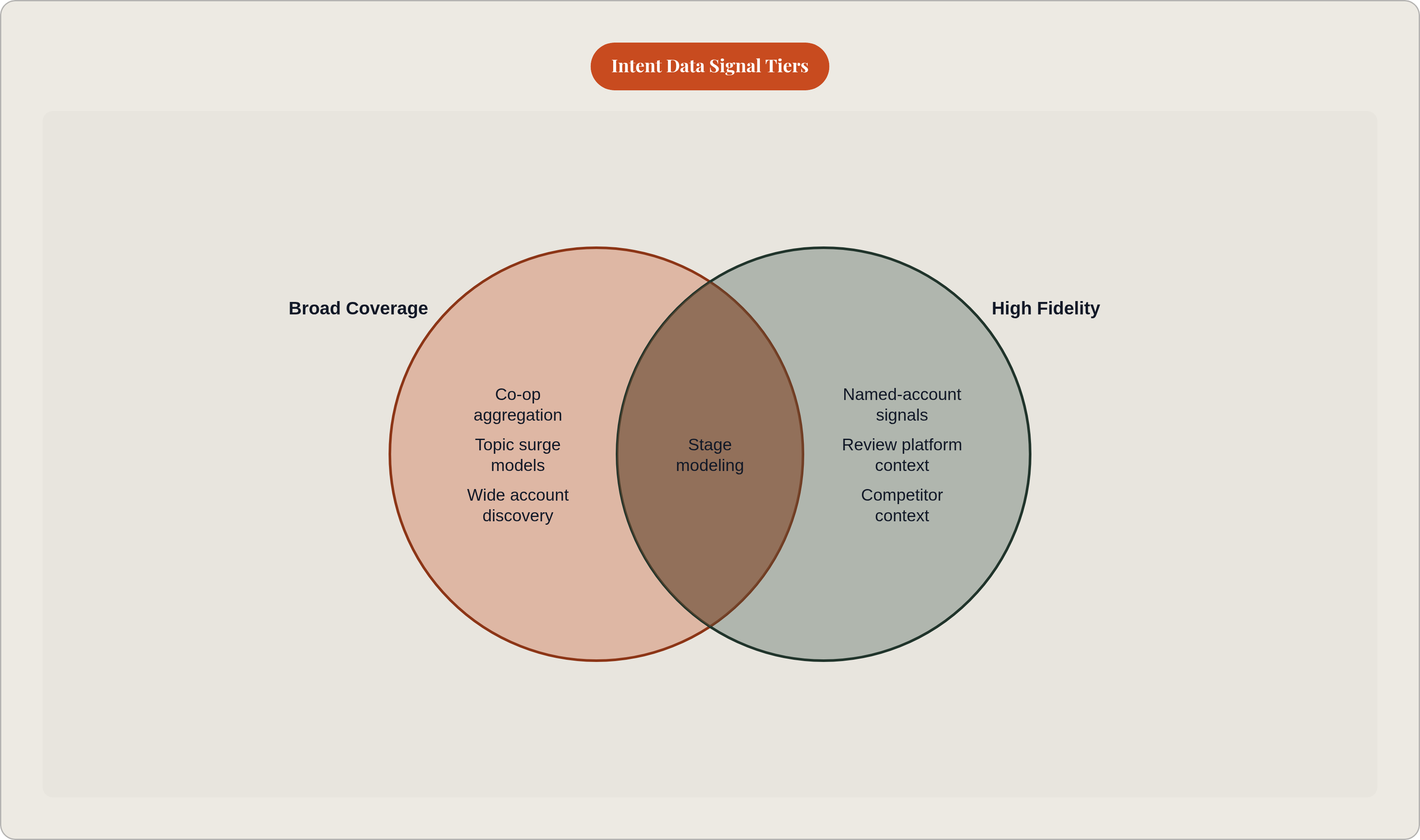
Every provider draws from some combination of three signal layers.
- First-party signals: Behavior on your own properties. Highest confidence possible. The catch is zero visibility into research happening anywhere else, which is most of it.
- Second-party signals: Behavior on review platforms like G2 or TrustRadius. Named-account activity. Captures accounts in vendor-comparison mode, which is a high-urgency moment.
- Third-party signals: Aggregated signals from data co-ops and publisher networks. Broadest coverage. Also the most prone to noise and false positives.
Gartner's 2026 research puts a number on the problem: roughly three-quarters of the B2B buying journey happens before any vendor contact. Buyers are researching, comparing, narrowing lists, and forming opinions while your CRM sits there blissfully unaware — like a detective who only shows up after the mystery is already solved. Intent data is the attempt to see into that window.
There is a newer blind spot worth naming. Buyers who use ChatGPT, Perplexity, or similar tools to compare vendors leave no trackable signal. No page view. No IP address. No co-op data. The shortlist exists before a sales team has any visibility. No intent provider has solved this yet, and anyone who claims otherwise is worth pressing hard on the methodology.
On the signal side, different behaviors map to different buying stages.
- Awareness stage: Broad topic research, industry content consumption. Lots of accounts. Most of them not ready.
- Consideration stage: Competitor page visits, side-by-side comparisons, review browsing. The pool narrows. Urgency increases.
- Decision stage: Pricing pages, RFP downloads, demo requests. Small number of accounts. High urgency. High confidence.
One more thing before moving on: a single signal is almost never reliable on its own. One content download is noise. Three aligned signals on the same account over two weeks is a pattern worth acting on. This is also why "more signals" is not automatically better. Volume without precision just creates more noise to sort through, and noise is what kills intent programs from the inside.
The Five Dimensions That Actually Differentiate Providers
Pull up any two intent providers' websites and you will see the same language. AI-powered. Predictive. Full-funnel. Actionable insights. It blurs together fast. So instead of comparing feature lists, here are five lenses that actually cut through.
Dimension 1. Data source and exclusivity. Where do the signals come from? An owned publisher network? A co-op? A review platform? Technographic overlays? The source determines what behaviors you can see. It also determines how much overlap exists between providers. If two providers both draw from the same co-op, buying both does not double your signal. It doubles your invoice.
Dimension 2. Signal type and fidelity. Named-account, first-party signals carry more confidence than modeled or inferred signals from IP resolution. Both have valid use cases, but they are not equivalent. When a vendor makes accuracy claims, look for methodology transparency. Vague precision claims without explanation are a flag worth taking seriously.
Dimension 3. Buying-stage modeling versus raw signal delivery. Some providers hand you a surge score and let you figure out what it means. Others map accounts to discrete buying stages and suggest what to do next. If your team does not have a dedicated analyst or a strong RevOps function, you almost certainly need stage modeling built in. Raw signals require interpretation, and that interpretation takes time and expertise most teams do not have sitting around.
Dimension 4. Activation surface. A signal that cannot reach a rep's workflow or a live ad platform is a report someone reads once and forgets. Before you evaluate a provider, ask: where exactly does this data go? CRM push? Sales alerting? Ad platform integration? Email sequencing? The shortest path between signal and action is usually the right path.
Dimension 5. Go-to-market motion fit. Enterprise ABM, mid-market outbound, content-led inbound, and competitive interception each need different signal types and different activation speeds. No single provider is optimal across all four. This is the dimension most teams skip, which is also why most teams end up blaming the data instead of the decision.
On cost: entry-level intent tools run a few thousand dollars annually. Purpose-built enterprise platforms can reach six figures. Buying the most expensive platform for a motion it was not designed to support is a very efficient way to convince your leadership that intent data does not work. It does. Just not like that.
Providers Built for Broad Third-Party Signal Coverage: Bombora and Intentsify
These two providers live in the third-party signal world. The tradeoff is coverage versus precision. Both handle it differently, and the difference matters depending on where you are in building your intent program.
Bombora
Bombora runs on a co-op model. Signals are aggregated from thousands of premium B2B publisher sites, tracking billions of interactions monthly. The core mechanic is what Bombora calls "Company Surge." Rather than flagging an account because it crossed some generic threshold, Surge measures when an account's content consumption on a topic rises above that account's own historical baseline. That baseline-relative approach actually matters. It filters out industry-wide noise and surfaces accounts where something has genuinely shifted.
The topic library runs deep. More than 10,000 subjects. You can also build custom taxonomies, which is important for teams whose buying triggers are niche or highly product-specific.
Their Curated Ecosystem Audiences, launched in 2025, are worth paying attention to for competitive plays. These are pre-built segments that combine intent with technographic data around specific tech stacks. Useful if you are going after customers of a competitor running a particular platform.
Pricing starts around $25,000 to $30,000 per year for the basic Company Surge plan. Most real implementations land between $50,000 and $100,000 depending on topic count and data volume.
Best fit: content-driven inbound and ABM programs that need to identify category-level interest before accounts raise their hands.
Intentsify
Intentsify took the top Current Offering score in the Forrester Wave Q1 2025 evaluation across the 15 vendors assessed. That is the strongest recent third-party validation in the category, and it is not an accident.
The differentiator is what they call "Precision Intent." Models are calibrated to each customer's specific product rather than mapping to generic topic buckets. This directly targets the false-positive problem that plagues broad co-op data. A company reading general content about "cloud security" is not necessarily in the market for your specific cloud security product. Intentsify's approach closes that gap, and for teams that have already been burned by noisy surge data, that specificity is the whole point.
Pricing is custom, based on data volume, activation channels, and signal configuration. No published tiers.
Best fit: teams that have already run broad surge data, gotten burned by the noise, and need precision over volume.
Where Both Fall Short
Neither Bombora nor Intentsify surfaces named individuals at an account. They show company-level behavior, which is genuinely useful, but it means they work best when paired with a contact-level data source. On their own, they will tell you a company is researching. They will not tell you who to call.
Providers Built for Full-Funnel ABM at Enterprise Scale: 6sense and Demandbase
These are the heavyweights. Built for enterprise teams running coordinated, multi-channel ABM programs. They are not lightweight tools. They are infrastructure investments, and you should treat the evaluation accordingly.
6sense
6sense's core differentiator is buying-stage modeling. It does not just score accounts. It maps them to discrete stages: Target, Awareness, Consideration, Decision, Purchase, Retention. Reps prioritize by readiness, not by raw signal volume. That distinction is more important than it sounds. A high surge score on an account that just onboarded a competitor is noise. A stage model that says "this account is in active Consideration" is something you can actually act on.
6sense's 2025 Buyer Experience Report found that the vast majority of B2B buying groups have already ranked preferred vendors before ever speaking to sales. Stage modeling is the attempt to surface those accounts before they reach out to someone else first.
RevvyAI, launched in 2025, takes the platform further. Instead of surfacing data and waiting for a human to decide what to do, it recommends next actions and triggers outreach automatically. The product is moving toward recommendation and action, not just reporting.
Pricing: a free entry tier exists for small teams. The Growth tier runs around $200 per user per month and includes buying stage insights and predictive scoring. Enterprise is custom.
Best fit: enterprise marketing and RevOps teams running coordinated multi-channel ABM with the infrastructure to act on stage signals. If your team is lean and your ops function is thin, this platform will underperform what it is capable of.
Demandbase
Demandbase's architecture is the differentiator. Intent data and account-based advertising live in the same platform. There is no manual bridge between a surge signal and a paid media activation. That sounds like a small thing until you have watched three intent programs die because no one built the bridge. The signal fires. The ad adjusts. It happens in one system.
Agentbase, launched in March 2025, adds an agentic AI layer that autonomously identifies in-market accounts, suggests engagement strategies, and orchestrates campaigns. The platform is moving toward autonomous action rather than passive signal delivery.
Best fit: enterprise teams where marketing owns both ad spend and sales alignment, and needs both moving together from a single data layer.
Shared Caveat
Both platforms assume meaningful RevOps or marketing operations investment to configure and sustain. Teams without that infrastructure will get far less than the platform is capable of delivering. That is not a knock on either product. It is just true.
Providers Built Around High-Fidelity, Named-Account Signals: G2 and HG Insights
This tier trades breadth for confidence. Smaller coverage footprint. Higher signal fidelity. For the right motion, that trade is absolutely worth making.
G2 Buyer Intent
G2's signal source is its own platform. Tens of millions of annual users on the world's largest B2B software review site. What products they viewed. Which comparison pages they visited. Which categories they browsed.
The specific value here is context. Review-platform intent captures accounts in active vendor evaluation, not general category curiosity. Someone visiting a side-by-side comparison page of your product against two specific competitors is not casually browsing. That is a buying signal with urgency attached, and G2 can surface that activity at named accounts with competitor context embedded in the signal. That last part matters. Knowing who they are comparing you to is often more useful than knowing they are looking at all.
Pricing: the Core tier starts around $10,000 to $15,000 per year. The Buyer Intent add-on lists around $40,000 to $50,000, though that is negotiable.
Best fit: sales and marketing teams in crowded SaaS categories where competitive win/loss dynamics are heavily shaped by review site research.
Limitation: G2's coverage is bounded by G2's platform. Accounts researching through other channels are invisible. High-fidelity where it reaches. It does not reach everywhere.
HG Insights
HG Insights acquired TrustRadius in June 2025. The combination is interesting. You get first-party TrustRadius review signals, named-account and verified buyer research, layered on top of technographic data. Installed tech stack. IT spend levels. Firmographic fit. All rolled into a single account score.
The technographic layer adds a displacement angle that pure intent data does not typically address. Knowing that a prospect runs a competing platform is as relevant as knowing they are researching alternatives. It tells you both that they are looking and what they are looking to replace, which is a very different starting point for a sales conversation.
Best fit: teams targeting technology buyers where tech-stack fit is a prerequisite for the deal. If your product only makes sense for accounts running certain infrastructure, HG Insights is designed for exactly that situation.
Both G2 and HG Insights illustrate a principle worth holding onto: first-party, named-account signals are harder to scale but easier to act on with confidence. The question is whether your team needs coverage or conviction. Those are usually not the same tool.
Providers That Layer Intent Into Contact Data and Outreach: ZoomInfo, Informa TechTarget, and Cognism
This tier is different from the others. Intent data here is not the main product. It is layered into something else: contact data, publisher-network leads, outbound prospecting tools. That context shapes how you should evaluate and use it.
ZoomInfo
ZoomInfo Intent layers behavioral signals directly onto contact-level firmographic data. The step between "this account is surging" and "here is who to call" is removed. For outbound sales teams that already live inside ZoomInfo's ecosystem, that is a real convenience. The signal surfaces inside the workflow the rep is already in, which means it actually gets used.
Copilot, updated in 2025, adds AI-generated next-step recommendations triggered by intent signals. The product is moving from data delivery toward action suggestion.
The limitation is that intent data is a secondary capability for ZoomInfo. Teams that need deep signal customization, granular buying-stage modeling, or high-confidence third-party coverage will find it thinner than purpose-built providers. It is not trying to be Bombora. It is trying to make Bombora-style signals useful inside a prospecting tool, which is a different goal.
Best fit: outbound sales teams that live in ZoomInfo and want intent to surface in their existing workflow rather than as a separate platform to check.
Informa TechTarget
Informa TechTarget's signals come from a network of technology-specific publications and websites. Deep coverage of IT and technology buyer research. Limited relevance outside that vertical. If you are selling to IT decision-makers, that depth is genuinely valuable. If you are not, it is largely irrelevant.
The output is typically actionable lead lists of named contacts at surging accounts. That makes it closer to demand generation than pure intent data. Forrester's Q1 2025 Wave named it a Customer Favorite, a distinction that reflects strong fit within its specific vertical rather than broad applicability.
Best fit: technology vendors targeting IT decision-makers where publisher-network behavior is a reliable proxy for purchase research.
Cognism
Cognism's primary differentiator is compliance and data accuracy for teams selling into Europe. It partnered with Bombora to deliver intent signals alongside its core contact data, which means the intent layer is additive, not the anchor. Do not choose Cognism as your intent strategy. Choose it if you need compliant European contact data and want intent built in without managing a separate vendor relationship.
Best fit: teams with significant European pipeline who need compliant contact data and want intent signals layered on.
Common Thread
Across all three: intent works best here as a prioritization filter on an existing contact universe, not as a standalone account discovery engine. If you are trying to figure out which accounts on your target list to call first, this tier is useful. If you are trying to discover net-new accounts showing intent, you want a different tier entirely.
Matching Provider Type to Go-to-Market Motion
Before selecting a provider, answer one question. What does your team do within 24 to 48 hours of seeing an intent signal, and can this provider's output actually trigger that action in your existing workflow? If you cannot answer both parts, you are not ready to buy. You are ready to map your motion first.
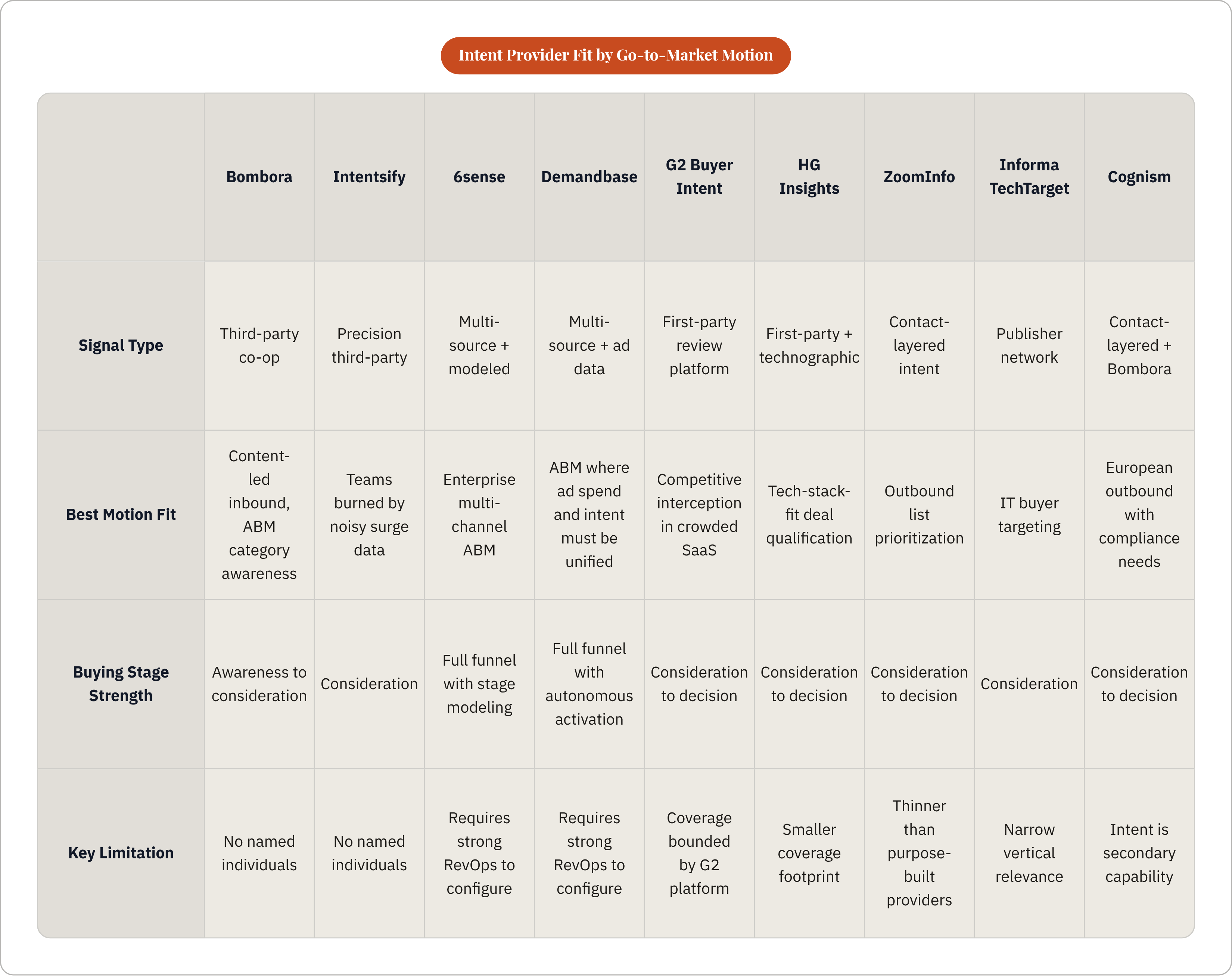
Here is how the motions map to the providers covered above.
- Content-led inbound, building category awareness: Bombora. Broad topic coverage. Surge detection before accounts self-identify.
- Enterprise ABM with coordinated multi-channel plays: 6sense for stage modeling and predictive prioritization. Demandbase if intent-to-ad-spend needs to live in one system.
- Competitive interception and mid-cycle displacement: G2 Buyer Intent for named-account comparison signals. Bombora Curated Ecosystem Audiences for technographic-plus-intent displacement plays.
- Outbound sales teams prioritizing call lists: ZoomInfo for intent on contact records inside an existing prospecting workflow. Intentsify for precision signals that reduce wasted outreach.
- Technology vertical, IT buyer focus: Informa TechTarget or HG Insights, depending on whether publisher-network coverage or tech-stack-fit signals matter more to your deal.
- European pipeline with compliance requirements: Cognism plus Bombora.
A word on stacking. Many mature intent programs run two providers. One for broad account discovery. One for high-fidelity decision-stage signals. The logic is sound because no single provider covers the full funnel with equal confidence at every stage. If you are early in building an intent program, start with one tool that fits your primary motion and learn it well. Think of it like learning to drive on one road before you try to navigate a highway interchange — mastery of the familiar path first, expansion second. If you have already done that and are still leaving signal gaps, that is when stacking makes sense. Stacking before you understand your primary motion just multiplies the noise.
The intent data itself is not the problem. The match between the data and the motion is. Get that right, and the ROI gap closes faster than most teams expect.