Revenue Enablement Platform Capabilities Worth Paying For
Freeing up rep time matters less than knowing which accounts are actually buying.

Sales enablement pulled in $5.23 billion in 2024, and Grand View Research has it growing at a 16.3% annual clip through 2030. Money like that draws crowds, and crowds bring feature bloat. Vendors start stacking checkboxes to win procurement instead of building things that actually move a deal forward, and buyers end up comparing dashboards instead of asking the one question that matters: does this thing shorten my sales cycle? This piece sorts the category by that question. No scorecards, no bake-offs, just a plain-language guide to what's worth your budget and what's just there to look good on a slide.
How sellers actually spend their time, and why it matters for platform ROI
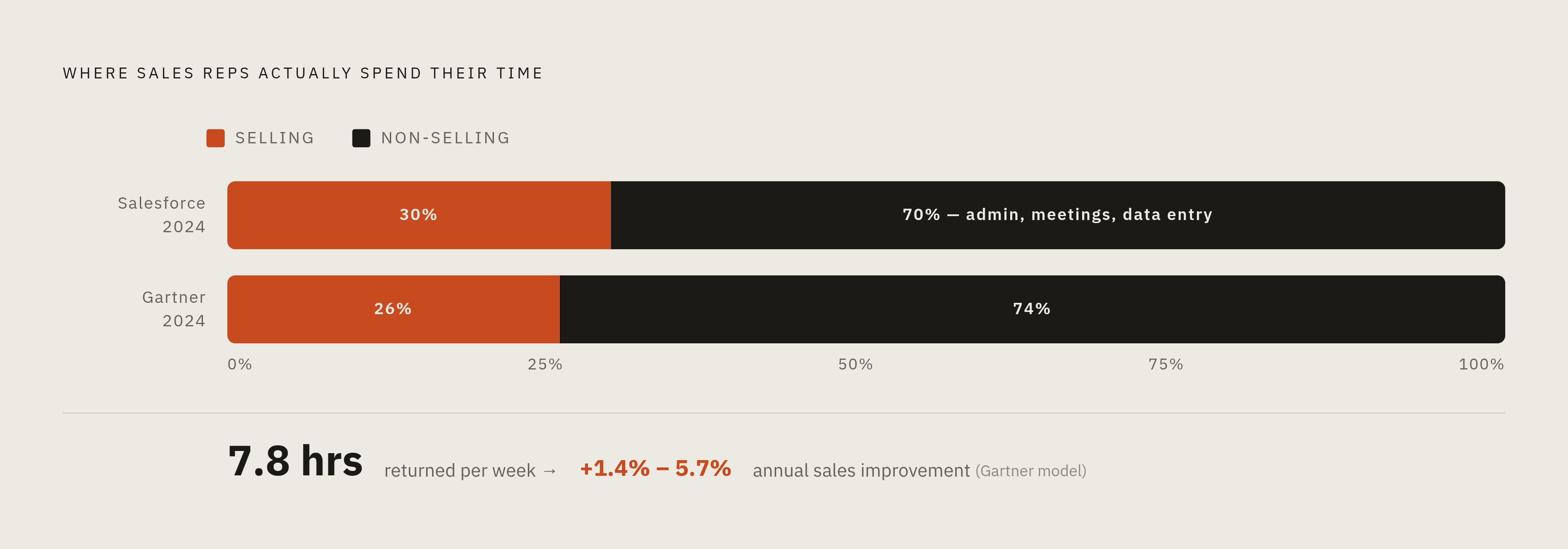
Salesforce's 2024 State of Sales report found reps spend 70% of their time on stuff that isn't selling. Admin. Internal meetings. Data entry. The kind of work that makes you feel busy without making you money.
Gartner ran its own numbers in 2024 and landed somewhere even worse: sellers spend just 26% of their time actually selling. Gartner also modeled what happens if you give reps back 7.8 hours a week. Sales outcomes improve, somewhere between 1.4% and 5.7% annually. That's a wide range, and the reason it's wide matters more than the number itself: the lift depends entirely on what reps do with the time they get back.
Here's where it gets practical. A platform that automates CRM cleanup or auto-generates call notes is fine. Good, even. But it has a ceiling, because cleaning up data doesn't close deals. The capabilities worth paying real money for are the ones that change what a rep does with their newly freed-up Tuesday afternoon: who they call, when they call, and why that timing matters.
The buyer timing problem that most platforms are still built to ignore
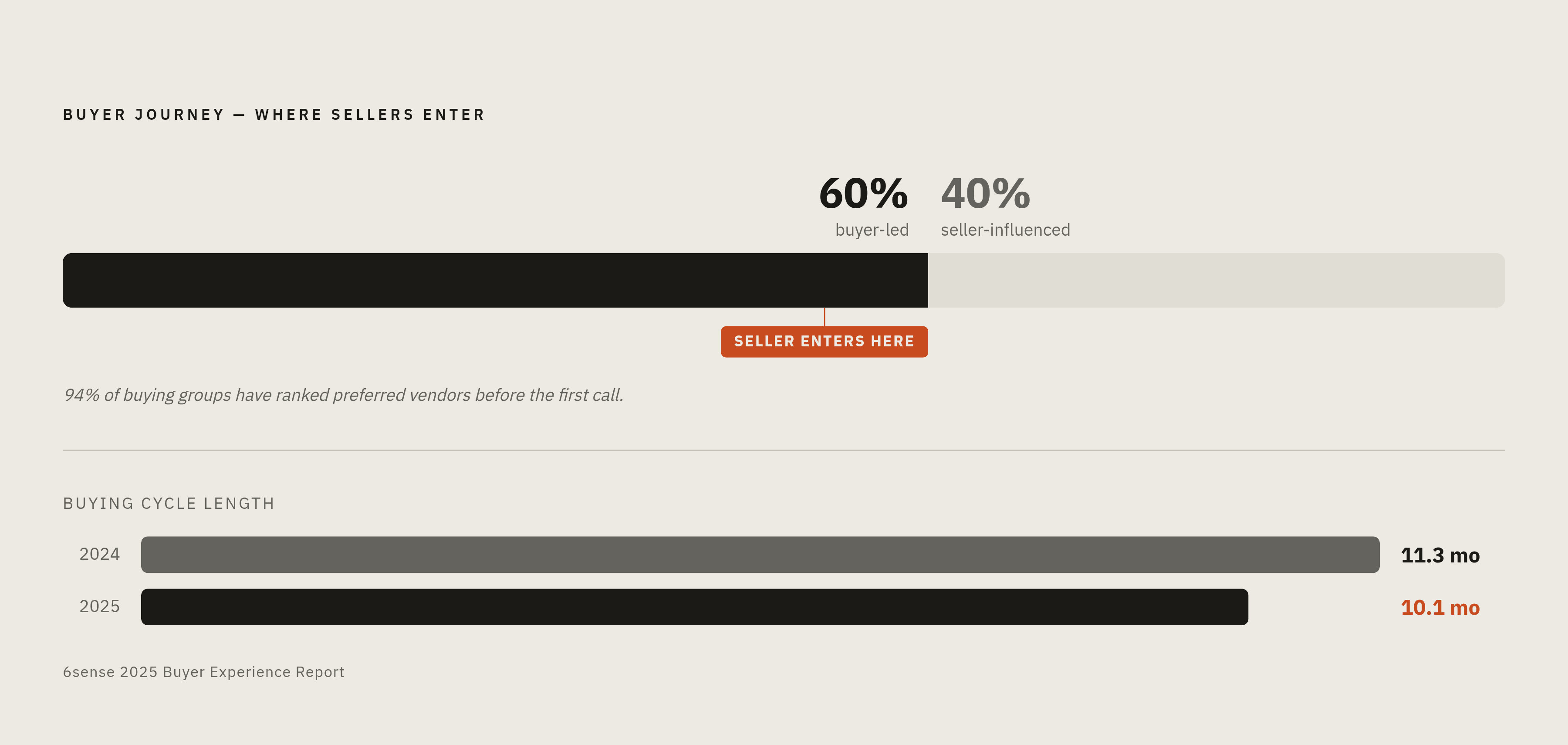
Here's a stat that should terrify anyone still building playbooks around cold outreach: buyers get through roughly 60% of their decision before a seller ever hears from them, according to 2025 buyer experience research. Worse, 94% of buying groups have already ranked their favorite vendors before the first call happens. You're not pitching. You're auditioning for a part that's already been cast.
The buying cycle is also getting shorter, down from 11.3 months in 2024 to 10.1 months in 2025. Less time to catch up once you notice a deal exists.
So think about what most enablement platforms are actually built for: contact management, content libraries, playbooks that help reps deliver a great pitch to accounts they already know about. That's a fine skill to have. It's just aimed at the wrong target, because if the account is already 60% through its decision, a better pitch deck isn't going to save you. You needed to know about them three months ago.
This is why intent detection, not content management, deserves the first and hardest look when you're evaluating a platform. Everything else is downstream of knowing who's actually in-market.
What genuine intent detection looks like versus what vendors typically sell as intent
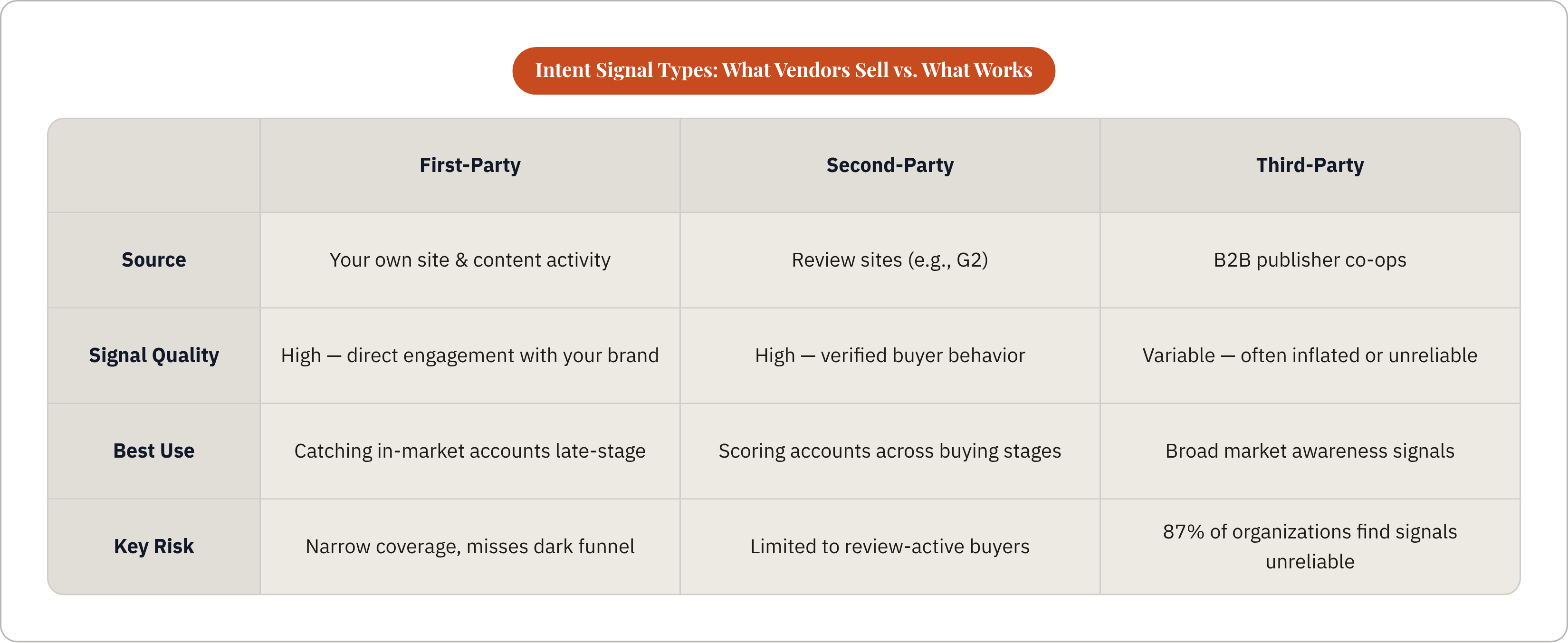
Intent data comes in three flavors, and knowing the difference separates a useful platform from an expensive rumor mill.
First-party is your own site and content activity, people clicking around your pricing page at 11pm. Second-party comes from review sites; G2, for instance, pulls verified signals from over 100 million software buyers and scores accounts daily across nine signal types and three buying stages (Awareness, Consideration, Decision). Third-party data comes from research co-ops that aggregate behavior across thousands of B2B publisher sites.
Sounds great in theory. In practice, DemandScience's benchmark found 87% of organizations say their intent signals are unreliable or inflated, and only about a quarter of those signals ever turn into a qualified opportunity. That's not a reason to skip intent data; it's a reason to stop buying it by the pound. The edge isn't in more signal, it's in filtering the signal you already have.
Layering is where this gets interesting. One signal alone rarely means much; an account visiting your pricing page could be a competitor doing homework, or a college student writing a term paper. But an account visiting your pricing page, that also just raised funding, and is actively hiring SDRs? That's a buyer showing you their hand. Cognism found that companies that recently raised funding are 2.5 times more likely to adopt new solutions, which is exactly the kind of business-event signal that makes behavioral data trustworthy instead of just noisy.
Competitive intent deserves its own category entirely. When an account starts researching you and your competitors side by side, that's decision-mode behavior, often the clearest trigger you'll get for a pricing conversation or an executive-level nudge. There's also a "dark funnel" pattern worth watching: renewed competitor research, review site visits, comparison searches, all pointing to an account that went quiet and is now waking back up. Letterdrop's competitor intent tracking is built specifically to catch this moment, giving reps a mid-cycle window to jump in that most inbound-focused platforms simply don't have.
When you're evaluating vendors here, ask four things: where do the signals come from (first, second, and third-party, or just one lonely source), how are they filtered and scored, do they surface competitive intent specifically, and how fast do signals actually reach a rep's inbox. The 2025 Forrester Wave named Intentsify, Informa TechTarget, and a handful of others as leaders in B2B intent data, and for enterprise account-based work, Demandbase shows up consistently on the analyst shortlists. Smaller teams looking for an accessible entry point tend to land on tools like Apollo.io or Dealfront.
Content-to-pipeline attribution: the capability most platforms claim and few deliver
Every vendor in this category will tell you they connect content to revenue. Almost none of them actually do it well, and the data backs that up. CMI's 2025 research, based on nearly a thousand B2B respondents, found 56% of marketers say attributing ROI to content is one of their top measurement headaches. Almost half don't measure content ROI at all. They just... make content, and hope.
Part of the problem is the attribution model itself. RevSure's 2025 study of senior B2B SaaS marketers found close to 90% still rely on single-touch or basic multi-touch models, the kind that assume one person made one decision at one moment. Real B2B deals don't work that way. Self-reported data consistently shows that somewhere between 30% and 50% of pipeline comes through channels that digital attribution simply can't see. Independent research also found that AI-driven attribution models lift forecasting accuracy by 22 percentage points over deterministic single-touch models, which is a bigger jump than almost anything else in the marketing ops toolbox.
Why does this matter so much? Because B2B deals involve committees, not individuals: an economic buyer, a technical evaluator, an end user, a champion who's fighting for you in meetings you're not in. Each of them reads different content at different points. A platform that only tracks whoever filled out the demo request form is watching one character in a five-person play and calling it the whole story.
So when you're kicking the tires on attribution features, ask if the platform tracks engagement across every person on the buying committee, not just the lead record. Ask if it connects content touchpoints to time-to-close, not just lead volume. Ask which content types actually correlate with faster deals. Only 7.6% of B2B teams currently use AI-powered attribution to tie something like a webinar directly to pipeline, which tells you this is still wide open territory, and the platforms that do it well have a real edge because of it. Companies that can point to clear content ROI see 30% higher growth than the ones flying blind. This isn't a reporting nicety. It's a growth lever.
Sales content delivery and readiness: where most platforms over-index
Content libraries, battlecards, playbooks: this is the meat and potatoes of nearly every enablement pitch you'll sit through, mostly because it's the easiest thing to demo. Someone uploads a PDF, tags it, and boom, feature built. That ease of demo is exactly why this category gets oversold relative to what it actually does for a deal.
Here's the honest problem. A content library is only as good as a rep's ability to find the right thing at the right moment, mid-conversation, without fumbling. Most libraries turn into graveyards: assets get uploaded once and never touched again, because reps default to whatever's already saved on their desktop or whatever pops up first in a two-click search. Readiness and training modules run into a similar wall. You can track who finished the course. You cannot easily track whether they actually sell any differently afterward.
Content delivery earns its cost under specific conditions. When it's surfaced automatically, tied to deal stage or live account signals or what's actually being said on a call, instead of asking a rep to go dig through folders. When competitive battlecards show up because a buyer is actively comparing you to a rival right now, not because it's Tuesday and that's when training happens. When you can point to onboarding ramp time actually shrinking, which is about as concrete an ROI case as this category gets.
Gartner's 2025 Magic Quadrant for Revenue Enablement Platforms named Highspot and Allego as Leaders, and both built their reputations on content management and readiness first. Worth asking them directly whether their intent and attribution layers run as deep as their content shelves do. And worth asking every vendor in this category one blunt question: can you show me, in your actual customer data, how content delivery changed a deal outcome, not just how many times someone opened a slide deck?
Conversation intelligence and deal inspection: useful signal or expensive noise
Conversation intelligence platforms record your calls, transcribe them, and go hunting for patterns. Gong is the name everyone knows here, running around $160 per user per month. The pitch is coaching and risk detection. The reality depends entirely on what happens after the insight gets generated.
Done right, conversation intelligence catches a deal going quiet before it actually dies; sentiment shifting, a stakeholder who stopped showing up to calls, an objection nobody ever circled back on. It surfaces competitor mentions in real conversations, which feeds straight back into your battlecard strategy. It can coach reps on the specific behaviors that correlate with wins in your particular segment, instead of generic sales advice pulled from a training manual.
Done wrong, it's just a firehose. Call summaries, talk-ratio charts, topic tags, endless dashboards that a sales manager glances at once and never opens again. Without a clear path from "here's what the AI noticed" to "here's what a human does about it," conversation intelligence turns into a reporting layer that costs real money and changes nothing. The question to ask isn't whether the platform generates insight. It's whether that insight lands on the right desk at the right time, or whether someone has to go spelunking for it.
Cost adds up fast here too. Stack Gong at $160 a seat with Clari for forecasting at $200 a seat, throw in a couple more point solutions, and you're easily past $500 per user per month before anyone's closed an extra deal. Some organizations that have consolidated fragmented stacks into a single AI-native platform report saving around $288,000 a year for a 50-person team. Consolidation isn't just a tidiness argument; it's a real budget line when two tools are quietly doing the same job.
Thought leadership and seller credibility as deal-acceleration infrastructure
Nobody thinks of a LinkedIn post as sales infrastructure, but the data says otherwise. The 2025 Edelman-LinkedIn B2B Thought Leadership Impact Report, based on nearly 2,000 management-level professionals across seven markets, found that the vast majority of what the report calls "hidden buyers" are more receptive to sales outreach from brands that publish strong thought leadership.
Who are hidden buyers? They're the people in finance, legal, compliance, and procurement who can kill your deal without ever taking a sales call. They account for a large share of deal stalls caused by internal disagreement, and the majority of them have little to no direct contact with a seller, ever. Whatever they think of you, they think it based entirely on what your company has already published somewhere they happened to read it.
And they're reading. a large share of hidden buyers spend more than an hour a week consuming thought leadership content, nearly matching the time your actual target buyers spend, and the great majority say good thought leadership helps them see problems they hadn't clocked yet. Here's the payoff: most hidden buyers say they're more likely to advocate for a brand internally during an RFP if that brand's thought leadership impressed them. That's a stranger you've never emailed, fighting for you in a room you're not allowed into.
So when you evaluate a platform on this front, don't just ask whether it publishes company blog posts. Ask whether it helps individual sellers distribute that content through their own networks, LinkedIn posts, personal outreach, sequences that put a real name behind the insight. Certain enablement tools are built around exactly this, turning company-level content into seller-distributed touchpoints that build trust before the first sales call even happens. And know that revenue-first content, the kind built around bottom-of-funnel questions and worked backward from there, converts at 2 to 3 times the rate of generic brand-awareness content. Thought leadership only accelerates deals when it answers the question a buyer is actually asking, not the question marketing wishes they were asking.
Forecasting and pipeline inspection: when AI-driven features earn their cost
AI-driven pipeline inspection tools promise to flag at-risk deals, predict close probability, and catch forecast anomalies before your VP does in the Monday pipeline review. The honest test for any of these tools is simple: is the flag actionable the moment you see it, or is it just a fancy way of telling you a deal died, three weeks after it already died?
A tool that says "this deal has gone quiet, no email response in 12 days, competitor mention detected on the last call" gives a manager something to do today. A tool that just recalculates a probability score based on deal age and stage, without tying it to anything happening on the ground, is describing the past dressed up as a prediction. The AI-driven features worth their subscription price are the ones built on the same real signals covered earlier: intent data, conversation patterns, content engagement, all pulled together into one view of a deal instead of scattered across four different logins.
That's really the throughline across every category here. Intent tells you who to call. Attribution tells you what's working. Content delivery and conversation intelligence tell you what to say and when. Forecasting is just the sum of all of it, expressed as a number your CFO can read. Buy the pieces that feed each other. Skip the ones that only feed a dashboard.