Miller Heiman Strategic Selling in Multi-Stakeholder B2B Deals
Master the four buying roles that actually decide enterprise deals.

Robert Miller and Stephen Heiman built this methodology in the late 1970s around a premise that sounds obvious now but was genuinely radical at the time: enterprise selling is a team sport on both sides of the table. Not just your team. Theirs too.
Over a million sales professionals have been trained on it since. Fortune 500 companies have used it since 1985. Korn Ferry owns it now, maintaining it as the backbone of its Sales and Service training through the Korn Ferry Sell platform, with core tools embedded natively in Salesforce and Microsoft Dynamics.
Two components make up the methodology:
- Strategic Selling. Planning the deal. Who are the stakeholders, what does each one need, and where do you actually stand with them.
- Conceptual Selling. Running the individual conversations that advance the plan.
The central tool is the Blue Sheet. It started as a paper planning document in 1978. Now it lives in your CRM.
The conviction the whole thing rests on is straightforward: job titles do not tell you who matters. Deals are won or lost based on how well a seller understands the difference between a title and a buying role. Those are two very different things, and most reps treat them as the same thing for their entire career.
One note on fit before going further. Miller Heiman is built for complex B2B sales with multiple stakeholders, deals above roughly $50,000, and longer cycles with internal approval chains. If you are selling to one person who makes the call same-day, this is overkill. Use something simpler and save yourself the headache.
The Four Buying Roles and Why Each One Needs a Completely Different Approach
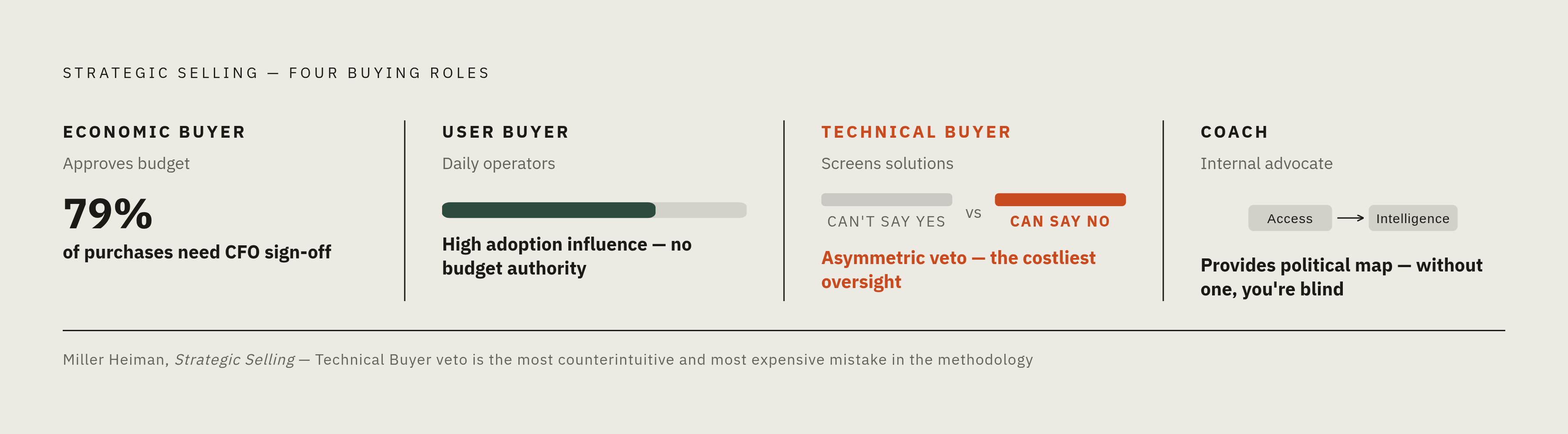
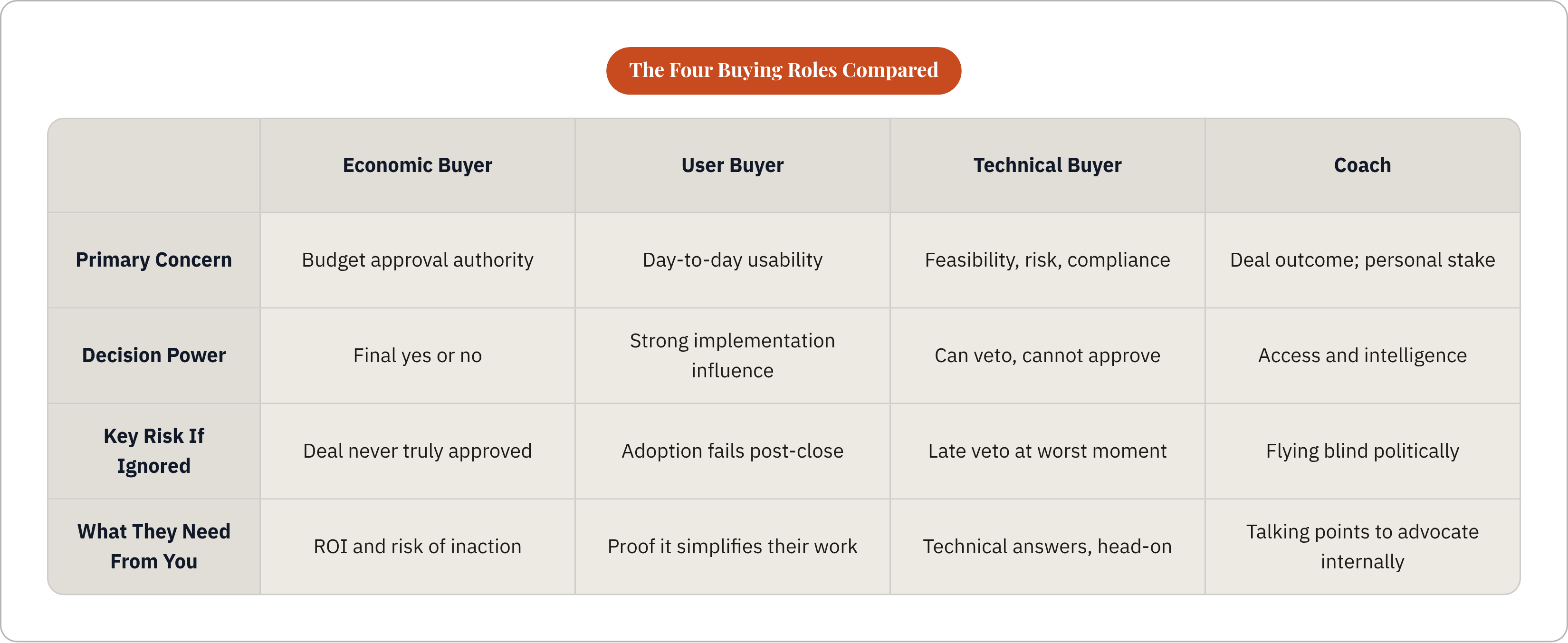
Every deal has four distinct buying roles regardless of org chart or title. A seller who conflates them loses, usually without ever figuring out why.
Economic Buyer
This is the person who can actually approve the budget. Often not your day-to-day contact. Frequently a C-suite or VP-level executive you have never spoken to. According to TrustRadius data from 2024, 52% of buying groups include decision-makers at VP level or above, and 79% of purchases require CFO approval.
That second number is worth sitting with. A rep who has built solid relationships at the practitioner level but has never reached the Economic Buyer is not as far along as they think. They are not even close, really.
User Buyer
These are the people who will live with the solution every day. Their concern is entirely practical: will this make my job easier or harder? Ignore them and you create internal friction that quietly kills implementations and referenceability long after you cash the check. They rarely have final budget authority. They have enormous influence over whether the thing actually works.
Technical Buyer
This person vets feasibility, risk, compliance, and integration. Think IT, security, legal, procurement. The critical thing to understand about Technical Buyers is their asymmetric power: they cannot say yes, but they can absolutely say no, and they will do it at the worst possible moment if you have been treating them like a box to check rather than a real stakeholder. Very expensive mistake. Very common.
Coach
Your internal advocate. They guide you through the org, give you candid intel, provide access, and flag political dynamics you would never see from the outside. Not necessarily the most senior person in the room. Usually the person who genuinely wants the deal to happen and has something personal at stake in the outcome.
If you do not have a Coach, finding one should be your next concrete action in any complex deal. The Coach is the difference between having a key to the building and wandering the hallways hoping a door is unlocked.
How Response Modes Tell You What Each Stakeholder Will Actually Do When Pushed
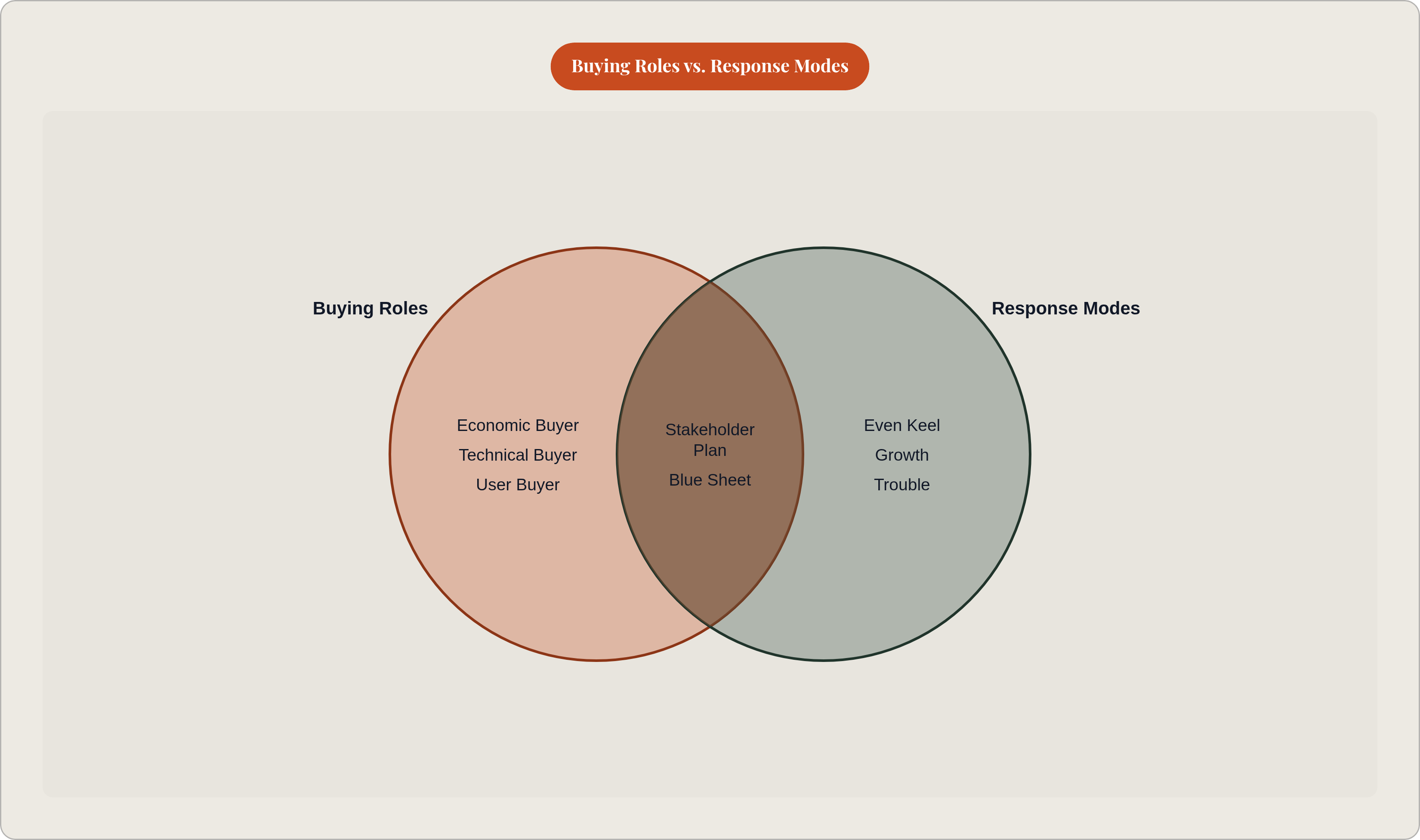
Knowing someone's buying role tells you what decision they make. Response Modes tell you how they feel about making any decision at all. That is a completely different thing.
Four modes:
- Growth. They see a gap between where they are and where they want to be. Actively looking for solutions. Most receptive to a real sales conversation.
- Trouble. Facing a problem that needs urgent resolution. High urgency, high emotion. They want speed, not a product tour.
- Even Keel. Things are fine. No perceived gap, no felt pain. The hardest stakeholder to move, and the one reps consistently underestimate.
- Overconfident. Believes their current situation is better than it actually is. Resistant. Sometimes dismissive, occasionally a little smug about it.
The same value proposition lands completely differently depending on the mode. An Even Keel Technical Buyer does not want to hear about capability improvements. They need to see a risk they have not accounted for. A Trouble Economic Buyer does not want a demo. They want to know how fast you can solve the problem and get out of the conversation.
Response Modes also shift, sometimes fast. Budget cycles change. A competitor makes a move. Leadership turns over. A stakeholder can go from Even Keel to Trouble basically overnight, and if you are still treating them the way you did three months ago, you are having the wrong conversation in the wrong key.
The most common mistake is treating every stakeholder as if they are in Growth mode. This is how reps spend an hour walking through a product roadmap with someone who never had any intention of moving in the first place. Both people leave that call feeling like something is wrong, and only one of them knows exactly what it is.
Win-Results: Separating What the Organization Needs from What Each Individual Wants
This is where Miller Heiman gets genuinely useful and genuinely uncomfortable at the same time.
- Results are the measurable business outcomes the organization needs. Cost reduction. Faster implementation. Reduced risk. The things that show up in a business case and get presented to a board.
- Wins are the personal, often unstated motivations of each individual stakeholder. Recognition. Job security. Being the person who made the right call. The things that almost never show up anywhere in writing.
Both matter. Both are different for every person in the buying group. A solution can deliver strong organizational Results and still lose because it never addressed the personal Wins of key influencers. This happens more than people admit, and the deals that die this way tend to die quietly, with everyone slightly confused about what happened.
When a deal goes cold for no obvious reason, Win-Results is the first place to look. Either a key stakeholder's personal Win has never been explicitly understood, or someone's Win is something the solution genuinely cannot deliver. That second case is actually valuable information. It is a qualification signal telling you to stop pouring resources into something that was never going to close.
Surfacing Wins requires asking about individual goals, not just company goals. "What does a successful outcome look like for you personally?" is a fundamentally different question than "What are your business objectives?" The good news is that people will usually tell you, if you ask directly and leave room for the answer instead of filling the silence with more talking.
The blunt implication for multi-stakeholder deals: you need a Win-Results profile for each buying influence. One message to the room is almost always the wrong message for everyone in it.
Filling Out the Blue Sheet in a Real Deal
The Blue Sheet is not a CRM field to check off and move on. It is a structured planning document that forces you to make your assumptions explicit, which turns out to be more uncomfortable than it sounds. Most reps carry a lot of assumptions they have never actually examined. Writing them down has a way of making that obvious fast.
It captures:
- All identified buying influences, their roles, and their current Response Modes
- Win-Results analysis per stakeholder
- Your current position with each buying influence: covered, uncovered, or dangerously over-reliant on one contact
- Competitive position: who else is in the deal and where you stand relative to them
- Gaps: stakeholders not yet contacted, roles not yet covered, information not yet gathered
- Ideal Customer Profile alignment: does this deal actually match the profile where you win consistently
Completing it thoroughly takes several hours. New reps typically need 90 to 120 days of real-deal practice before they develop genuine proficiency. There is no shortcut there, and anyone who tells you otherwise is selling a shortcut.
The payoff is real though. The Blue Sheet converts "I think we're in good shape" into an auditable record of where the deal actually stands. Managers can run deal reviews without relying on rep optimism. The whole team can see the gaps instead of discovering them in the loss review.
One failure mode worth naming: filling out the Blue Sheet once at deal open and never updating it again. The value is in keeping it current as stakeholders shift, competitive dynamics change, and Response Modes evolve. A snapshot from three months ago is not a plan. It is just something that used to be a plan.
Where Miller Heiman Fits Alongside SPIN, Challenger, and MEDDICC
Most enterprise teams combine methodologies deliberately, and the major ones divide the work differently enough that combining them actually makes sense.
- SPIN Selling structures the discovery conversation. It surfaces the problems and implications that feed directly into Win-Results analysis. Good at getting people to articulate things they have never quite said out loud.
- Challenger Sale provides the insight-led reframe. Particularly useful for Even Keel or Overconfident stakeholders who need their assumptions disrupted before they are open to anything new.
- MEDDICC (Metrics, Economic Buyer, Decision Criteria, Decision Process, Identify Pain, Champion, Competition) is primarily a qualification framework. It overlaps with Miller Heiman's role map but focuses more on qualifying and gating deal stages than on planning the full political landscape of an account.
Miller Heiman's distinctive contribution is stakeholder mapping and deal planning at depth. The others handle conversation structure or qualification. Miller Heiman handles the organizational complexity that sits underneath all of those conversations.
An integration pattern that actually works in practice:
- Use SPIN or Challenger to run individual conversations
- Use MEDDICC to qualify and gate deal stages
- Use the Blue Sheet to plan overall deal strategy and track stakeholder coverage
One honest caveat: methodology complexity should match deal complexity. Smaller sales organizations or shorter cycles do not need all of this running simultaneously. Forcing it creates more overhead than value, and that overhead will kill adoption faster than any objection from a rep.
Using Intent Signals to Know When and Where to Apply the Stakeholder Map
Here is a timing problem that changes how you use everything above.
By the time a buying group initiates contact with a vendor, they have already ranked their shortlist internally. The vendor ranked first wins the vast majority of the time. Being on the shortlist is not enough. Position on that shortlist is what actually matters, and that position is mostly determined before you even know an evaluation is happening.
The window to shape an evaluation is before the buyer reaches out. Not after.
Intent signals are how you find that window.
First-party signals come from your own properties. Pricing page visits, content downloads, product comparison engagement. Someone from a target account is actively researching something.
Third-party signals come from external platforms. Review site activity, category research, competitor page visits on G2. They are comparing you to alternatives right now, without having told you.
Contextual signals are public events. Job postings for VP of Sales or Revenue Operations roles, leadership changes, earnings call language that signals a strategic shift. These create buying windows before active research even begins, which is the best possible time to be in the conversation.
The competitive intent signal is the highest-priority trigger. When an account visits comparison pages or reads head-to-head content, they are in active vendor evaluation mode. That is the moment to move, not the moment to schedule a follow-up for next week.
A single homepage visit is noise. A homepage visit followed by pricing page engagement followed by competitor comparison activity is a different situation entirely. Signal layering is what separates real intent from someone who clicked a link by accident and immediately regretted it.
How this connects to Miller Heiman specifically: intent signals tell you when to activate the Blue Sheet and which accounts actually warrant the time investment of full stakeholder mapping. Not every account deserves three to five hours of analysis. Some platforms surface competitive intent signals and route them into the rep workflow, so when an account shows active evaluation behavior, the rep gets the trigger with enough context to do something with it rather than just knowing something vague is happening.
What to Do When a Buyer Is Already Evaluating a Competitor
Nearly half of enterprise deals involve three or more vendors being evaluated simultaneously. Competitive presence is the norm, not the exception.
The response window when a strong competitive intent signal fires is hours, not days. Delayed response hands competitors the relationship. Once a competitor has the relationship, catching up is genuinely hard in a way that does not improve over time.
Step One: Figure Out Which Stakeholders Are Doing the Research
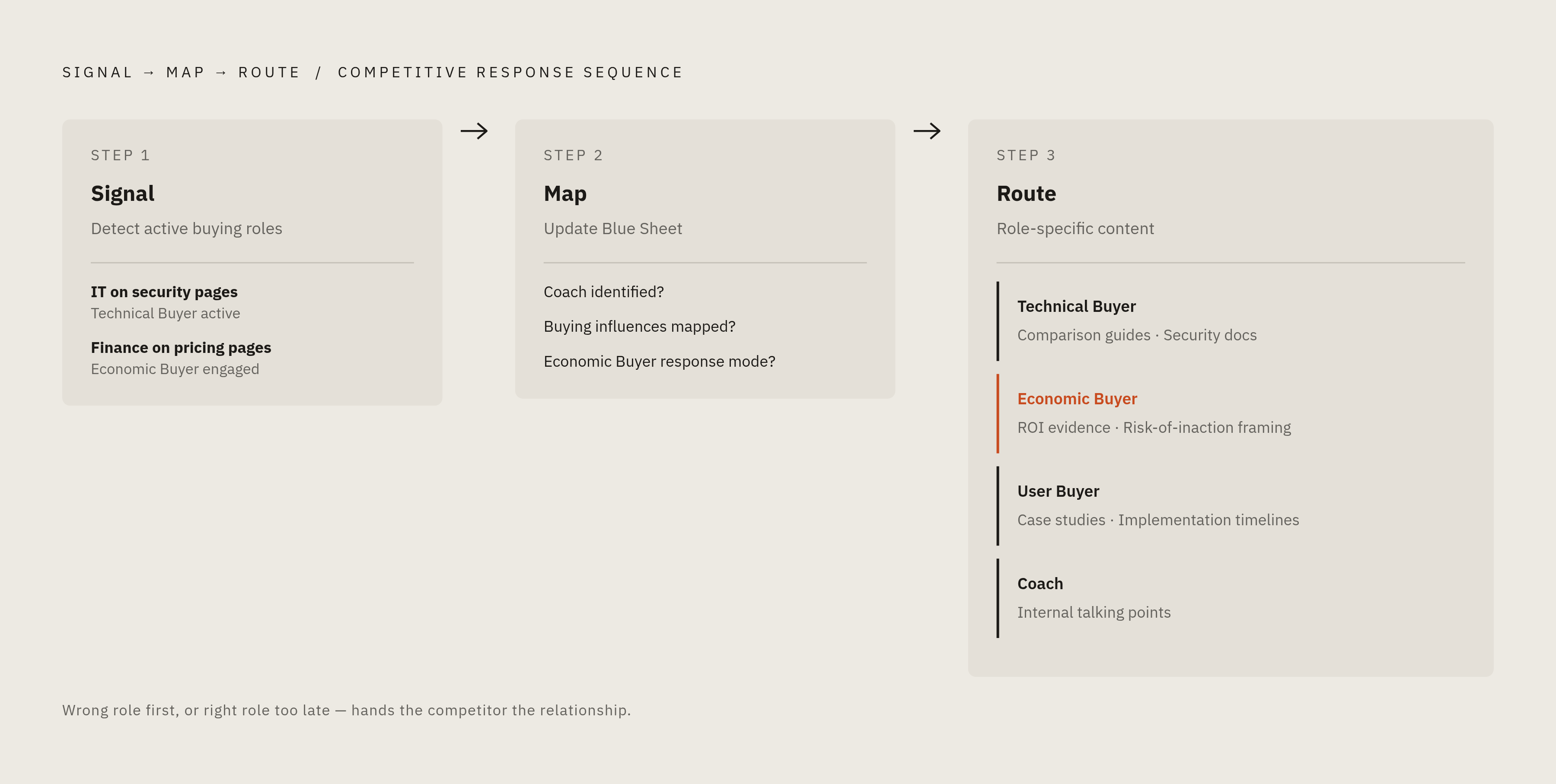
Different personas researching different things tells you which buying roles are active right now.
- IT team visiting security comparison pages means the Technical Buyer is doing due diligence.
- Finance team on pricing pages means the Economic Buyer is now actively involved.
That information tells you where to focus first. Running at everyone at once with the same message wastes time and tends to annoy people.
Step Two: Map What You Know Against the Blue Sheet
- Is there already a Coach in this account? If not, who is the most likely candidate?
- Which buying influences are still uncovered?
- What is the likely Response Mode of the Economic Buyer at this stage of the evaluation?
If the Blue Sheet is current, this step takes minutes. If it is three months out of date, you are starting from scratch while the competitor who stayed current is already in the room. That gap is real and it compounds.
Step Three: Get the Right Content to the Right Role
This is where the stakeholder map earns its keep.
- Technical Buyer. Comparison guides, security documentation, integration specs. Answer the "can it actually work?" questions head-on, because they are already asking them, just not to you.
- Economic Buyer. Business outcome framing, ROI evidence, risk of inaction. Speak to Results. Features are irrelevant to this conversation.
- User Buyer. Case studies from similar users, implementation timelines, adoption support. Address the "will this make my life harder?" concern before it quietly becomes a blocker nobody talks about.
- Coach. Arm them with internal talking points. Make it easy for them to advocate on your behalf when you are not in the room, because that is the moment that actually determines whether your deal survives.
The sequence matters more than the content. Get to the right person with the right message before the evaluation solidifies into a decision that everyone is just waiting to announce. The stakeholder map tells you who that is. Intent signals tell you it is time to move.