Outbound vs Inbound Marketing for B2B
The best B2B growth combines inbound trust-building with outbound precision timing.

At their simplest:
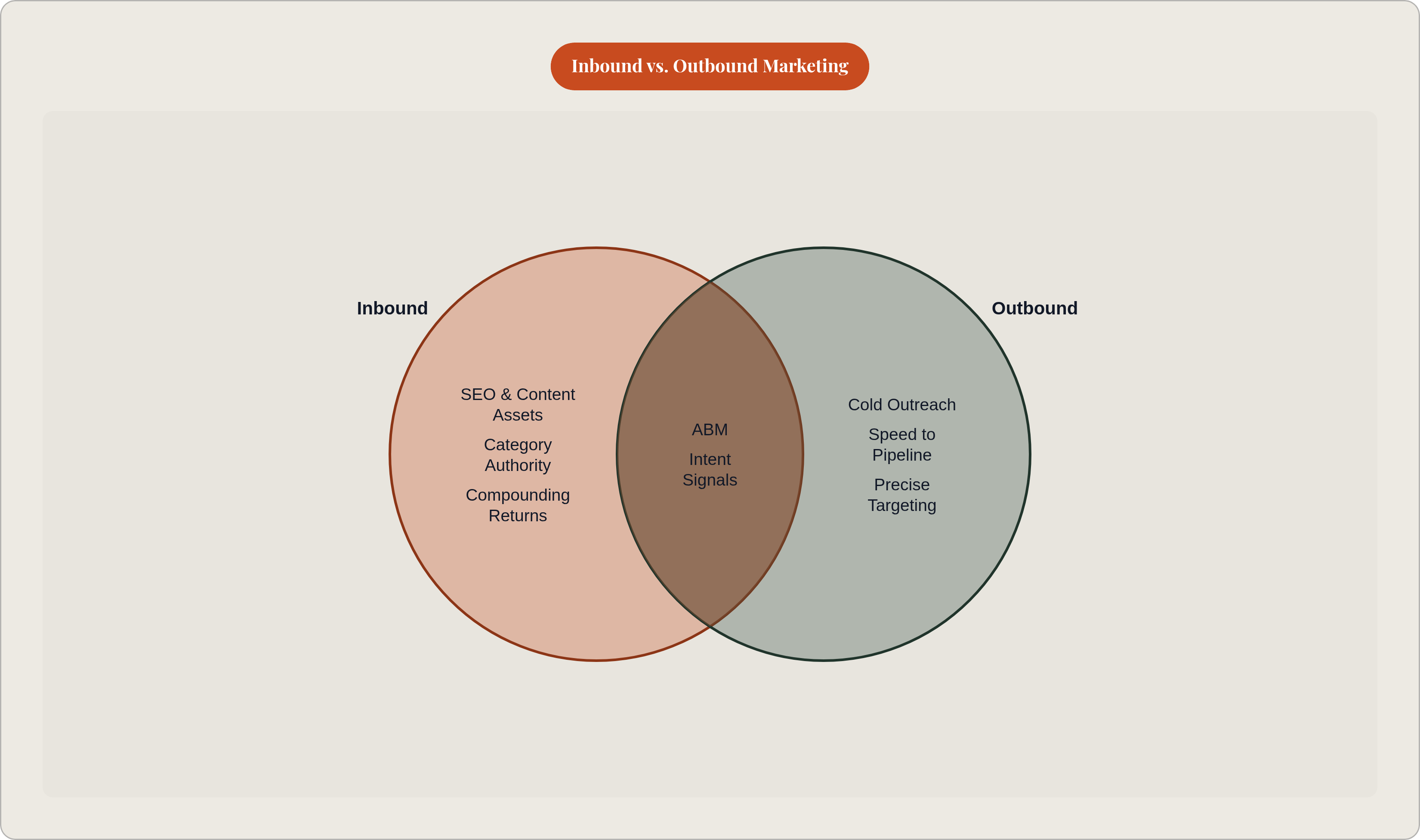
- Inbound is pull. You create content, build SEO authority, produce thought leadership, and develop educational assets that attract buyers when they're already searching for something.
- Outbound is push. You initiate contact. Cold email, cold calls, paid ads, direct mail, event outreach. Reaching buyers before they've raised their hand.
Simple enough. Except the line blurs almost immediately in practice.
Take paid social that amplifies a content piece. Is that inbound or outbound? You're paying to push it in front of people who didn't ask for it, but the content itself is educational. A sales rep who shares a thought leadership post before making a cold call (which motion does that belong to?) ABM (account-based marketing) is the clearest example: inbound-style content delivered through outbound-style targeting. It lives in both worlds at once.
The blurring isn't a problem. It's a clue. These two motions depend on each other more than most teams want to admit. Think of inbound and outbound like two oars on the same boat — pull on only one, and you're going in circles.
Hold "inbound equals pull, outbound equals push" loosely. The best executions borrow freely from both.
What Inbound Does Well, and Where It Stalls Without Outbound Behind It
Inbound has real structural advantages in B2B. None of them are subtle.
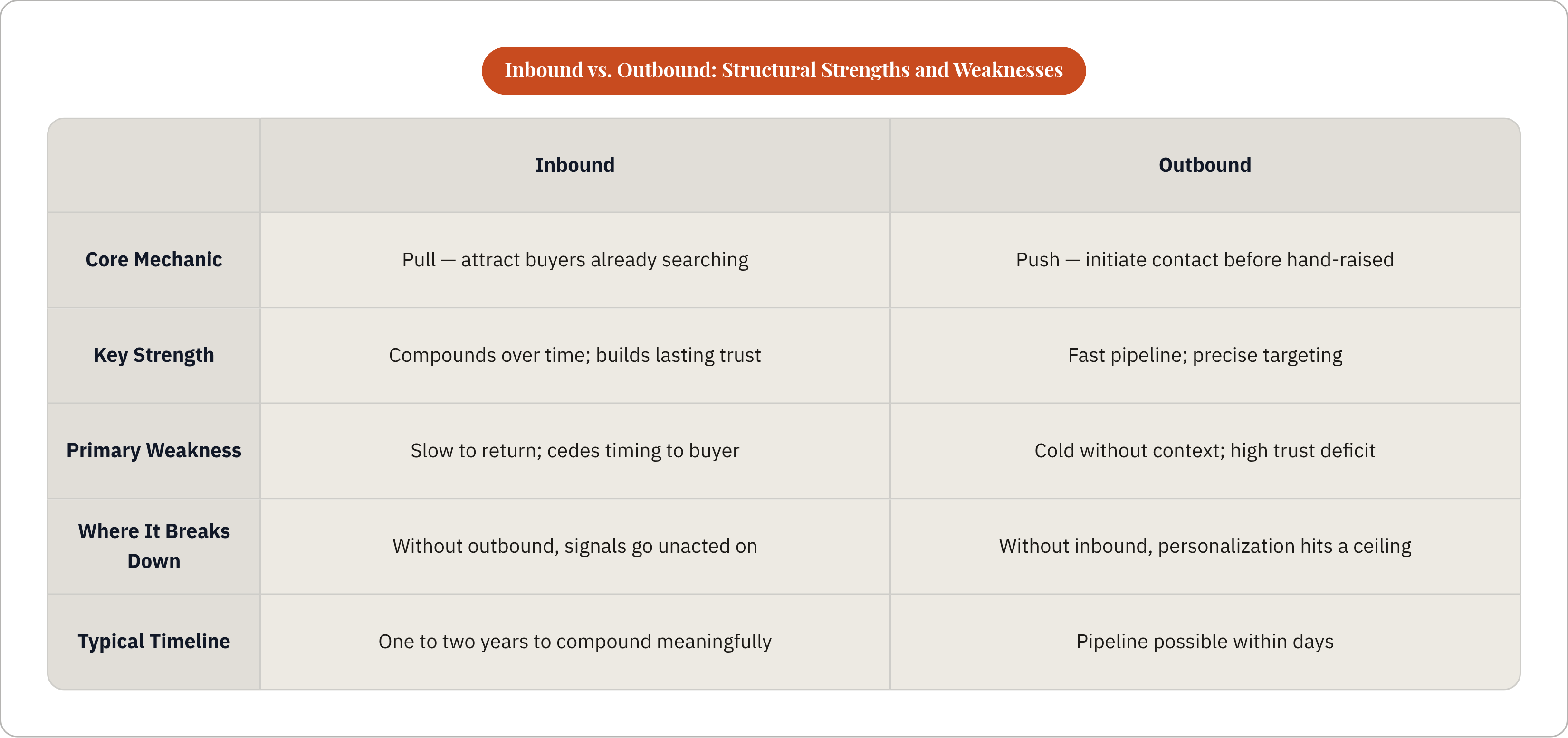
- Content assets compound. Something you publish today can generate leads a year from now with no additional spend.
- It attracts buyers already in research or evaluation mode, which means higher purchase intent at the point of contact.
- It builds category authority and trust before a seller ever makes contact.
- Cost per lead drops meaningfully after sustained investment.
The problem is that word "sustained." Inbound takes a year or more before it generates meaningful compound returns. For growth-stage companies with near-term pipeline pressure, that timeline is genuinely hard to live with. It's not a knock on the strategy. It's just how it works.
There's also a structural blind spot. Inbound waits for the buyer to come to you. That means you've ceded control of timing entirely to the prospect. And given that many buying groups have already ranked preferred vendors before making first contact with any of them, an inbound-only posture means you're entering late into a race you could have led.
Inbound also generates volume without necessarily generating precision. Lots of traffic. Lots of leads. But not all of them are the right accounts at the right moment. Without outbound to act on the signals inbound generates, you're leaving real precision on the table.
What Outbound Does Well, and Where It Breaks Down Without Inbound Behind It
Outbound's structural advantages are almost the mirror image of inbound's.
- Speed. Outbound can generate pipeline in days rather than months.
- Precision. You can target exactly the accounts, titles, and segments that matter most.
- It works before a buyer has started searching. Outbound creates demand rather than just capturing it.
- Cold calling still drives a substantial share of B2B lead origination, especially in enterprise segments.
Here's the compounding problem: most companies spend the lion's share of their marketing budgets on outbound, even though per-lead performance data consistently favors inbound over time. That's a structural mismatch worth naming.
And outbound without context fails in predictable ways. Cold outreach from an unknown sender reaches a buyer who has no reason to trust you. Generic messaging produces low response rates. Reps burn through lists without any real signal about which accounts are actually in-market right now.
AI-assisted personalization has improved outbound conversion rates in recent years. But the ceiling on those gains is higher when outbound is pointed at accounts that are already warm. The best personalization isn't just firmographic (company size, industry, title). It's behavioral. It's knowing what an account is doing right now, not just who they are on paper.
That's where inbound comes in.
How the Buying Journey Has Changed in Ways That Make the Integrated Motion Necessary, Not Optional
Buyers have fundamentally changed how they buy. Not gradually. Pretty dramatically, and in ways that break the old playbook.
A significant majority of the B2B buying journey now happens before a buyer contacts a seller. Research, peer review reading, competitor comparisons, internal consensus-building. All of it happens before your reps ever get a call on the calendar. Most buying groups have already ranked preferred vendors before making first contact with any of them. First contact, in many cases, is almost a formality.
There's also the dark funnel to contend with. A substantial portion of pipeline originates from channels that standard digital attribution can't track. Private Slack communities, peer recommendations, content consumed anonymously. Buyers are forming opinions and preferences in places you can't see and can't control. That's uncomfortable. It's also just reality.
What this means practically:
- Your content needs to be building trust and authority in places where buyers do invisible research. Not just on your own website.
- A rep who reaches out cold to an account that has already formed vendor preferences faces a structurally harder conversation than a rep who reaches out because they can see the account is actively researching right now.
Speed-to-signal is a real differentiator. When a buyer's research behavior creates a detectable signal, the first credible vendor to respond wins disproportionately. "Credible" is doing a lot of work in that sentence. Without trust built through inbound content, an outbound response to that signal just feels intrusive. You're another stranger in the inbox.
Intent Signals as the Connective Tissue Between Inbound Content and Outbound Timing
Intent data is what actually connects the two motions. It's behavioral signals that reveal which accounts are in an active research or evaluation phase right now.
Three signal types matter:
- First-party signals. Behavior on your own assets. Website visits, pricing-page views, content downloads, email engagement. Highest signal quality because it's direct and you own it.
- Second-party signals. Behavior on third-party platforms your audience uses for evaluation. Review site activity, competitor comparisons, category browsing. Particularly valuable because it captures buyers in active vendor evaluation mode.
- Third-party signals. Topic-surge data aggregated across large networks of B2B publisher sites. Reveals accounts researching your category even when they've never visited anything you own.
There are also contextual signals most teams underuse: job postings, leadership changes, funding announcements, org restructuring. Public events that create buying windows even before a prospect has started actively researching solutions.
Here's how intent connects the two motions: inbound content creates first-party signals, because every content engagement is a data point. Intent data tells outbound which accounts to prioritize and when to reach out. The combination means outbound is no longer cold. It's warm, timed, and contextualized.
Intent data is only as good as its freshness, accuracy, and how directly it's wired into outbound execution. A lot of organizations report unreliable or inflated signals. Intent data sitting in a dashboard no one checks produces nothing. Wired into a rep's daily workflow, it produces a fundamentally different outbound motion. That gap (between data sitting in a tool and data driving actual action) is where most teams leave the value behind.
The intent data market has grown significantly, with signal coverage expanding fast. Some platforms now offer intent audiences on channels like Reddit, which is increasingly where B2B buyers do informal research. Intentsify is one provider worth evaluating, particularly for its focus on multi-source signal activation and routing intent directly into outbound workflows.
Competitor Intent Signals as the Highest-Value Interception Moment in the Combined Motion
When a buyer is actively evaluating a competitor, they are not at the start of their journey. They are close to a decision. Reaching them at that moment is categorically different from cold outreach at a random point in time. The conversion math reflects that difference by a wide margin.
What competitor intent looks like in practice:
- An account visiting competitor profile pages and comparison content on review platforms.
- A current customer whose review-site behavior suddenly shifts toward a competitor's profile.
- Topic-surge data showing an account researching an adjacent category where a competitor is strong.
This is where inbound content becomes essential to making the interception work. A rep who reaches out cold at this moment is just another vendor. A rep whose company has already established credibility through thought leadership the buyer encountered, comparison content that surfaced during their research, or a trusted peer's recommendation enters that conversation with a real head start. That's not a small difference.
There's also an account manager application that often gets overlooked. If a current customer begins engaging with competitor content, that's a retention signal as much as a competitive one. A well-timed check-in, a roadmap share, or an exclusive offer can close the gap before the account drifts. Most teams miss this window entirely because they're not watching for it.
The underlying distinction is between static personalization and signal-based personalization. Static outreach uses firmographic data (industry, size, title) to approximate relevance. Signal-based outreach uses what an account is actually doing right now to achieve it. The difference in response rates is substantial, and it's not close.
How Thought Leadership Content Earns the Trust That Makes Outbound Land
The 2025 Edelman-LinkedIn B2B Thought Leadership Impact Report, drawing on nearly two thousand global professionals, is the most authoritative primary source on this. The findings are worth sitting with.
Start with the "hidden buyer" insight. Many B2B deals stall not because the economic buyer said no, but because unseen stakeholders in finance, legal, procurement, or compliance quietly blocked progress. These hidden stakeholders consume thought leadership at rates nearly equal to the buyers reps are actively targeting. They're reading. They're forming opinions. They're just not on anyone's call list.
Hidden buyers are specifically looking for content that challenges assumptions and reframes their thinking. Not product marketing. Not pitches. Actual insight. The majority of hidden buyers say strong thought leadership makes them more likely to advocate for a vendor during evaluation, and more than half say it can outweigh brand recognition alone.
That changes the calculus on thought leadership as a business investment. It's not just a marketing asset. It's an active sales tool that pre-sells to stakeholders the rep will never directly reach.
Sellers who show up to an outbound conversation after a buyer has already encountered credible thought leadership from their company aren't starting from zero. They're continuing a conversation the content already started — like picking up the phone mid-sentence instead of dialing cold.
One thing worth being direct about: for content-backed outbound to work, the content has to be actually useful. Low-quality thought leadership produces the opposite effect. Sophisticated buyers notice immediately, and it signals that the vendor can't be trusted. There's no shortcut here.
What the Integrated Motion Looks Like in Practice (and How to Allocate Between the Two)
The allocation question is stage-dependent. There's no universal answer, and anyone who tells you otherwise is selling something.
Early-stage and growth companies with shorter revenue runways and meaningful ACVs typically need outbound to dominate early. Content assets haven't compounded yet. Pipeline pressure is real. The Starr Conspiracy's guidance for growth-stage B2B companies with significant ACVs and multi-month sales cycles leans outbound-heavy in early stages, shifting toward inbound as content matures.
More established companies with mature content programs can shift toward inbound-led motions because their content is already building trust and generating first-party signals in volume.
The break-even point for inbound investment falls somewhere in the range of one to two years for companies with higher ACVs. Plan around that timeline explicitly rather than treat it as a surprise when inbound hasn't "worked" at month six.
A practical framework for how the motions divide the work:
- Inbound's job. Build category authority. Generate first-party intent signals. Create content that surfaces in competitor comparisons and buyer research. Give sales reps shareable assets that establish credibility before and during outreach.
- Outbound's job. Use intent signals (first-, second-, and third-party) to identify accounts already in-market. Prioritize outreach by signal strength. Personalize messaging based on what an account is actually doing, not just who they are on paper.
- The feedback loop. Outbound conversations surface objections, questions, and competitive dynamics that should feed directly back into inbound content strategy. This is consistently the most neglected part of the motion, and it's where a lot of compounding value gets left behind.
What good alignment between the two motions requires structurally:
- Marketing and sales sharing a common view of account-level intent signals. Not siloed in separate platforms.
- Reps equipped with content assets mapped to the signals they're acting on.
- Content production prioritizing bottom-of-funnel and competitor-adjacent topics before awareness plays. Revenue-first content prioritization produces meaningfully higher conversion rates than awareness-first approaches.
Measuring the Combined Motion (Why Standard Attribution Models Undercount Inbound's Role)
Here's the honest measurement problem: a large share of B2B marketers cite difficulty attributing ROI to content as a top challenge. Many don't measure content ROI at all. And the models that are most commonly used make the problem worse.
Single-touch and basic multi-touch models assign credit to the touchpoints that are easiest to track. Last-click gives all the credit to whatever interaction immediately preceded conversion. First-touch gives all the credit to the earliest tracked interaction. Neither captures what inbound content actually does, which is influence a buyer across multiple anonymous touchpoints over an extended period before any tracked interaction occurs.
The dark funnel problem compounds this. Content consumed anonymously, peer recommendations in private communities, thought leadership encountered on LinkedIn weeks before a rep ever calls. None of this shows up in standard attribution. But all of it contributed to why the buyer took the call.
A few things that help close the attribution gap:
- Self-reported attribution. Simply asking buyers in discovery calls and post-sale surveys how they first became aware of you and what content influenced their evaluation. Qualitative, yes. But often more accurate than any model.
- Pipeline velocity analysis. Accounts that engaged with inbound content before outbound contact typically move through the pipeline faster and close at higher rates than cold accounts. Measuring that difference makes inbound's contribution visible even when it's not attributable in a traditional model.
- Account-level engagement scoring. Tracking content engagement at the account level over time, not just the individual lead level, gives a more accurate picture of inbound's influence on accounts that eventually convert through outbound.
Perfect attribution in B2B doesn't exist. The goal is a measurement approach that doesn't systematically disadvantage the motion that's building the trust your outbound depends on.
Getting this wrong doesn't just produce bad dashboards. It produces bad budget decisions. And bad budget decisions, compounded over quarters, are how teams end up staring at declining outbound conversion rates while simultaneously cranking up outreach volume, genuinely confused about why more effort is producing less result.
The answer is usually simpler than people want it to be. They cut the inbound motion that was making outbound work. The pipeline didn't collapse immediately, so no one noticed the connection. By the time the numbers made it obvious, the content program had been dark for two quarters and rebuilding it felt too slow to justify.
That's the actual cost of treating these as separate strategies.