Intent Data for Customer Success Teams Defending Renewal Deals
Catch churn signals before customers research competitors and disengage.

Most CS teams are set up to notice a problem only after the customer has already solved it by leaving. That's the real story behind a lot of surprise churn: the same company that spends heavily on intent data to catch buyers before they pick a vendor turns that entire system off the moment the deal closes.
For years, customer success ran on a simple idea: be warm, be responsive, build the relationship, and renewals will follow. That "concierge" style, friendly generalists checking in and smoothing things over, got a pass during the growth-at-all-costs years when new logos covered for a multitude of sins. The 2026 planning cycle doesn't give that model the same pass anymore. A CS team that can't produce a clear report showing the customer saved money or made money because of the product is exposed at every single renewal, no matter how many friendly calls happened along the way.
The tool CS teams lean on to catch trouble early, the health score, mostly tells them about last week, not this week. A standard Green/Yellow/Red score blends login frequency, support ticket counts, and NPS, all of which look backward and live entirely inside the product. That creates a strange blind spot: a customer logging in fifty times a day can still be quietly comparing vendors on the side, while a customer logging in less might just have automated their workflow and need the product less often, not want it less. The health score has nothing to say about whether that account is reading reviews on G2, pricing out a competitor, or asking in a LinkedIn group whether some other tool can do something yours can't. It's a dashboard built to watch the house while the real activity is happening next door.
How customers move toward churn
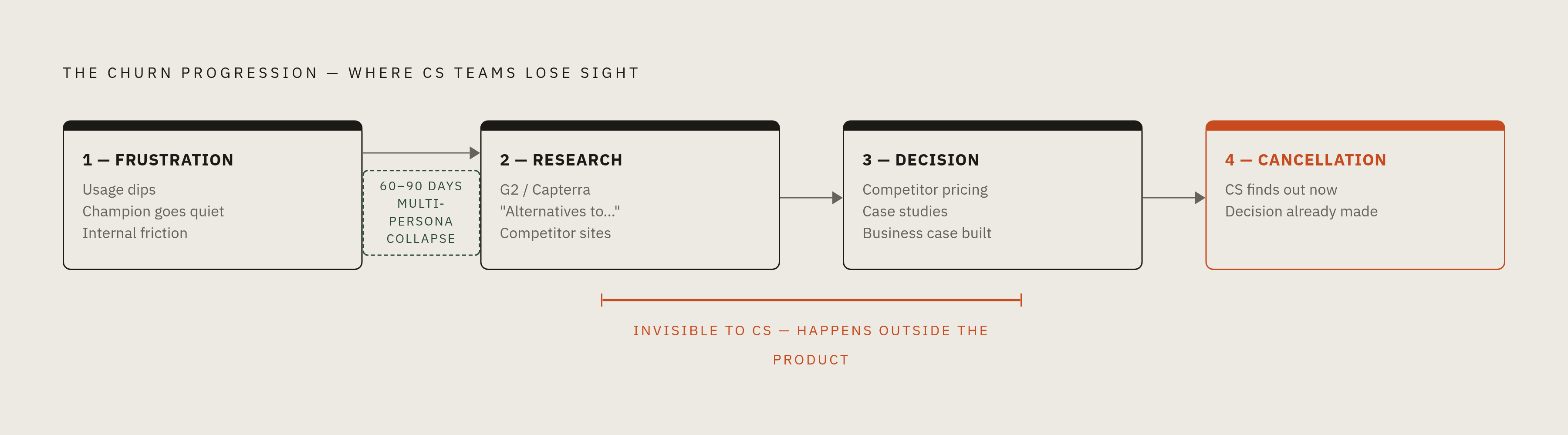
Customers almost never wake up one morning and decide to cancel. Churn moves in stages, frustration first, then research, then the cancellation itself, and by the time that last step happens, the decision was made a while ago.
The frustration stage appears as quiet internal friction: usage dips, the champion who used to be the biggest fan goes quiet. From there, the account moves outward, browsing G2 and Capterra, checking out a competitor's website, typing "alternatives to [Brand]" into a search bar, reading up on how to cut costs or switch vendors. None of that happens inside your product, so none of it appears on a health score.
Some of it doesn't even happen in a place anyone's watching. Employees from the account might ask questions in a LinkedIn industry group or a Reddit thread about a limitation they think your product has, and that conversation lives entirely outside any CRM or dashboard a CS team checks. Marketers call this the dark funnel for a reason: it's real activity that leaves no footprint in the systems built to track customers.
There's also a signal that comes from inside the account, separate from any outside research: engagement collapsing across multiple people at once. When several people at a customer stop logging in or stop engaging around the same time, that tends to occur 60 to 90 days before the account actually churns, which is a real window to work with. Watching only the one champion understates the risk. A single quiet user might just be busy, but when the CMO, the VP of demand gen, and the finance stakeholder all go dark together, that's a far more reliable warning than any individual's behavior. Traditional health scoring tends to blend every user's activity into one account-level number, which is exactly the lens that misses this.
A structural condition makes some accounts far more exposed than others: the Value Gap. It happens when the outcome a customer was sold at the start of the deal never gets connected to the features that would actually deliver it. The customer uses the product, technically, but never gets the return they were promised, and high login numbers won't save that account. A company that bought a tool to cut audit time, but never turned on the feature that automates audit reporting, is sitting on exactly this gap, and that gap is what eventually sends someone at that company to Google. Spotting it requires capturing what the customer actually wanted at the time of sale as real structured data, then checking whether they're using the features tied to that goal, a discipline very few CS teams currently have in place.
Signal types that give CS teams advance notice
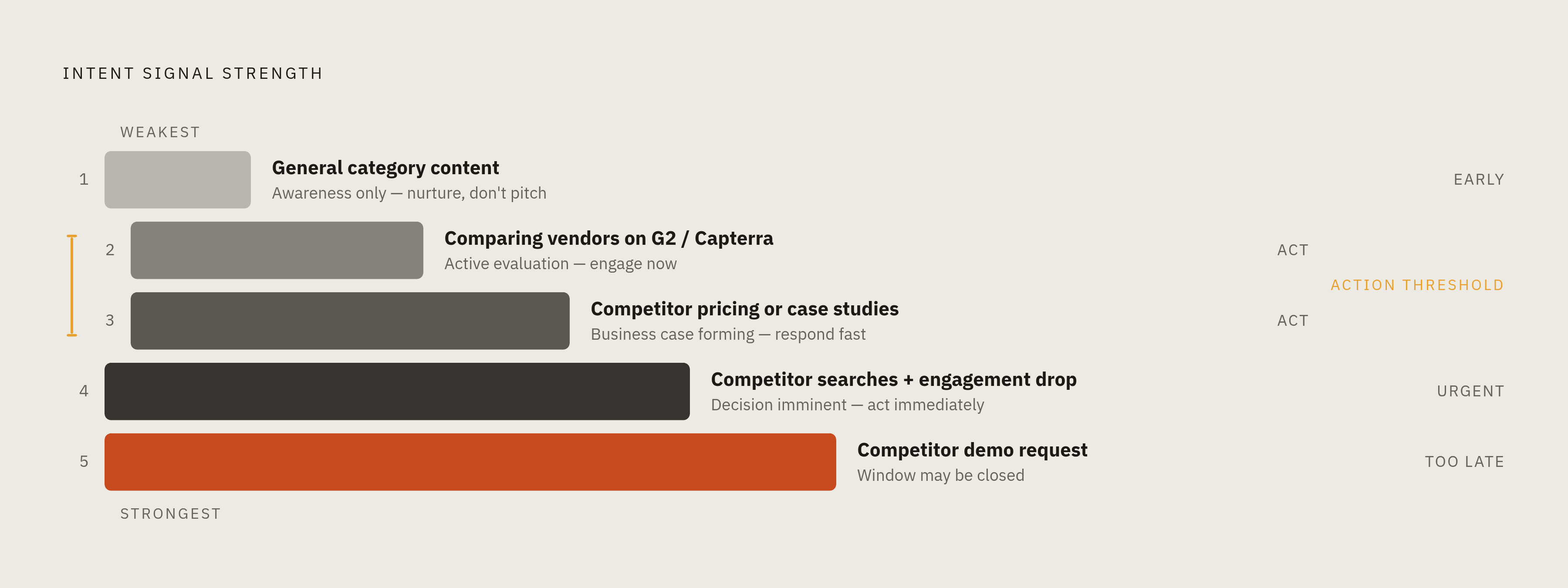
Not every signal deserves the same reaction, and treating them all equally burns the window that the strongest signals give you. Intent signals run on a kind of confidence ladder, weak at the bottom, unmistakable at the top, and knowing where a signal sits determines how fast a CS team should move.
An account reading more general content about your product category is at the weak end. It shows awareness, nothing more; plenty of people read industry content with no plans to switch anything. Comparing vendors on a review site is a step up, a real sign that active evaluation is happening. Visiting a competitor's pricing page or reading their case studies is stronger still, since that usually means someone is building a business case internally. The strongest signal from outside sources is a form fill or demo request at a competitor, though by the time that happens, the window to intervene may already be closing.
For CS teams specifically, the signals worth acting on are in the moderate-to-strong range. An account comparing vendors on G2 while also browsing a competitor's pricing page is the kind of combination that should trigger an immediate save play rather than waiting for the next scheduled check-in.
One signal rarely tells the whole story on its own. A single data point is noise; several signals clustering together in a short window is a different thing entirely, and that stacking is what should move a CS team to act. Combining outside research activity with internal signs of disengagement produces a far sharper picture than either one alone. A champion changing jobs means little by itself. That same champion leaving, combined with competitor research activity and a drop in engagement across several people at the account, adds up to a renewal-risk alert that deserves outreach that same week. Layering first-party product usage, third-party research activity, review-platform behavior, and organizational changes like a champion departure into one composite view is what separates teams that catch churn early from teams that find out about it on the cancellation call.
Review platforms like G2 and Capterra deserve special attention here, because they don't just show that an account is evaluating, they show who the account is evaluating against. A notification reading "Acme Corp compared you to Competitor X on G2 this week" is about as close to the customer saying it out loud as third-party data gets, and it names the exact threat the CS team needs to address. Worth tracking specifically are competitor brand names, competitor product names, broader category research, and content about problems the product supposedly can't solve. Searches about cutting martech costs or finding cheaper alternatives often appear earlier than direct competitor research, since budget doubts tend to come before someone picks a specific replacement.
Why intent data for retention is almost entirely unused
Forrester and Gartner have made the same point for years: keeping an existing customer costs far less than winning a new one. Yet intent data budgets don't follow that math. Almost all of the spending still flows toward outbound and demand generation, acquisition work, while retention gets whatever attention is left over.
An Ascend2 survey puts a number on just how lopsided that is: only about a third of B2B marketers use intent data to prevent churn, and out of nine intent use cases the survey measured, only event planning ranked lower. Of all the ways to use intent data, stopping a customer from leaving ranks second to last, just ahead of figuring out where to set up a booth.
Even the teams that do have access to the right signals often miss the window to use them. For mid-market deals, the stretch between "actively researching options" and "vendor picked" can run as short as two to four weeks, so a signal that's three weeks old is closer to noise than warning. There's a typical two-week delay before intent data gets processed, plus another week for a CS team to route the alert and act on it, so the save play arrives after the decision is already made. The signals exist. They sit in a dashboard nobody's routed anywhere useful, which makes this a workflow and routing failure more than a data shortage.
The pressure to fix this is rising. CFOs are consolidating their software stacks and rewarding vendors who can prove fast time-to-value, which puts standalone, single-purpose tools at growing risk of getting folded into some larger platform's feature list. For a lot of SaaS vendors, strong renewal defense now keeps them in the stack, while weak renewal defense gets them cut from it.
What a working renewal defense motion looks like
Turning any of this into something a CS team actually runs day to day takes three pieces working together: the signals need to land inside the tools a CSM already uses, there needs to be a clear playbook tied to specific thresholds, and success needs to get measured by retained revenue, not by how many alerts fired.
On integration: a CSM isn't going to log into three separate systems just to figure out if an account is at risk. Intent signals need to show up as alerts inside the CRM or CS platform directly, with the account context already attached, arriving as a task with a deadline rather than a report someone has to go dig through.
On the playbook: a simple threshold rule does most of the work. If an account's intent score spikes in the "alternatives" category, the system should automatically create a task for the account manager to reach out within 24 hours. That one rule closes most of the gap between seeing a signal and doing something about it.
The actual outreach, the save play, has to be handled with some tact. Calling a customer to say "we noticed you're shopping around" is a fast way to turn a quiet concern into an angry one. A published framework from Intentsify lays out a better approach: use the signal as the reason to reach out, not the subject of the conversation, through things like an invitation to a strategic quarterly review, an executive checking in to understand pain points, or extra training on features the account isn't using yet. The goal is rebuilding the value the customer isn't seeing, before they ever have to say out loud that they're unhappy.
Different signals call for different plays. A competitive comparison signal points toward an executive review built around proving ROI. A cost-cutting research signal points toward a proactive conversation about renegotiating the package before the customer asks. A multi-persona engagement drop points toward additional onboarding or training aimed at whoever went quiet.
None of this works if it only watches one person at the account. A mid-market SaaS renewal might involve a CMO, a VP of demand gen, someone in marketing ops, and a finance stakeholder, and each of them researches different things and can independently put the renewal at risk. Building intent models around each person's research pattern, instead of one blended account score, catches risk earlier and points to exactly where it's coming from. The same setup that flags a new persona starting to ask risky questions can also flag the opposite: someone new at the account, say from sales enablement, researching a capability they don't currently use is an expansion opportunity. Same infrastructure, two very different outcomes depending on what the research reveals.
Where content-driven signals fit into renewal defense
A good chunk of the most useful signal data already exists inside the company. It just lives in marketing's systems, where CS never looks.
When someone at an existing customer reads a competitor comparison article, checks out a competitor's pricing page, or clicks into an "alternatives to" piece, even one published by a rival, that's a direct signal about renewal risk, not just a line item in a content report. Marketing captures that activity because it's tracking traffic and leads, but it's optimizing for the wrong outcome from CS's point of view, and the team that could actually act on it, customer success, usually has no visibility into what existing accounts are reading at all. The data is sitting in the wrong department's spreadsheet, waiting for someone to connect it to the renewal that's about to walk out the door.
Sources
- Customer Marketing & Intent Data Churn Prevention - Intentsify
- How to Use Intent Data to Detect Customer Churn Before It Happens
- 2026 Customer Success: The Revenue Engine Shift
- Intent Data Beyond Acquisition: Retention Defending
- How Marketing, Sales, and Customer Success Teams Can Save Resources Using Intent Data