Renewal Negotiation Tactics When a Competitor Is in the Picture
Early engagement and documented value are the only leverage left once competitors arrive.

A competitor showing up mid-renewal doesn't erase the vendor's leverage, it just moves it. The vendor is no longer selling something new, they're defending something the customer has quietly stopped noticing. Handled right, that's a fixable problem. Handled late, it's a price war the incumbent didn't need to enter.
How leverage erodes over time and why the renewal clock starts earlier than most sellers think
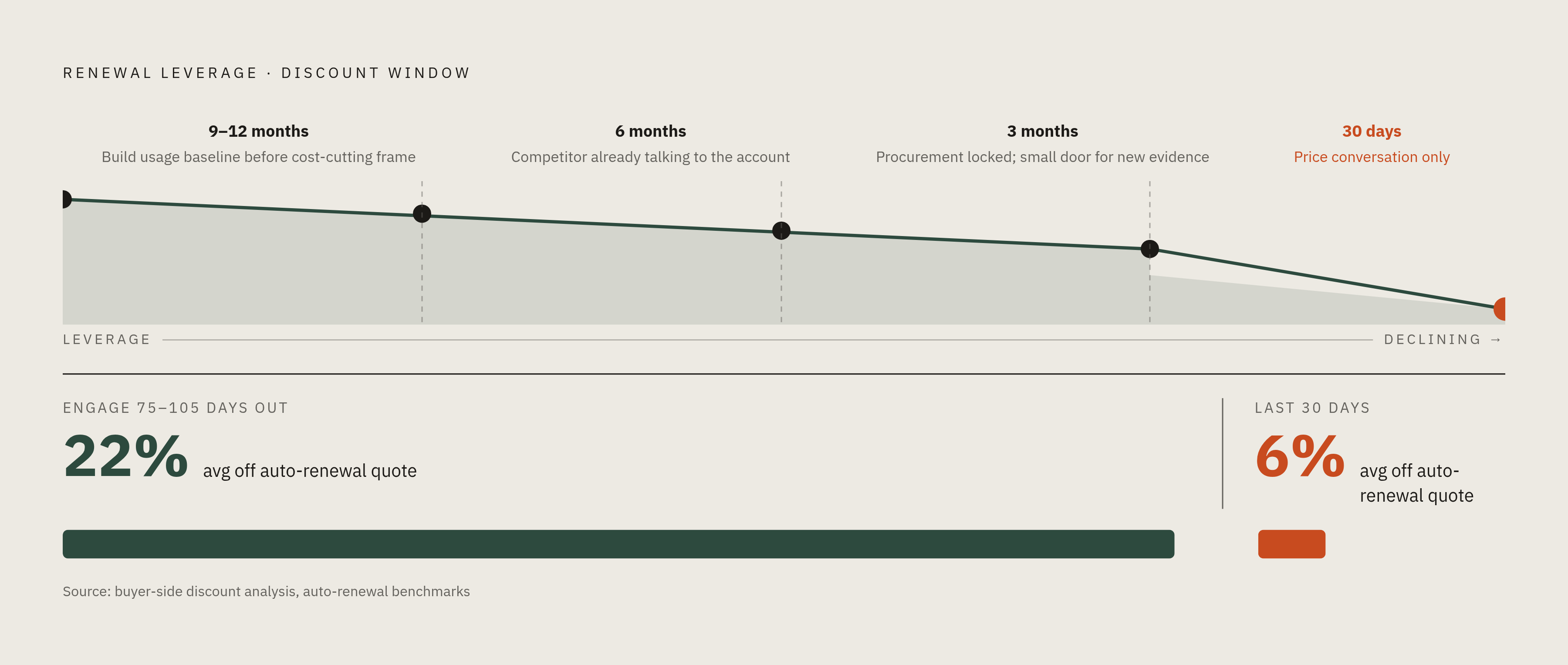
Vendr's 2026 SaaS Trends Report put a number on something most people intuit: buyers who open renewal talks 75 to 105 days out land an average 22% off the auto-renewal quote. Vendr's 2026 SaaS Trends Report found that buyers who open renewal talks 75 to 105 days out land an average 22% off the auto-renewal quote, a figure that drops to 6% if they wait until the last 30 days. That's a buyer-side stat, but it cuts both ways. The same clock that punishes a slow buyer punishes a slow vendor, just from the other direction. Early engagement is room to maneuver. Late engagement is just negotiating over what's left.
Redress Compliance's runbook, built from advising somewhere between 30 and 40 Microsoft renewals across 2024 to 2026, found structured renewals moved total cost 10 to 25% off the opening number. Buyers who started in the last quarter had already given up the timing and the competitive leverage before anyone sat down at the table. Their Workday data tells a similar story: renewals started inside a 6-month window left no room to model alternatives, and that cost buyers 5 to 12%. Flip that around and it's a vendor's best argument for engaging early, since the same asymmetry that hurts a slow buyer helps a fast-moving seller.
Think of it as a countdown with four checkpoints, and each one closes a door:
9 to 12 months out: this is the only window to build a usage and value baseline before procurement's cost-cutting frame takes over the whole conversation. 6 months out: a competitor is probably already talking to someone on the account. If the seller hasn't shown up yet, they're reacting, not shaping. 3 months out: procurement has usually locked the process by now, and new evidence has a much smaller door to walk through. Final 30 days: leverage is mostly gone. What's left is a price conversation.
Vendors bundling AI features into existing SKUs at renewal are pushing price increases of 20 to 37%, according to Tropic, way past the typical 3 to 9% annual bump. That's a gift to a transparent-pricing competitor if the incumbent hasn't already made the case for why the increase is worth it. Many software contracts carry auto-renewal clauses with cancellation windows, so that opt-out date isn't a deadline. It's an early warning light, and it should be treated like one.
Reading the competitive signal: how to tell whether "we're looking at alternatives" is theater, process, or real
Three completely different situations hide behind that one sentence, and conflating them produces the single most common mistake sellers make at renewal.
Theater is a negotiation tactic. There's no evaluation timeline, no named competitor, nobody new has entered the conversation. It's posture, plain and simple.
Process is procurement doing its job, running a comparison at every renewal on principle, whether or not the incumbent is actually at risk. The right response isn't panic, it's arming the internal champion with material that makes the vendor look strong in that comparison.
Real means something changed. A need shifted, a competitor's been circling, something about the relationship has worn thin. This one isn't a renewal anymore, it's a new sales cycle wearing a renewal's clothes, and it needs the full treatment: needs analysis, adjusted solution, maybe a whole new pitch.
Telling them apart comes down to watching for signal density. Multiple people from the same account hitting competitor pricing pages in the same short window signals a real threat, while one person doing it once does not. New finance or procurement contacts asking for meetings the champion used to handle solo is a signal. So is a new executive hire who came out of a competitor's customer base; check what stack they left behind, not just where they landed. And a champion who suddenly goes quiet may be signaling that the account's internal dynamics have shifted in ways worth investigating.
None of this stays fresh for long. Signals go stale quickly, so one that's real today might be meaningless in a few weeks. Speed of interpretation matters almost as much as the signal itself.
When the signal looks real, skip the defensive crouch. Ask: "What prompted you to look around right now?" That one question does more work than any pitch, because it separates budget pressure from a genuinely changed need from a competitor who just showed up with a good story.
Building the value story before procurement takes over the process
The single most useful document in a renewal isn't a proposal, it's a plain summary of what actually happened during the contract: usage, deliveries, results, problems that got solved, anything added at no extra charge. Written in the customer's terms, not the vendor's. Hours saved. Cases handled. Revenue moved. Not "improved operational efficiency."
That document does two jobs at once. It's the vendor's material for the negotiation room, and it's the ammunition the champion needs to defend the relationship to stakeholders the vendor will probably never meet.
Get this in front of people early and the whole conversation shifts. Instead of "what does this cost versus nothing," it becomes "what does this cost versus what it's already delivered." That reframe alone neutralizes most of a competitor's opening price advantage, but only if it happens before the renewal starts, not as a scramble once someone asks "what are we even paying for?" If that question gets asked first in the negotiation room, the vendor's already climbing uphill.
Going through the account and flagging unused or underused licenses, then offering to right-size before anyone asks, is also a trust move. Going through the account and flagging unused or underused licenses, then offering to right-size before anyone asks, signals confidence instead of defensiveness. The pattern holds more broadly: modules purchased in a prior cycle and never touched tend to renew at full price unless someone challenges it. A competitor who points that out first owns the conversation. Better the incumbent gets there first.
The best version of this isn't a renewal-season fire drill, it's a routine. Send the value summary quarterly or twice a year and the renewal conversation starts from a position that's already been earned, not one that has to be built from scratch under deadline pressure.
A practical 90-day skeleton: at 90 days out, walk the champion through the value summary with zero negotiation agenda attached, just the numbers. At 60 days, map the full decision group and ask to meet any procurement or finance people who joined since the original deal. At 30 days, put the renewal proposal on the table with terms and any price adjustments already justified. The last month is for negotiating. It's too late to be introducing evidence.
Navigating the expanded buying group when a competitor has already reached some of them
Forrester research puts procurement in the decision-maker seat on 53% of B2B deals. At renewal, a lot of those procurement and finance people are new arrivals who weren't part of the original purchase and have zero relationship with the incumbent.
That gap is exactly what a sharp competitor exploits. IT wants features, finance wants savings, legal wants risk reduced, and any stakeholder the vendor hasn't spoken to is an open door for whoever appears first with a compelling pitch aimed squarely at that person's priority.
There's also a quieter risk here. Some enterprise buyers run internal blackout periods during renewal negotiations, where contact with the vendor has to be cleared through the negotiation lead. An end-user telling a rep "we love this" during that window, innocently, can undercut the buyer's whole negotiating position. The fix isn't clever timing during the blackout, it's building relationships with multiple stakeholders long before the blackout ever starts.
That means multi-threading as a defensive habit, not just a prospecting tactic: at least three engaged contacts across different roles before the formal renewal process kicks off, and executive sponsorship that isn't optional. Leaning on one mid-level champion while a competitor's gone straight to senior leadership is a structural failure, not bad luck.
The Edelman–LinkedIn B2B Thought Leadership Impact Report found more than 40% of B2B deals stall because of internal misalignment within buying groups, stakeholders who hold real influence and have little to no direct contact with sales. That same report found 95% of those hidden buyers say strong thought leadership makes them more open to being contacted, even though 71% report almost no interaction with sales reps through normal channels. So a vendor whose content has already reached finance and legal has a relationship those people don't even realize exists yet. Worth checking who's new to the buying group this cycle and getting in front of them fast. If procurement joined six months ago, they've likely had six months of competitor outreach nobody on the vendor side knew was happening.
What competitive credibility looks like in the renewal conversation
Badmouthing the competitor is the fastest way to lose the room. Acknowledge what they do well, then pivot to where the vendor actually wins. Procurement teams are trained to spot reps who trash the competition, and it costs trust every time.
A sharper move: ask questions that let the buyer find the competitor's weak spot themselves, rather than the vendor stating it outright. When facing a competitor known for expensive implementations, ask about hidden setup fees and time-to-adoption. Against a complex platform, ask about ramp time and what happens when trained staff leave. Against a newer entrant, ask about enterprise support response times and whether they have reference customers at a similar scale. Buyers trust what they discover far more than what they're told.
Credibility beats intent here. A seller who shows up with a clean reference architecture and actual win-loss data changes the tone of the room, while a seller making vague competitor threats gets clocked immediately by any experienced account team. Battlecards built from real win-loss interviews, actual quotes from customers who evaluated both vendors, carry more weight than any internal marketing claim. Sellers and buyers disagree on the actual reason a deal was lost somewhere between 50 and 70% of the time. A rep working from verified data handles the competitive objection completely differently than one working off a feature-comparison sheet built six quarters ago and never touched since.
Most battlecards get built once and frozen, and when the competitor changes packaging, the card doesn't get updated, sellers stop trusting it, and it becomes useless right when it's needed most. Most battlecards get built once and frozen. The competitor changes packaging, the card doesn't get updated, sellers stop trusting it, and it becomes useless right when it's needed most.
Research cited by IBM found reps using AI-driven demand generation and enablement tools forecast 25% higher revenue growth. That's consistent with treating seller readiness as something built into the systems around the rep, not a personal skill some people happen to have. The cost of showing up unprepared against a buyer who's spent months quietly evaluating alternatives runs 10 to 30 margin points in B2B deals generally. Competitive renewals are about as high-stakes as that gap gets, since the buyer's had a quarter to prepare and the seller may have had days.
Using intent signals to get ahead of competitive conversations before the customer initiates them
Competitors targeting an existing customer often start their outreach well before the contract renews. Wait for the customer to bring up a rival's name and that rival may already have had weeks or months of head start.
The defense mirrors the offense. Account-level signal density, three different roles from the same company visiting a pricing or comparison page in a short window, isn't a curiosity, it's a fire alarm. One person browsing is noise. A pattern across an account is something else entirely.
There's a real gap in how this data gets used. Reported success with intent data is widespread among B2B marketers, yet only a small share of companies actually use these tools in any structured way. That gap is a structural edge for whoever closes it first. DemandScience's 2026 State of Performance Marketing report, based on interviews with 750 senior B2B marketing leaders, found 87% of organizations call their intent signals unreliable or inflated, and 66% say campaign metrics look good on paper while doing nothing for revenue, showing that volume isn't the same as quality. Interpretation is the actual skill here.
Intent data and buying signals get lumped together, but they are two separate things. Intent data is third-party behavior: content downloads, review-site research, competitor page visits. Buying signals are more direct: a champion changing jobs, a new CFO asking pointed questions, a procurement lead suddenly cc'd on renewal emails, a competitor's rep connecting with five people at the account on LinkedIn in the same week. One data point from either category is interesting. Both showing up together, across the same account, in the same stretch of time, is the pattern to act on.
A handful of platforms get used specifically to track this kind of competitor-evaluation activity. G2 Buyer Intent captures signals from companies actively researching a product or its competitors on G2, with G2's marketing packages running roughly $10,000 to $30,000 a year depending on tier and features. Demandbase covers buying-group tracking and account-based targeting built for enterprise teams. ZoomInfo Intent pairs account and person-level intent with ZoomInfo's own contact database, which makes sense mainly for teams already using that platform. TrustRadius offers buyer intent data drawn from its review and research traffic. None of these replace judgment. They just shorten the time between a competitor showing up and a vendor noticing.