Psychographic Segmentation in B2B Go-to-Market Targeting
Identical prospects decide differently—psychographics reveal why.

Two CTOs, same company size, same revenue band, same title. One won't sign anything without a SOC 2 report and a full security review. The other doesn't care about certifications at all, he just wants to know if implementation takes two weeks or two quarters. Same firmographic profile, completely different buyer. Most B2B go-to-market teams still don't have a real answer for that gap, and it's costing them the deals that look identical on paper but close (or die) for opposite reasons.
What psychographic segmentation means in a B2B context
Psychographic segmentation sorts prospects by what's happening in their head, not what's printed on their business card. Values, risk tolerance, career incentives, trust preferences. Firmographics tell you who someone is. Psychographics tell you how they decide, and those two questions have completely different answers.
Consumer marketers have run this playbook for decades, sorting people into outdoorsy types, luxury shoppers, bargain hunters. B2B doesn't work that way, because a B2B buyer is spending someone else's money and putting their own name on the outcome. A B2B buyer spends someone else's money and puts their own name on the outcome, so B2B psychographics appear as risk tolerance and career incentive instead of hobbies and lifestyle brands. The stakes are professional, so the variables shift accordingly.
Five things do most of the work:
- Personality traits (cautious versus decisive, detail-oriented versus big-picture)
- Values and beliefs (what "good" looks like to this buyer)
- Attitudes toward vendors, change, and risk
- Working style (how they research, who they loop in before deciding)
- Professional identity (what this purchase signals about their standing internally)
None of these five means much alone. A buyer who's "detail-oriented" might obsess over security architecture, or might obsess over the fourth decimal in a pricing spreadsheet. Those are two different people who look identical on a firmographic checklist. Only when all five layer together do you get something usable: a real picture of how a buyer type thinks, what they prioritize, and what they need to hear before they'll move.
Where psychographics sit in the four-layer segmentation stack
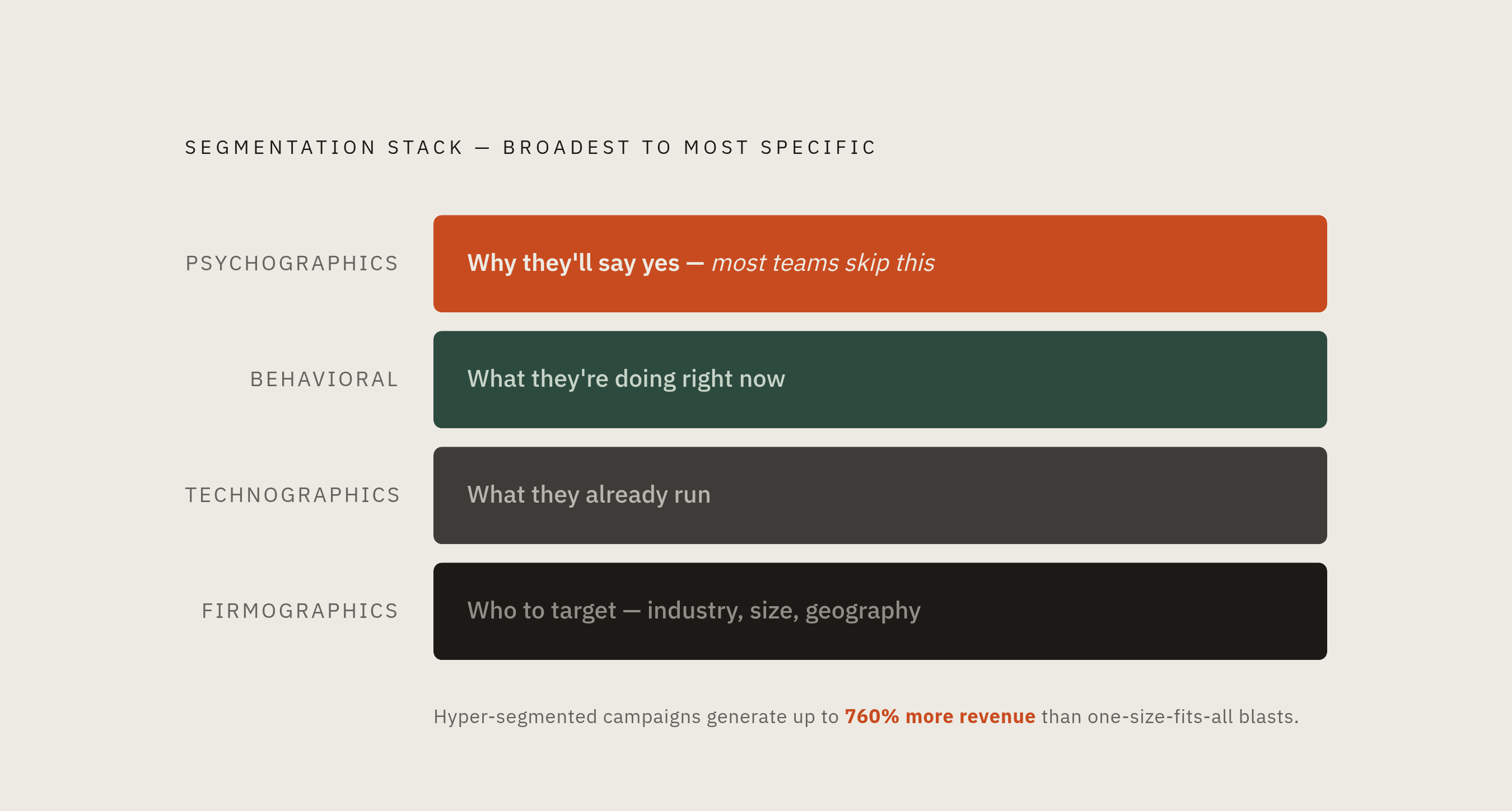
Firmographics answer who to target: industry, size, revenue, geography. Technographics answer what they already run, which tells you fit and where you might displace an incumbent. Behavioral data answers what they're doing right now, meaning downloads, site visits, review-site browsing. Needs-based data narrows things further to the specific problem in front of them today. Psychographics answer why they'll eventually say yes, and most teams skip that layer because it's the hardest one to pull off a dashboard.
Treating psychographics as competing with firmographics, as if you have to pick one system, is the mistake. Firmographics sort the accounts. Psychographics sort the message and the sequence you run against those accounts. They operate at different altitudes. Psychographics don't replace the ICP, they multiply what the ICP can do, and skipping that layer means the other three just tell you who to email, never what to say once you've got them open.
That multiplier is not small. Hyper-segmented campaigns generate up to 760% more revenue than one-size-fits-all blasts, and 77% of marketing ROI comes from campaigns that are segmented, targeted, and triggered rather than fired at a generic list. Stacking all four layers (firmographic, technographic, behavioral, psychographic) compounds the effect. Dropping the psychographic layer leaves you with a very accurate list of names and no idea what to say to any of them.
Where psychographic data comes from in B2B
Firmographic data lives in a database, ready to query. Psychographic data doesn't work that way. Nobody fills out a form labeled "risk tolerance." It has to get pulled out of signals and interpreted by hand. A data enrichment tool can't do this part for you.
The richest source sits inside the CRM already, completely ignored. Sales call notes. That's a strange gap to leave open, given the data's already paid for. Customer interviews come next: why did you choose us, what almost stopped you, what does success look like six months out? Asking those three questions across twenty closed-won accounts reveals patterns in fear, motivation, and proof preference fast, in language the customer actually used.
A handful of other channels carry this signal too, if someone bothers to read them closely.
- Structured AIO surveys (activities, interests, opinions), though this needs an existing audience to survey in the first place
- Content consumption sequencing, since the order someone reads topics in reveals a shift in priority
- LinkedIn language, where word choice in posts and comments gives away values and identity
- Reviews and support tickets, basically psychographic gold mines written in the customer's own voice
- On-site behavior like pricing page visits and FAQ engagement, which is motivation wearing a disguise
A 2025 peer-reviewed study in the Journal of Strategic Marketing used large language models to pull psychographic value segments out of large-scale text data, and the results held up at a fraction of what traditional primary research costs. Machine learning clustering approaches the same problem from the other direction: instead of hunting for evidence that fits predefined buckets, it finds which behavioral and attitudinal signals cluster together on their own, and the output contains segments nobody on the team would have guessed at.
Building a psychographic segment that sales can use
A psychographic segment is a profile, and a profile only earns its keep if it carries four parts. A motivation (what this buyer wants, or is trying to avoid). A trigger (the event that pushes them from passive to active). An objection (the specific doubt that stalls them). Proof (the exact evidence format that resolves that doubt for this buyer type, and only this buyer type).
Take the career-safe buyer, a common profile in B2B SaaS. Motivation: avoid a visible mistake, keep credibility intact with leadership. Trigger: an external deadline or an internal review that forces the question onto the agenda. Objection: what if this breaks something that already works fine. Proof: peer logos, compliance certifications, case studies that emphasize low-disruption rollouts. Every piece of that profile changes what a rep says on a call and what a marketer puts in an email. When the buyer chases innovation instead, the entire messaging stack flips with them, proof included.
Building this takes two phases, and skipping either one produces a segment that looks sharp in a slide deck and does nothing in the field. Phase one is collection: surveys, interviews, CRM behavioral data, LinkedIn analysis, AI-assisted pattern recognition across whatever text already exists. Phase two is construction, clustering those signals into a small number of profiles and then assigning each one a messaging approach, a channel preference, and an objection pattern. Skipping phase two turns collection into a pile of interesting data nobody ever acts on, which is worse than not collecting it at all, since now someone has to explain why the dashboard exists.
How intent signals expose psychographic profile in real time
Roughly 70% of the B2B buying journey wraps up before a buyer ever contacts a vendor directly. The shortlist gets built in the dark, weeks before any rep knows a deal exists. Intent signals are the flashlight, and teams that ignore them are essentially trying to read in the dark by feel.
What a prospect researches, compares, and reads is a live readout of which motivational profile they're running at that exact moment. Three tiers carry this signal, and they don't carry equal weight, not even close.
First-party signals (behavior on a company's own site) carry the highest fidelity. A pricing page visit paired with a vertical-specific case study download tells you stage and risk profile in a single motion. Second-party signals, the kind found on review platforms like G2 or TrustRadius, catch buyers mid-comparison, which is the single highest-psychographic-density moment in the entire cycle. G2's Buyer Intent product draws from signals across more than 100 million software buyers and routes nine distinct signal types into the sales stack with a daily-updated buying stage score. Third-party co-op data, pulled from thousands of publisher sites across tens of thousands of topic categories, shows topic surge scores at the account level, a rough proxy for whichever problem is currently eating a company's attention.
These signals deliver the real value when they stack. An account that hits the pricing page twice in three days, then pulls down an industry-specific case study, is confirming a risk-aware, proof-hungry profile in real time. That profile maps to a specific messaging track, and the rep should already have it queued up before the phone rings.
Applying psychographic segments to messaging, content, and outreach sequencing
Once a profile is confirmed, everything downstream needs to shift at once, including the hook in the outreach, the proof format attached to it, which channel gets used first, and the objection the rep rehearses before dialing.
Content maps cleanly onto profile, and here's where most teams get lazy and reuse the same asset library for everyone. A risk-averse, career-safe buyer needs ROI calculators, implementation case studies, compliance paperwork, peer references, essentially anything that whispers "this won't blow up on you." An innovation-oriented buyer wants competitive differentiation content and early-adopter stories, proof that says "this puts you ahead of the pack." An efficiency-focused buyer wants workflow diagrams and time-to-value numbers, proof that this doesn't bolt more complexity onto an already-full plate. Sending the compliance packet to the innovation buyer makes them go quiet.
Cold outreach follows the same split, and this is the part almost nobody fixes even though it costs nothing to fix. Email hooks, call talk tracks, LinkedIn messages, all of it needs to shift by psychographic profile. Running the identical opening line across every profile is the biggest personalization failure in outbound today, and it persists mostly out of laziness rather than difficulty. When an account throws off late-stage intent signals, the response has to be same-day and specific: a rep naming the exact problem behind the content that account just consumed. A generic "just checking in, wanted to touch base" email at that exact moment isn't just weak, it's close to malpractice.
Competitor evaluation as the highest-value psychographic moment in the buying cycle
A buyer sitting on a review site, actively comparing a competitor, has already told on themselves. They're skeptical of the status quo. They're open to something new. They're building a decision framework in their head right now, not someday, not next quarter.
That makes it the single highest-leverage moment for psychographic-matched messaging in the entire cycle, because motivation sits fully exposed and openness to persuasion peaks right there. Vendors that earn a spot on a buyer's initial shortlist are positioned to win the deal well before most competitors even know it exists. So if the psychographic positioning hasn't already done its work by the time a buyer raises a hand, sales is competing for a seat that got assigned weeks earlier, and showing up late to an assignment that already happened is a rough way to make quota.
Review platforms like TrustRadius (acquired by HG Insights) sit right at this intercept point, catching the moment a buyer starts comparing rather than the moment they're finally ready to talk. Teams treating review-site activity as a trigger, not an afterthought, are the ones showing up on Day One instead of scrambling in on day twelve.