Sales Tools That Fire Real-Time Alerts When a Prospect Hits a Competitor Website
Catch buyers during evaluation, not after they've already chosen a vendor.

Sales tools that fire real-time alerts when a prospect hits a competitor website help B2B teams enter an evaluation before a buyer settles on a vendor. The key is knowing what each tool actually detects, because review-site comparisons, topic research, and competitor website changes are different signals. The winning response combines fresh evidence with relevant content.
Why most sales outreach arrives too late, and what that costs
By the time a prospect fills out a form or picks up the phone, they typically already have a preferred vendor. B2B buyers are through most of their purchase journey before they contact sales, so an inbound inquiry often comes after they have compared vendors. The rep enters with a structural disadvantage. They must challenge criteria the buyer has already set, perhaps around a competitor’s strengths, when they could have helped shape those criteria earlier. The invitation to compete can arrive after someone else has written the rules.
A better time to reach buyers is during active evaluation, when they are reading reviews, comparing options, and visiting competitor pages. At that stage, relevant evidence can still influence the choice. Waiting for buyers to identify themselves leaves that period to competitors who reach them earlier. An inbound-only approach therefore misses more than potential conversations. It misses the moment when those conversations have the most leverage, because helping a buyer decide is a different task from asking them to reconsider.
What a competitor website visit actually signals about where a buyer is in their journey
Research into “what is sales enablement” suggests interest in a problem or category, while “Competitor X vs. Competitor Y pricing” suggests a buyer weighing vendors. These are not interchangeable signs of readiness. One asks what something is, while the other asks which option deserves the budget. Treating both as the same lead score erases the distinction sales needs most.
A competitor’s pricing or product page sits much closer to active evaluation than general content consumption. Review comparisons offer similarly specific evidence because they show buyers examining vendors and alternatives. Specificity makes the signal valuable, but it does not reveal the buyer’s thoughts. A visit indicates consideration. It gives a rep a reason to address the comparison.
The same behavior takes on a different meaning for an existing customer. A current account exploring a competitor may be at risk. For a prospect, the opening is to influence a shortlist. For a customer, it is to understand what might be pulling them away, without turning a possible concern into a cheerful prospecting sequence.
How these tools actually detect that a prospect visited a competitor's site
There are three broad ways to detect competitor intent: review-site observation, web-behavior collection, and competitive intelligence monitoring. They observe different things. Review platforms such as G2 can see when companies visit competitor profiles, category comparison pages, or pricing information on the platform itself. That is second-party data when another business uses it, because the platform owns the original observation. Its purchase fidelity is high, but a competitor profile visit on a review site is not a visit to the competitor’s own website.
Web-behavior collection draws on what people read across publisher networks, how they search, and who visits a website, as identified through reverse IP lookup or tracking pixels. First-party data comes from a company’s own site, while third-party data aggregates behavior across many B2B sites through data cooperatives. Ownership determines the scope of the observation. A tool that identifies visitors to your website does not, by that fact alone, identify visitors to a competitor’s website. Broad cooperative data usually resolves activity to a company by IP.
Competitive intelligence platforms take a different route. They monitor competitor websites for changes to pricing, products, and messaging, producing alerts about moves that could affect active deals. Some combine competitive intelligence with account or buying signals. However, detecting that a competitor changed a page does not establish that a prospect read it. A website-change alert is competitive context.
Each mechanism also has a coverage boundary. Review platforms see their own users, reverse-IP identification depends on an identifiable connection, and cooperative data reflects the publisher network it covers, often on a weekly cadence. Account identity is another limit. Knowing that “Acme Corp” is researching a competitor is useful, but it is less precise than knowing which person is evaluating which page. Research inside AI assistants or through autonomous research agents remains a dark-funnel boundary that these mechanisms do not capture as a traceable buyer visit.
What triggers an alert and how fast it needs to fire to be useful
An alert can begin with a review comparison, detected topic interest, a first-party behavioral event, or a competitor website change. The trigger determines what the rep can reasonably conclude. A pricing comparison tells the rep something different from an account reading category content, even if both alerts sound just as urgent. “Real-time” describes delivery speed. A fast alert about the wrong behavior is still the wrong cue.
Real-time person-level alerts offer the most immediate and specific opening, followed by same-day account-level alerts and then weekly account-level batches. Information that is already a few days old may arrive after a competitor has reached out. Yet collection and delivery are separate steps. An instant notification cannot turn a weekly data update into a live observation.
A useful alert includes the account name, the specific behavior, the person when available, and enough context to support a relevant message. Delivery belongs in the rep’s working environment, such as Slack or the CRM, rather than a separate dashboard waiting to be remembered. Even well-delivered alerts become more useful when combined with other evidence, because a competitor comparison plus a buying-committee job change or funding announcement supports stronger prioritization than a comparison alone. Signal stacking therefore often needs different types of providers that work together.
What tools alert sales reps when a prospect visits a competitor website?
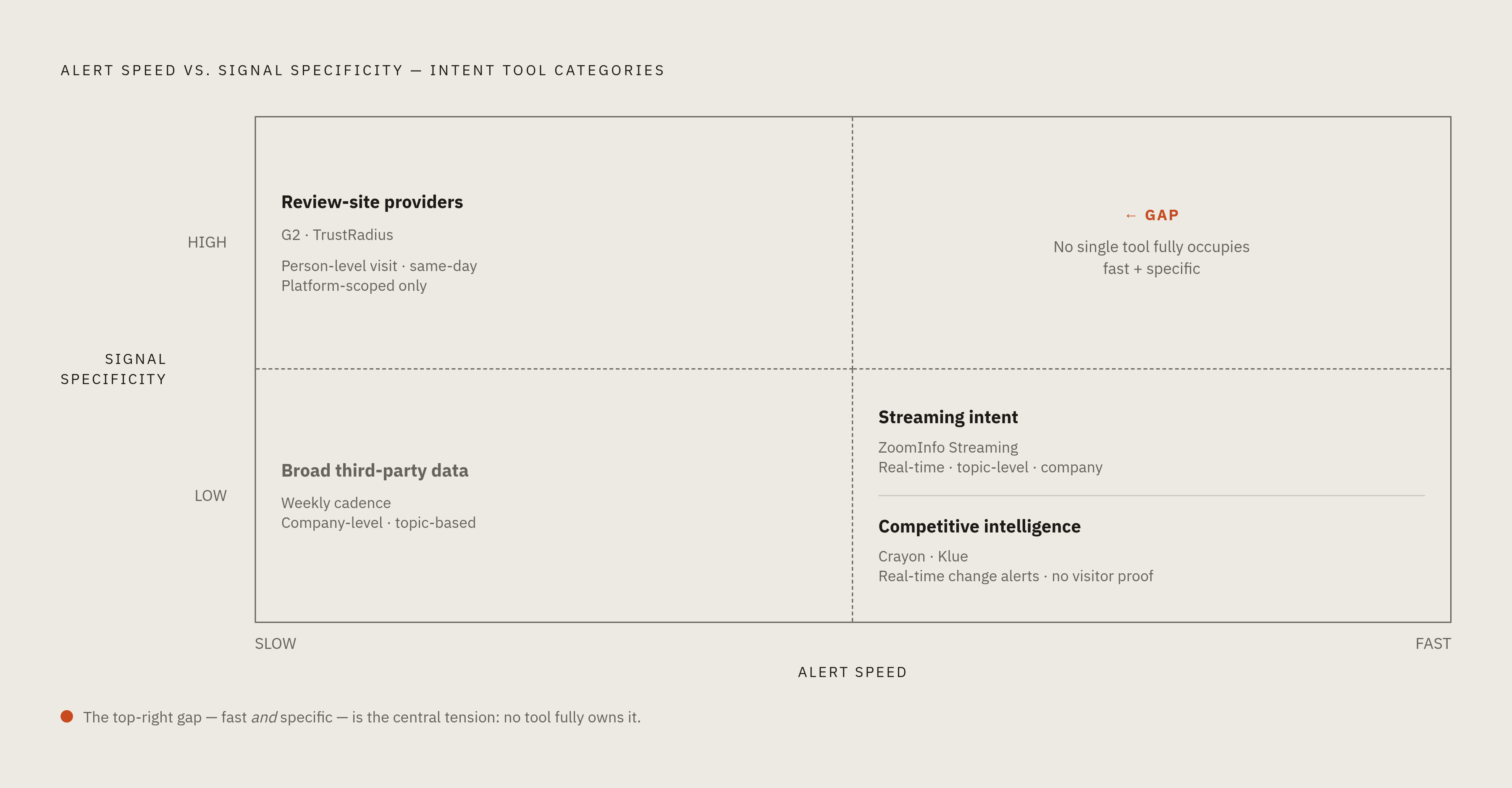
Review-site providers are the closest match when the question is which vendors a buyer is comparing on a review platform. G2 observes competitor-profile and comparison activity within its own environment. TrustRadius provides second-party intent from its B2B technology review platform and verifies reviewer identity through LinkedIn or a work email address. It became part of HG Insights following an acquisition in June 2025, bringing that review intent together with technographic install data and IT spend intelligence. The trade-off is narrow but useful visibility. These signals capture research on the review platform.
Competitive intelligence platforms suit teams that need to know what competitors are doing and help sellers while deals are in progress. Crayon tracks competitor websites, pricing pages, product updates, job postings, and marketing campaigns in real time. Its AI-powered classification separates signals from noise, while dynamic battlecards bring competitive information into Salesforce and other CRMs. Klue combines public-web insights with CRM records, sales calls, win-loss data, and internal documents to create dynamic battlecards. Its Compete Agent sends competitive intelligence for each deal straight to sellers in real time. Both help with competitive selling, but tracking a website does not prove that a named prospect visited a page.
Autobound combines competitive intelligence with buying signals to personalize outreach when competitors make moves. Demandbase combines account identification, intent data, and native B2B programmatic advertising. Its Advertising Cloud adjusts account-based targeting and bidding across display, social, video, and CTV when intent signals fire. The emphasis here is account activation. Broad third-party cooperative data covers more of the market, but its signals come each week, concern a company, and track topics, so they do not show which solution a buyer wants. Research into sales enablement could point toward a platform, a consultant, or a training program.
For teams that need faster alerts they can act on, ZoomInfo Streaming Intent finds accounts that show interest in specific business topics in real time and sends the signals through ZoomInfo Sales. Its contact database supports immediate outreach, although access to contacts is not proof that a particular contact performed the research. FL0 combines first-party CRM activity, website visits, and content engagement with third-party intent feeds. It surfaces ready-to-buy accounts through Slack and CRM alerts within minutes and is positioned for one-to-fifty-person revenue teams. These tools emphasize speed to action. Their underlying signals still need to be read as topic or behavioral evidence.
Clay can bridge multiple intent providers into one workflow and add context, such as whether a visiting company recently stopped using a competitor’s product or installed a complementary tool. Salesmotion instead tracks named, sourced real-world events, including a new VP hire, an earnings-call priority, or a funding round, with ready-to-use talking points. These are context builders. Their role is to help explain why an account deserves attention and what a useful opening might address.
How sales teams should actually respond when an alert fires
For sales teams, the practical response is to enter the comparison with something useful. A competitor signal reveals what the buyer is doing, but not what they are thinking. Relevant context is helpful. A surveillance-flavored greeting is not. A case study, a direct answer to a competitor’s claimed differentiator, or a battlecard-backed talking point gives the buyer a reason to engage.
A competitor visit alone calls for a prompt response, while that visit plus a buying-committee job change and a funding announcement calls for immediate escalation and a sequence tailored to the account. The additional signals help the team judge how much attention the account deserves and give the rep more context for outreach. Speed still matters, but the buyer has to trust the message to give it a hearing.
Routing should make the next action clear. An alert pushed to Slack and paired with a task in Salesforce or HubSpot gives the responsible rep something to act on where work already happens. An alert left in a vendor dashboard depends on someone remembering another login. Ownership must also reflect the account’s relationship with the business. When an existing customer triggers a competitor signal, customer success should lead the response rather than sales treating the account as a fresh prospect.
Why the alert-to-intercept window is won or lost before the alert fires
A response window measured in hours leaves little room to invent a credible point of view. Before the alert arrives, the rep needs content that fits the buyer, competitive positioning, and talking points that are easy to find and use. Preparation is the real bottleneck. Dynamic battlecards turn current competitive knowledge into something a seller can use inside an active deal, while case studies supply evidence that an unsupported claim cannot.
Prior visibility strengthens that preparation. Buyers who already know a seller through relevant content, thought leadership, or earlier engagement have a frame for the outreach when it arrives. The advantage of established credibility depends on operational work as well as content, including routing signals to the right owner, equipping that person, and closing the loop on outcomes. Otherwise, the business collects evidence of buying activity without building a reliable way to influence it.
The next advantage belongs to companies building signal infrastructure and content-backed enablement at the same time. Detection gives them an opening while the comparison is still underway. Preparation gives the buyer a reason to change it.