CRM Workflows for Automated Champion and Stakeholder Tracking
Former champions switching jobs convert 49% higher—catch them within 48 hours.

A champion is the person inside the account who sells your deal when you're not in the room. Lose track of them and the deal doesn't crash. It goes quiet, and quiet is worse, because nobody notices until the quarter's already over and someone's asking why the forecast was wrong.
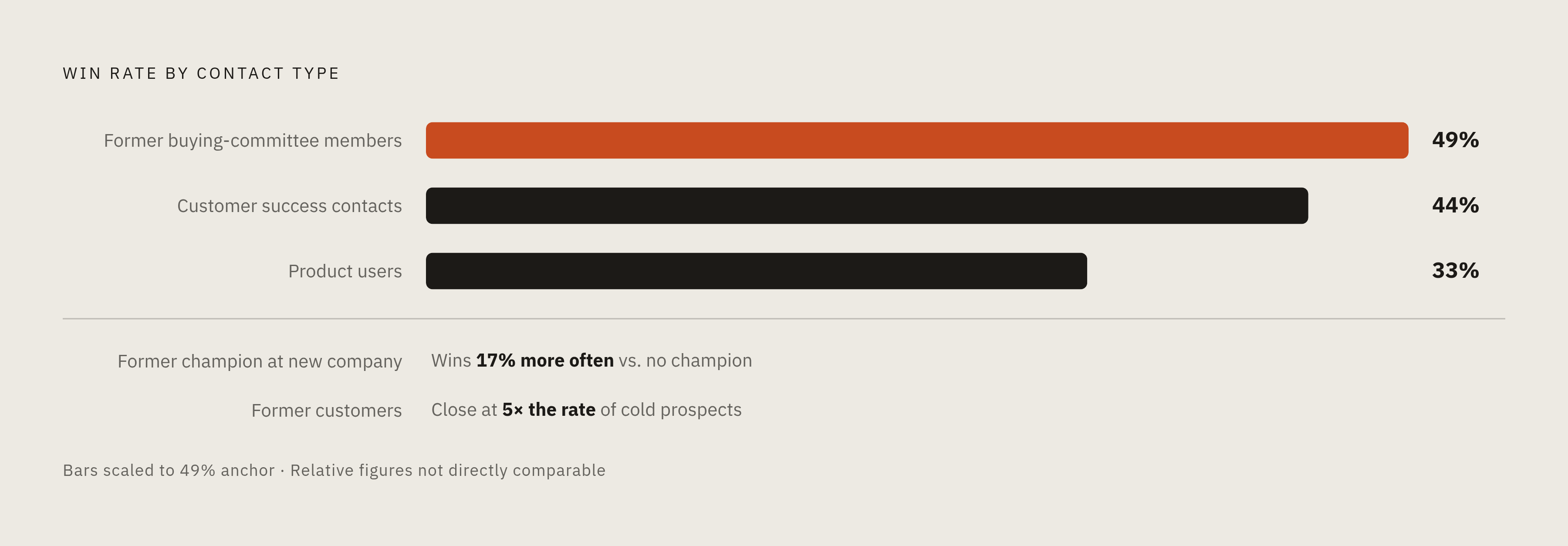
Start with the upside, because most teams underrate it badly. Deals involving a former champion, someone who advocated for you at a previous company and now sits somewhere new, win 17% more often. That's money left on the table by any team that isn't watching job changes.
The hierarchy of who's worth chasing isn't close, either. Former buying-committee members convert at a 49% win rate if they show up again. Customer success contacts land at 44%. Product users, the folks who actually clicked around in your tool, convert at 33%. Former customers close at five times the rate of cold prospects. Familiarity does half the selling before the rep even opens the email.
What actually creates urgency is the clock. The window between a verified champion move and a warm reconnect runs about 48 hours. After that, "hey, saw you moved" turns into a cold email indistinguishable from the fifty others hitting that inbox that week. Every hour between the signal firing and the rep acting on it is an hour the buyer spends looking at a competitor instead. That's structural, not a motivation problem. The clock doesn't care how busy your rep's Tuesday is.
So building a champion-tracking system "eventually," once the roadmap clears, isn't a plan. It's a bet that nobody important is job-hopping this quarter, and that bet is wrong more often than teams want to admit. Some champion is walking out some door in some account right now, whether the system exists to catch it or not.
The three-layer architecture every champion-tracking workflow needs
Think of it like a smoke detector. Nobody wants to walk around sniffing for smoke every hour, so the detector sits on the ceiling and does that job on its own, firing the second something changes. Champion tracking works the same way: constant watching, not a rep manually re-checking contact records every quarter, which, let's be honest, nobody actually does.
Layer one is detection. A clean contact record is the foundation everything else sits on. Enrichment feeds, tools like Clay, Champify, Enrich-CRM, ZoomInfo, or Coresignal's webhook feeds, watch employment status, title, and company on an ongoing basis and flag the moment something shifts.
Layer two is signal prioritization, and this is where most teams get it wrong by treating every change as equal weight. A champion switching companies is the highest-value signal in the system, full stop. It's a risk at the account they left and a brand-new opportunity at wherever they landed, at the same time. A promotion is good news; they're stronger now. A champion getting sidelined into a smaller role means you need a new internal ally before the deal moves another inch. And a sudden drop in engagement from someone who used to respond fast is often the earliest warning of all, arriving well before anyone confirms they've actually left.
Layer three is routing and resolution. Most systems fail quietly right here. A signal that doesn't turn into an owned task with a name and a due date attached is just noise, and noise gets ignored within a week. A workflow rule has to convert "this person changed jobs" into "Sarah, call this person by Thursday," or the whole detection layer was wasted effort.
Enrich-CRM lets teams set daily, weekly, or monthly monitoring cadences, and choosing among them depends on how quickly deals move through the pipeline. On the technical side, subscribing to an event feed the way Coresignal's employee webhooks work, getting notified daily when a qualifying change happens, is about as responsive as this gets right now.
None of it matters, though, if nobody can prove it works. A report tracking deals saved and champions re-engaged is what keeps this funded past the first quarter. Ops leaders need evidence, not vibes, before they'll keep paying for enrichment tools.
How to build the CRM contact structure that makes tracking possible
None of the workflows above fire correctly without the right contact structure underneath them. The foundation is account-based contact management: multiple contacts linked under one company record, each tagged with an actual role (champion, decision maker, influencer, blocker, economic buyer).
A contact without a role tag is just a name floating in a database. A workflow can't fire "champion departed, act now" if the CRM never knew that person was the champion to begin with. That's the whole failure mode, in one sentence.
Grouping contacts under a shared account record does something else useful: it builds one interaction history that sales, customer success, and account management can all see. Take a supply chain software deal. The CTO, the procurement officer, and the IT manager all sit under the same account record, each with a separate interaction log, role tag, and engagement score. Sales isn't stepping on CS's toes, and nobody's sending the same intro email twice because two teams didn't know the other already reached out.
Organizational hierarchy fields (reports-to relationships, department tags) map the politics underneath the org chart: who influences whom, and who actually controls the budget versus who just looks like they do. Access matters here too. A junior rep should see their own contacts. A CS rep should see closed-won accounts they're onboarding. A manager needs the full committee view. Get the permissions wrong and the data quality follows it downhill fast.
The real risk shows up at handoff. When a rep leaves or a deal transfers, the contact record, the role tags, the interaction history, the hierarchy notes, has to survive intact. That's the core argument for CRM discipline on any multi-stakeholder deal: people leave, but the record can't lose the plot when they do.
On the platform side, the options split by scale. HubSpot handles account-based contact management well and suits growing B2B teams. Salesforce supports custom objects for complicated stakeholder hierarchies and remains the enterprise standard. Attio offers customizable data models with automatic enrichment at $29 per user per month, built for tech-forward teams that want to design their own structure. Pipedrive gives a visual pipeline at $14 per user per month and tends to work best for teams under 50 reps.
The four trigger-based workflows that intercept deal risk before it becomes deal loss
ZoomInfo's research on champion tracking points to four plays that cover most of the risk surface: re-engaging former champions at new companies, protecting accounts from champion-departure churn, targeting new decision-makers inside accounts that fit your ideal customer profile, and stacking job-change signals with intent data.
Workflow one: champion departure alert. The trigger fires when an enrichment feed detects a title or employer change on someone tagged "champion." The CRM creates a task for the account owner promptly, with the contact's new company, new title, and a direct link back to the account record. A second branch runs at the same time: if the champion's new company fits your ideal customer profile, the system opens a brand-new opportunity record there. Remember that 48-hour window? This workflow exists to beat that clock, routing straight to the rep instead of sitting in a queue waiting to get checked.
Workflow two: buying-committee coverage check. This fires when a deal hits a defined pipeline stage, say "Proposal Sent," without contacts tagged across every required role. The workflow flags the deal and creates a task asking the rep to go find and log whoever's missing before it moves forward. A deal at proposal stage with no named economic buyer or no identified champion is shaky by definition, and the workflow enforces the qualification bar instead of letting it slide.
Workflow three: engagement-drop re-engagement. If a champion or key stakeholder goes quiet, no logged email, call, or meeting within a defined inactivity window, while the deal's still open, the workflow routes a task to the rep with a suggested outreach move. No response after a second interval, it escalates to the manager. Sudden silence from someone who used to be responsive is often the earliest sign that internal politics shifted against you, and catching it in week three beats catching it in month three.
Workflow four: contract renewal and stakeholder re-verification. This fires a set lead time before renewal, say 30 to 60 days out, sending a task to customer success or the account manager to confirm every key stakeholder is still in their role and still engaged. TechVentures, a 200-person B2B software company, built this exact pattern in Salesforce: automated renewal alerts to customer success 30 days before contract expiry. Within six months, forecast accuracy climbed from 62% to 89%, and renewal rates went up 18%.
Every one of these four workflows shares one rule, and it's not negotiable. If it doesn't produce an owned task with a named rep, a due date, and enough context to actually act on, it's not a workflow. It's a notification that's going to get archived unread.
Layering intent signals onto stakeholder workflows to catch mid-cycle competitive evaluations
Here's the gap none of the four workflows above can close alone: a champion can still hold their job, still be responding to emails, and the account can still be quietly shopping a competitor. Internal signals miss that entirely, because nothing about the internal relationship changed. The evaluation is happening somewhere the CRM can't see, unless intent data gets added into the mix.
Intent signals track behavior, content consumption, search activity, research on review sites, visits to your website and others, that show active evaluation happening before anyone on the buying committee says a word about it. Only about a quarter of B2B companies use these tools today, which is a strange gap considering intent signals reportedly surface most of the buyer journey that traditional tracking never sees.
Specificity is everything here, and this is where most intent programs waste their budget. Tracking at the category level, something broad like "marketing software," floods the queue with low-quality noise, because half the internet is casually researching marketing software on any given Tuesday. Configuring competitor names individually as tracked topics is what surfaces the accounts actually in active competitive evaluation. That's the moment worth knowing about.
Interpretation matters just as much. A buyer reading educational blog posts is doing early-stage research. A buyer reading head-to-head comparison pages against a named competitor is deep into an active evaluation. Those two behaviors call for different workflows and different outreach entirely, and treating them the same wastes the signal.
The workflow trigger itself is straightforward. When a monitored account crosses a competitor-intent threshold, route a task to the account owner with the specific topics being researched and the contacts already on file, so the rep walks into that conversation armed instead of guessing. And when a job-change alert and a competitor-intent spike land on the same account in the same week, that's a high-priority escalation. Surface both signals in one consolidated task, not two separate pings a busy rep might only half-read.
Signal decay is the real operational risk underneath all of this. Teams that disconnect intent data from the CRM and fall back on manually downloading spreadsheets once a week lose the timing edge completely. By the time anyone opens that spreadsheet, the buyer's already three steps further into the competitor's sales process.
What the CRM workflow system needs to produce as outputs, not just inputs
Most teams build the triggers and stop there. They never build the reports, which means nobody can actually say whether the system is saving deals, surfacing the right people, or just generating tasks that quietly pile up unread.
A handful of reports close that gap. Champion-departure response rate tracks the percentage of departure tasks acted on within that critical 48-hour window, and it's the clearest signal of whether the workflow is changing rep behavior or just generating noise. Deals saved or re-engaged counts the opportunities where a departure alert led to real outreach and a deal that stayed alive instead of going cold. Buying-committee coverage by deal stage shows the percentage of open deals with every required role mapped, exposing exactly where the pipeline is structurally thin. Re-engagement pipeline tracks the value of new opportunities opened at former champions' new companies, the most direct return figure the whole system produces. Intent-signal response time measures the average hours between a competitor-intent signal firing and a rep logging action on it, which catches signal decay before it quietly erodes the program.
Forecast accuracy tends to be the upstream benefit nobody talks about enough. TechVentures went from 62% to 89% forecast accuracy after implementing Salesforce, and that same logic scales from a single account up to the whole pipeline.
A monthly review of the re-engagement pipeline report gives revenue operations the evidence to keep funding enrichment tools, tighten trigger thresholds that are firing too often or not often enough, and retire workflows generating tasks nobody's completing anyway. That review is what keeps the system alive past its first six months, not the initial build.
None of this is really about defense, even though it started that way. A system built to protect deals from champion turnover ends up generating brand-new pipeline from champions who've moved on to their next company. What looks like a safety net turns out to be a lead source hiding in plain sight.