Mapping Blog Posts and Case Studies to Closed Won Opportunities Inside Your CRM
Map your content to revenue by connecting blog posts and case studies directly to closed-won deals.

Mapping blog posts and case studies to closed-won opportunities requires infrastructure. The solution is a CRM-native attribution layer that connects content engagement to contacts, contacts to deals, and closed revenue back to specific assets. That gives revenue teams evidence for content investment and tells sales which proof points to use next.
Why content teams keep losing budget arguments despite strong traffic numbers
A content lead walks into a budget review with traffic charts. The CFO asks, “which deals did this close?” The charts have no answer, even if the content helped buyers reach a decision. The data on engagement is in web analytics, while the data on revenue is in the CRM. Without a bridge, the team has brought a weather report to a discussion about the harvest.
This is a measurement failure. Yet programs can be cut or flat-funded because their revenue influence goes unmeasured. The gap also changes what teams produce, as page views become the target because they are easy to count. Goodhart’s Law applies neatly here. Once traffic becomes the goal, teams can get better at drawing readers in without getting better at showing leadership which readers become customers.
What closed-loop attribution actually means and why the CRM is the only place it can live
Closed-loop attribution tracks a prospect from the first marketing touch to a closed-won deal, keeping the data thread intact throughout. The loop closes when the deal’s revenue flows back to the originating marketing source and the content touched along the way. A form submission identifies a prospect whose purchase status remains unestablished.
Web analytics asks who arrived and how they behaved on the site. Content analytics asks which specific assets influenced pipeline and closed deals. That requires deal data. The CRM is the revenue system of record, so attribution that stops in an analytics platform or marketing automation tool cannot independently establish which content influenced closed-won deals.
The credit model must also reflect how buyers buy. They may read several assets over weeks or months, rather than follow a tidy route from one article to one purchase. Last-touch attribution erases the earlier work, while first-touch attribution misses the proof that helped finish the deal. Multi-touch models preserve more of that journey. Linear attribution gives equal credit to each touch, time-decay gives more credit to touches closer to close, and data-driven attribution weights touches by actual conversion patterns.
These models allocate credit while leaving uncertainty intact. An asset appearing in a won deal’s history is evidence of involvement.
The three-layer technical setup that connects blog posts and case studies to CRM deals
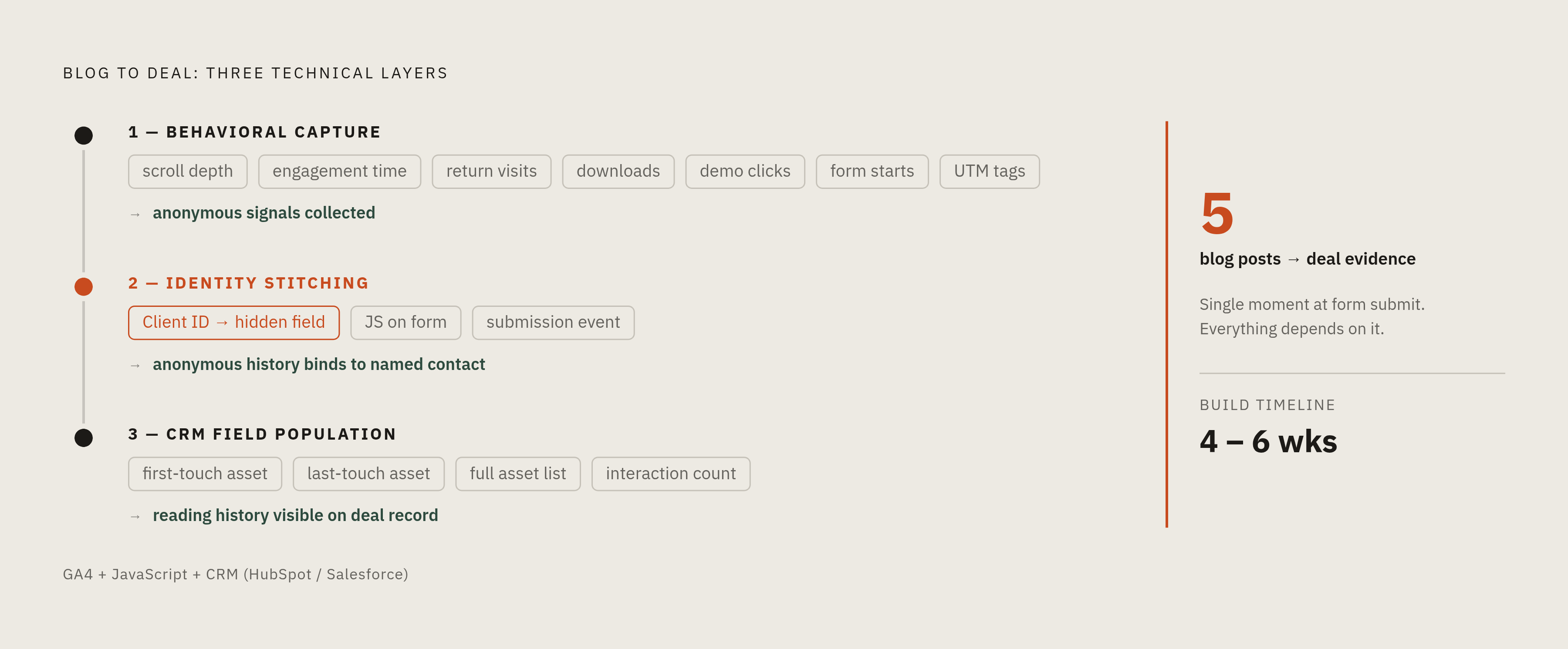
For teams building this connection, the work has three sequential layers. They are behavioral capture, identity stitching, and CRM field population. Each solves a different break in the chain. Capture records engagement, stitching connects anonymous behavior to a known contact, and field population makes that history available on the associated opportunity.
Behavioral capture starts with GA4 events beyond page views, including scroll depth, engagement time, return visits, and micro-conversions such as downloads, demo clicks, and form starts. Distribution needs the same discipline as measurement. Content links shared through email, social, or paid channels should include UTM parameters so their source can be attributed. Otherwise, traffic from private messages or later visits prompted by AI-generated summaries may appear as direct traffic. Some AI-referred clicks do pass a referrer, so not every such visit loses its origin.
Identity stitching addresses the prospect who reads five blog posts anonymously and then submits a form. The Client ID provides the identifier used to connect the anonymous analytics history to the resulting CRM record. At form submission, JavaScript captures it into a hidden form field that populates a custom CRM field. The conversion path, including the last several content pieces viewed before conversion, should be stored with it.
Salesforce does not have an official GA4 connector that makes this happen simply by installing it. The contact’s content history must then flow to the associated deal.
The full build takes four to six weeks. Instead of asking whether anyone remembers what the buyer read, a rep can see the relevant blog posts, pricing pages, and case studies in the CRM.
Building the closed-won content report inside your CRM
With those fields populated, the recurring report can answer a precise question. Which assets did closed-won customers read in the 90 days before conversion? Start by filtering opportunities to Stage = Closed Won and Close Date within a rolling 90-day window. Then pull the first-touch asset and last-touch asset, along with the full asset list and the content interaction count.
Group the results by asset to see which blog posts and case studies appear most often across won deals. Then add deal value. Frequency alone can send production in the wrong direction, because a post appearing in three low-ACV deals may deserve less investment than one appearing in two enterprise deals. The report should keep the link to deal stage, since some content interactions are closer to revenue than others.
Executive reporting can then use assisted pipeline as its main revenue measure. Assisted pipeline is the sum of opportunity values where an asset appeared anywhere in the journey. Influenced revenue is the closed-won subset of that pipeline. Because several assets can touch the same deal, their influenced-revenue totals should not be mistaken for separate, additive revenue.
A digital asset management firm integrated Salesforce and HubSpot. Before the integration, manual Excel lead handoffs left no mechanism for attributing closed-won revenue to marketing campaigns, preventing customer acquisition cost calculation. The firm replaced those handoffs with a bidirectional integration and real-time, score-based routing. Leadership could then follow the thread from first touch to closed-won and identify campaigns and content associated with real pipeline.
Along with ranking assets, the report shows which topics draw in buyers who close and where those buyers have no content to turn to along the way. A stage with no recorded content touches raises a different question from an asset with weak engagement. The former may need a missing proof point.
How case studies behave differently from blog posts in the attribution data — and why it matters for production decisions
Blog posts often appear as first or second touches, introducing the brand before a buyer enters active evaluation. Case studies tend to appear later in deal histories, including in the weeks before close. In multi-stakeholder deals, they give the champion concrete proof to put before the economic buyer. One opens the conversation, while the other helps the buyer defend the decision.
Last-touch attribution undercounts blogs that introduce the buyer earlier in the journey and can overstate a case study’s role by treating the final proof point as the whole reason the deal happened. Counting readers alone can skew the picture the other way, making a blog that many people read look more valuable than a case study aimed at a small group of serious buyers. Neither view captures the relay.
When blogs repeatedly appear as first touches in won deals but the same histories lack mid-funnel case studies, the gap points toward missing proof. When blog topics bring in high-ACV buyers, those topics call for case studies that go into more depth. The deal records can identify the industries, pain points, and use cases to develop.
For that audit, filter the closed-won report by industry segment or deal size. Look for buyer profiles with strong blog-driven first touches but little case study coverage. Specificity is part of the sales argument. Buyers evaluating a purchase want evidence from companies resembling their own in industry, size, and use case. The roadmap should then focus on adding proof points to journeys that have led to sales, instead of just finding a topic to fill next week’s publishing slot.
Surfacing competitor-evaluation signals in the attribution data and routing content to intercept them
The same content history can reveal an active evaluation before a deal closes. An account visiting the pricing page, a case study, and a comparison guide within a compressed window shows a different pattern from someone casually reading a blog. The sequence suggests active consideration. This signal is an inference about the buyer’s intent. The signal carries weight because it comes from people using the company’s own assets, while research elsewhere is more general.
That signal can exist before a form submission, although the identity link still has to be made. Someone may read several ungated posts and then a case study and still not be a known contact. When that person later converts, the stitched history can appear in the CRM.
To turn the signal into a sales action, teams should build a CRM workflow or alert around a defined engagement threshold. For example, the threshold could be a pricing-page visit, at least one case study, and comparison content within a rolling window. The alert should show which assets the buyer read as well as a score. For mid-market evaluations, routing must happen within days, before the next weekly pipeline review. By then, the buyer may already have selected a vendor.
Sales can respond with customer stories about switching from the relevant competitor or capability comparisons matched to the buyer’s reading. Sales should answer the question implied by that history. No additional third-party tool is required for this core motion, though other intent signals can enrich the picture. Content-driven sales enablement becomes tied to pipeline when the CRM identifies the opportunity, reveals its content history, and helps sales choose the next proof point.
What revenue teams that have built this infrastructure can now do that others cannot
A shared attribution layer changes how content, sales, and leadership make decisions together. Content teams can connect an asset to named opportunities and deal values, while leadership can weigh investment against pipeline evidence. Sales adds to the same history, so marketing’s reports also cover what sales does.
That shared record also makes content strategy a managed asset portfolio. A quarterly coverage-gap audit can identify segments with strong introductory content but insufficient mid-funnel proof. Assets that consistently appear in won-deal histories can be refreshed, expanded, and distributed more deliberately. Underperformers can be retired or consolidated. Production choices then have a revenue rationale without pretending that editorial judgment has become unnecessary.
Not every team can fund the full build immediately. Teams can start with a manual version of the report at the end of each quarter. Interview sales reps about the last ten closed deals and ask which specific assets prospects referenced or reps shared. That produces directional evidence with zero technical overhead. It is enough to begin a better budget conversation and build the internal case for the infrastructure that will make the answer repeatable.